You can turn off daytime running lights on your Volkswagen through several methods depending on your model. For vehicles with digital displays, navigate to Settings > Lights and Vision, then uncheck “Daytime Running Lights.” On MK4 Golf models, remove the headlight switch and swap pins 7 and 10 using a de-pinning tool. Some MK7/MQB platforms allow temporary deactivation by engaging the parking brake, though this requires VCDS or OBDeleven coding. Before proceeding, consider that DRLs reduce collision risk by 5-10% and improve visibility—further model-specific details explain these procedures thoroughly.
Understanding Daytime Running Lights in Volkswagen Models
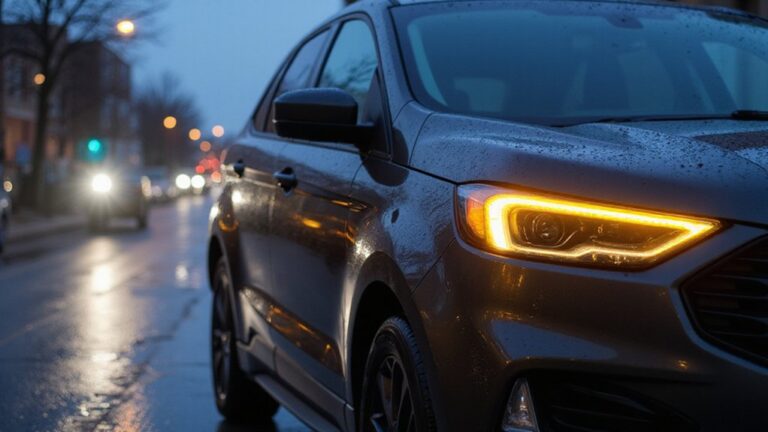
When you start your Volkswagen’s engine, daytime running lights (DRLs) activate automatically to enhance your vehicle’s visibility to other motorists, pedestrians, and cyclists during daylight hours. Your VW’s DRL system engages when the light switch is in the ON, AUTO, or parking position and light sensors detect sufficient brightness. Unlike headlights, DRLs aren’t designed to illuminate the road—they emit forward-directed white, yellow, or amber light that makes your vehicle more detectable without activating tail or instrument lights. The DRL benefits include reduced collision risk and improved safety in challenging conditions like fog or rain. DRLs are particularly effective during dim ambient light conditions such as dusk, dawn, or cloudy weather when visibility is naturally reduced. A DRL module in your engine compartment communicates with light sensors to control activation, automatically dimming or deactivating when you manually turn on your headlamps during low-light conditions.
Method 1: Menu Settings Disable for Digital Display Models
Modern Volkswagen models equipped with digital instrument clusters typically include a factory menu option that lets you disable daytime running lights without requiring diagnostic tools or wiring modifications. Turn your ignition to the accessory position and navigate through the steering wheel controls to Settings > Lights and Vision. The user interface design varies by model year, but you’ll find “Daytime Running Lights” as a checkbox or toggle. Uncheck this option and cycle the ignition to verify the change persists. This user accessibility feature may be absent in vehicles lacking digital displays or locked in regions where DRL operation is legally mandated. Some users report that the DRL setting may revert back to ON after 24 hours on the first attempt, though subsequent disabling procedures typically maintain the new configuration. Before disabling, confirm local regulations permit modification, as reduced visibility affects road safety and some jurisdictions require active daytime running lights.
Method 2: Headlight Switch Pin Modification for MK4 Golf
Volkswagen MK4 Golf owners can permanently disable daytime running lights by swapping two specific pins within the headlight switch wiring harness—a modification that reconfigures which circuit activates when you start the engine.
Begin by pushing the headlight switch knob inward, rotating it rightward to release retaining clips, then pulling the assembly straight out. Disconnect the wiring harness from the switch’s rear. Locate pin 7 (56*—low beam power from fuses S20/S21) and pin 10 (ground connection 31) on both headlight plugs. A paper clip can be used as a de-pinning tool to carefully extract each pin from its connector slot. Perform the pin swapping by moving pin 7 into pin 10’s position and pin 10 into pin 7’s position on both plugs. Unlike some vehicle models where daytime running lights cannot be fully disabled due to design constraints, this modification allows complete control over the DRL functionality.
Complete switch reinstallation by reconnecting the harness, inserting the unit until clips engage, then testing all positions. This guarantees running lights remain off during engine starts while preserving normal headlight functionality.

Replaces Part #: 1C0941531

【Applicable Vehicle】Compatible with Volkswagen Bora 1999-2005; Compatible with Volkswagen Beetle 1999-2010; Compatible with Volkswagen Gti MK4; Compatible with Volkswagen Golf MK4 1998-2006; Compatible with Volkswagen Jetta MK4 1999-2005; Compatible with Volkswagen Passat B5 B5.5 1997-2005.
Method 3: Emergency Brake Workaround for Temporary Deactivation
Unlike permanent wiring modifications, the emergency brake workaround leverages your vehicle’s existing control logic to temporarily disable daytime running lights without altering circuits or removing components. Many VW models route DRL control through Central Electrics, allowing parking brake status to deactivate lights and prevent battery drain.
For temporary deactivation, simply engage your parking brake while stationary. This works on MK7/MQB platforms and select Jetta/Passat models when factory logic or diagnostic coding supports the function. This method is particularly useful when running your A/C in hot weather while parked, as it eliminates the distraction of bright lights that might bother neighbors or passersby. Proper electrical connections ensure the system functions reliably without compromising vehicle safety features.
To enable this feature, connect OBDeleven or VCDS, access Central Electrics (module 09), and activate the “DRL off with handbrake” adaptation channel. Test by cycling the brake—lights should extinguish when engaged, illuminate when released.
Always verify module compatibility before coding and document original adaptation values for safe restoration.
Method 4: Stalk Activation Sequence for Accessory Mode
Certain VW models, particularly 2010 Jetta TDI variants, support a stalk-based sequence that temporarily disables DRLs through accessory mode activation without requiring diagnostic tools or circuit modifications. This stalk functionality involves precise coordination: position your headlight switch to OFF, engage the left turn signal, then pull the high beam stalk rearward forcefully. Maintain these simultaneous inputs while switching ignition to the accessory position without starting the engine. The combination triggers the DRL operating sequence, potentially revealing menu options on your infotainment screen. Note this provides temporary deactivation only—DRLs reset upon full ignition cycling. Similar sequences apply to Golf and Passat B6 models. The headlight switch functions as a signal for requested lighting functions rather than directly controlling power to the bulbs themselves. Verify local regulations before modifying DRL operation, as daytime running lights remain legally mandated in many jurisdictions for enhanced visibility and safety.
Model-Specific Variations by Year and Ignition Type
Across Volkswagen’s model generations, DRL deactivation methods vary considerably based on production year, ignition type, and headlight configuration—requiring precise identification of your vehicle’s specifications before attempting modification. MK4 Golf/Jetta models utilize TFL pin manipulation on the headlight switch connector, while MK5 variants employ turn signal stalk sequences specifically for halogen setups. MK6 and newer Volkswagen Models with traditional key ignitions often support stalk-based deactivation, whereas push-button ignitions post-2015 typically demand VCDS coding exclusively. Vehicles equipped with MFD navigation screens enable menu-based toggles through settings interfaces. Verify your Daytime Running Lights configuration before proceeding—halogen systems respond differently than LED assemblies. Parking brake engagement affects DRL logic across key-based platforms, making proper diagnostic verification essential post-modification.
Safety Considerations and Battery Impact
While modification procedures address the mechanical aspects of DRL control, understanding the system’s electrical behavior and safety implications determines whether deactivation serves your interests. DRLs enhance vehicle detectability in daylight, with EU studies documenting casualty reductions and favorable benefit-cost ratios. UK research confirms accident drops in dim conditions. Removing these safety benefits compromises visibility for you and other road users. Unlike headlights, DRLs are specifically designed to increase conspicuity rather than illuminate the road ahead.
Regarding battery longevity, normally functioning DRLs pose minimal drain risk. They activate only when your engine runs and consume considerably less power than full headlights. LED configurations draw fractional electricity compared to conventional lighting. Battery depletion occurs exclusively during malfunctions—faulty systems remaining active post-shutdown or Canbus errors triggering dim persistence at low voltages. Proper DRL operation protects battery life; deactivation doesn’t improve it unless addressing diagnosed electrical faults. Studies indicate that DRL installation can lead to a 5-10% reduction in daytime accidents.