

LED headlights outperform halogens with 1,600+ lumens versus 700-1,200 lumens, extending visibility from 150 to 200+ meters while consuming 85% less power. You’ll get 30,000-50,000 hours of lifespan compared to halogen’s 450-1,000 hours, though LEDs cost $50-$200 upfront versus $15-$30 for halogens. However, improper LED retrofits in halogen housings create 50% more glare and violate DOT regulations. The complete technical analysis below examines cost-of-ownership calculations, weather performance differences, and proper installation requirements.
Performance and Light Output Comparison
LED headlights deliver measurably superior luminous flux compared to halogen technology. You’ll observe LEDs generating 1,600+ lumens versus halogens’ 700-1,200 lumen range—representing two to three times greater output. This brightness comparison demonstrates LEDs’ fundamental advantage in illumination efficiency.
Best-in-class LED assemblies achieve 45,000 lumens, while halogens average approximately 1,100 lumens. You’ll experience this translating to 25% increased beam distance: LEDs reach 200+ meters compared to halogens’ ~150-meter range. IIHS testing confirms superior performance, with good-rated LED low beams illuminating 325 feet on straight roadways. Additionally, LED headlights offer longer lifespan compared to halogen bulbs, providing extended durability and reduced replacement frequency. For drivers seeking maximum illumination distance, laser headlight technology can extend beam range up to 600 meters on certain models.
The spectral distribution also differs greatly. LEDs emit whiter light (5,000-6,500 Kelvin), enhancing road marker visibility and hazard detection. Their directional beam characteristics provide concentrated illumination patterns with improved focus quality over conventional halogen diffusion. Advanced LED systems can follow steering input, dynamically adjusting light arrays to illuminate corners as you turn the wheel.

6500K Daylight Clarity: Radiant 6500K color temperature delivers a crisp cool white beam that instantly sharpens contrast on dark roads and foggy mornings. This 9005/HB3 H11/H9 combo cuts through haze and shadow so you spot hazards sooner, giving you the confidence to push through low-light conditions without second-guessing what's ahead

【Experience a 1500% Brighter Night】Transform your drive with our advanced 9008 light bulbs. Each 9008 light bulbs combo, equipped with 12 high-performance chips, delivers a blinding 80,000 lumens per set. Powered by latest upgraded Z10 technology which provide unparalleled road illumination—turning night into day for a safer, more confident, and utterly superior driving journey.
Energy Efficiency and Electrical System Impact
Beyond raw illumination capability, the electrical characteristics of these technologies reveal dramatic operational differences. LEDs convert 80% of energy to light versus halogens’ 20%, achieving 50 lm/W compared to 14.5 lm/W. You’ll consume 20-90W per LED bulb versus 55-125W for halogens—an 85% reduction in power draw. This translates to substantial energy savings across your vehicle’s electrical architecture.
Heat dissipation further differentiates these technologies. Halogens reach 150°C, wasting 80% of energy as thermal radiation, while LEDs remain under 90°C. Reduced thermal stress extends headlight assembly longevity and decreases strain on your alternator and voltage regulator. The lower heat output of LEDs also contributes to better durability and improved safety by reducing thermal degradation of surrounding components. When selecting headlight bulb replacements, considering the brightness levels and lifespan differences between halogen and LED options ensures optimal performance for your specific vehicle needs.
For battery preservation, LEDs draw 75-85% less current, minimizing discharge cycles and extending service life. Electric vehicles particularly benefit from this efficiency, as reduced parasitic loads directly increase range. The superior energy conversion efficiency of LEDs also reduces your environmental footprint by minimizing wasted electricity.

Exceptional Brightness Upgrade: These SEALIGHT 9012 stock bulbs offer an astounding 800% increase in brightness compared to standard stock bulbs. They boast a powerful output of 120W per pair, delivering an impressive 70,000 lumens. With a color temperature of 6500K, they ensure clearer and more vibrant colors, enhancing visibility and driving experience significantly

【1:1 Mini Size & 3 MINS Plug and Play】Sealight H11/H9/H16 bulbs or Fog Light Bulbs feature a near-identical 1:1 mini design as original bulbs, requiring no external drivers or wires for a true plug-and-play experience. 3 MINS quick installation

【500% Brighter – 30000LM 6000K Cool White】Upgrade your H11/H8/H9/H16 LED bulbs. 30,000LM per pair, 500% brighter than halogen. Fanless passive cooling (Copper Base + Aluminum Housing) delivers 0 dB quiet operation and no moving parts to break.
Lifespan and Long-Term Maintenance Requirements
When evaluating total cost of ownership, operational lifespan differences between these technologies prove substantial. Halogen bulbs deliver 450–1,000 hours (1–2 years typical use), while LEDs achieve 30,000–50,000 hours (10–15 years). OEM halogen variants extend lifetime expectations to 5,000 hours, yet they’ll still require multiple replacements compared to LED‘s single-installation longevity.
Degradation patterns reveal critical distinctions: halogen experiences 70–80% light loss before failure, whereas LED maintains brightness with only 20–30% degradation over 50,000 hours. Filament-based halogen suffers from vibration sensitivity and frequent on/off cycling wear.
Maintenance frequency dramatically favors LED technology. You’ll replace halogen bulbs every 1–2 years with regular inspections needed for progressive dimming. LED’s solid-state construction eliminates this burden, delivering minimal maintenance requirements over decades of operation. LED systems require proper heat management and stable voltage to achieve their maximum lifespan potential.

【900% Brighter - Newly Enhanced】SEALIGHT 9007/HB5 LED bulbs feature 24 high-performance chips, delivering up to 9 times the brightness of standard halogen bulbs. Upgrade your nighttime driving experience by replacing dim, yellow stock bulbs with SEALIGHT 9007/HB5 LED Bulbs fog lights, offering superior illumination and enhanced visibility with a crisp 6500K cool white light for optimal light transmission

【900% Brighter - S1 Pro Bulbs】The SEALIGHT 9005 H11 bulbs combo feature 16pcs high-performance chips, delivering up to 8 times the brightness than stock bulbs. Upgrade your nighttime driving experience by replacing dim, narrow stock bulbs with SEALIGHT 9005/HB3 H11/H9/H8/H16 LED Bulbs Combo. Enjoy crystal-clear 6500K cool white light that cuts through the dark, giving you way better visibility for safer night drives

Precision-Focused Safety Beam: The newly upgraded Termitor H4/9003 exterior light bulbs feature enhanced light projection, delivering a sharply defined focused beam with distinct boundaries. It significantly enhances illumination without causing glare to oncoming vehicles, providing a safer driving experience for you and others.
Replacement and Repair Cost Analysis
Replacement economics between halogen and LED technologies reveal a counterintuitive cost structure where initial investment and long-term expenditure diverge noticeably. You’ll spend $15–$30 for halogen pairs versus $50–$200 for LED equivalents upfront. However, replacement frequency fundamentally alters total ownership costs. Halogen’s 500–1,000 hour lifespan necessitates annual replacements, accumulating $75–$300 over ten years plus $100–$200 in labor if you’re not DIY-capable. LED’s 10,000–50,000 hour longevity typically requires zero to one replacement during the same period, totaling $50–$150.
Installation complexity differs considerably. Basic halogen swaps demand minimal technical expertise, while sealed LED assemblies cost $700–$1,500 each when failures occur. Professional installation ranges from $20–$60 for halogens to $100–$250+ for LED systems, with dealerships charging premium rates exceeding $300 total. Replacing bulbs in pairs ensures consistent visibility and helps avoid additional labor costs down the road.

Material & Build Quality: High-quality aluminum alloy housing with durable UV-resistant polycarbonate lens. Built for long-term reliability with strong impact resistance and stable performance across various driving conditions.

[High quality material] : The headlight connector is made of durable ABS material and stable transmission copper wire material, ABS shell is scratch-resistant, wear-resistant, not easy to break, durable; Copper wire has excellent electrical conductivity and stable transmission. The whole has the characteristics of high efficiency, high temperature resistance, heavy duty and lasting, and can be used for a long time
![True Mods H6054 H4 LED Headlight Wiring Harness [Negative Switched Conversion] [Fused] Universal H4 Head Light Relay Harness Kit for 9003 H6024 5x7 7x6 4x6 Subaru Toyota Jeep Sealed Beam Headlamp](https://m.media-amazon.com/images/I/51+wV9S2Q4L._SL500_.jpg)
YOUR VEHICLE NEEDS THIS - Swapping out old headlights for LED conversions on negative switched vehicles like Toyota, Subaru, Mitsubishi, or Suzuki, is not a simple job. But with our plug-and-play universal dual H4 headlight relay harness kit for high/low beam it can be! The compatible sockets include: 7x6 5x7 H6024 (2D1 H6054 H5054 H6054LL 6014 6052 6053)|H6024 (2D1)|4x6 6x4 (H4651, H4652, H4656, H4666, H6545)|H5006 (2C1) sealed beam headlights and more!
Visibility in Different Weather Conditions
While upfront and maintenance costs influence your headlight selection, performance metrics under varied atmospheric conditions directly impact driving safety and operational effectiveness. LED light technology delivers 1,600+ lumens with 4000K-6000K color temperature, extending visibility to 300 meters in clear conditions—triple halogen‘s 100-meter range. However, halogen’s 3000K warm spectrum scatters less in fog, providing superior penetration. In rain, LED’s crisp white beam enhances contrast for obstacle detection, extending visibility 30%-50% farther than halogen’s 1,100 lumens. For night driving, LED’s whiter frequency improves hazard recognition and reduces eye strain through instant-on full brightness. High-output LED systems (8000+ lumens) with properly focused beam patterns optimize driving safety across all adverse weather scenarios while maintaining 80-90% efficiency. Advanced adaptive lighting systems can selectively adjust beam patterns based on driving conditions and vehicle speed. LED headlights achieve instant brightness without warm-up time, unlike halogens which require a brief period to reach full output. When upgrading your headlights, you may need to access the headlight bulb retaining clip to complete the installation process.
Glare Control and Road Safety Considerations
Glare management separates safe headlight performance from hazardous light pollution that compromises visibility for all road users. You’ll find halogen’s 700-1200 lumen output and 3000-4000K yellowish beam produces softer glare perception with vague cutoff lines, enhancing driving comfort in city environments. LEDs deliver 1600+ lumens at 5000-6500K with sharp cutoffs, but misalignment in halogen reflectors creates massive scatter that blinds oncoming drivers. DOT/SAE regulations don’t approve LED bulbs in halogen housings—this disrupts filament-optimized optics and eliminates horizon beam control. You need dedicated projector housings for LEDs to achieve proper light distribution. Halogen’s 150m throw inherently limits glare hazards, while LED retrofits without compatible optics reduce reaction times for other road users, creating illegal installations in certain regions. Most headlight replacements can be completed in 10-15 minutes with basic tools like socket wrenches and screwdrivers. Proper aiming prevents both technologies from directing excessive light into oncoming traffic, though LED’s higher intensity demands more precise alignment procedures. Choosing quality bulbs and maintaining your vehicle’s electrical system health can prevent frequent replacements that might indicate underlying electrical issues.
Total Cost of Ownership Over Vehicle Life
Beyond the sticker price, headlight technology selection determines cumulative ownership expenses through replacement cycles, energy consumption, and labor costs across your vehicle’s operational lifespan. Halogen’s $15–$30 upfront costs appear economical, but 500–1,000-hour lifespans necessitate 5–10 replacements over ownership duration, accumulating $200–$800 in bulb expenses alone. LED systems demand $50–$150 initial investment yet deliver 10,000–30,000-hour operational windows, requiring zero to one replacement across identical timeframes.
Energy efficiency compounds these differentials: halogen converts merely 10% of electrical input to illumination, wasting 90% as thermal radiation and increasing alternator load. LED achieves 80–90% conversion efficiency, reducing parasitic electrical draw. Proper headlight alignment techniques prevent light scatter that can further diminish effective illumination and efficiency. Over ten-year ownership duration, LED’s superior economics become evident—total expenditure of $50–$150 versus halogen’s $275–$1,100 combined bulb and energy costs. The engineering calculus clearly favors LED for lifecycle cost optimization.
LED headlights’ premium feature status can enhance resale value, providing an additional financial benefit when selling or trading your vehicle.
Retrofit Options and Legal Compliance
Upgrading halogen systems to LED technology presents significant compatibility and regulatory challenges that extend beyond simple bulb replacement. Direct LED swaps typically fail because halogen filaments center precisely while LED diodes offset, disrupting beam focus and causing reflector housings to scatter light unevenly. You’ll face retrofit regulations requiring DOT certification—a process comparable to EPA emissions approvals, potentially costing millions and taking extensive time. Holley’s achievement in securing certification demonstrates the barrier’s height. Most plug-and-play LEDs lack official road-legal status, creating legal ramifications when glare from misaligned installations exceeds safe cutoff levels. Sylvania’s premium LED headlight models like the SilverStar Ultra and ZEVO series showcase how properly engineered LED technology can deliver superior beam patterns and brightness when installed in compatible vehicles. Projector retrofits with vehicle-specific adapter kits offer superior compliance over direct bulb swaps, delivering controlled beams while reducing scatter. Testing on reflector-based headlights demonstrates that LED bulbs produce approximately 50% more glare than halogen bulbs above the cutoff line, measuring 15 lux compared to halogen’s 9.5 lux. Non-compliant aftermarket LED bulbs are generally prohibited for street-registered vehicles, though state laws vary on retrofit allowances and tinting regulations. Always verify local DOT standards before installation to avoid illegal configurations that blind oncoming drivers.
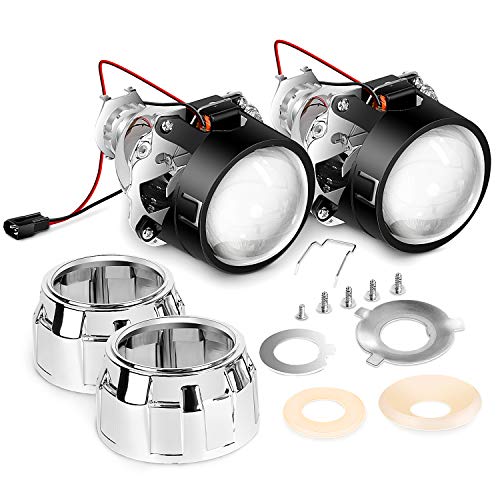
H1 mini projector kits (low/high beams), fit in tight spaces for quad retrofits or fog lamp upgrade

Premium Ceramic Construction: These wiring adapters utilize high-grade ceramic material that provides exceptional heat resistance and electrical insulation. The ceramic housing incorporates advanced waterproof and dustproof technology for reliable performance in all conditions. Inside, high-efficiency copper wiring ensures optimal conductivity and power transmission.
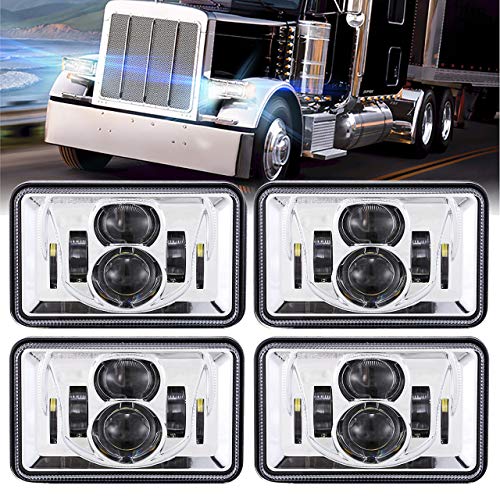
DOT Approved 60W 4x6 LED Headlights: The DOT-compliant headlights compatible with Kenworth w900 guarantee your lights are compliant with the United States Department of Transportation for use in the U.S. & Canada to secure the safety of others.


