LED headlights are objectively superior to xenon in most metrics. You’ll get 30,000-50,000 hours of lifespan versus xenon’s 2,000-10,000 hours, while consuming 95% less power at 22 watts compared to xenon’s higher draw. LEDs produce 3,000-5,000 lumens with 90% energy conversion efficiency and instant activation. However, xenon excels in fog penetration with its wide-diffused beam pattern. LEDs cost $50-$350 initially but reduce replacement frequency markedly. Below, you’ll uncover detailed performance comparisons, cost analyses, and safety considerations that’ll help you make an informed decision.
Brightness and Light Output Comparison
Modern xenon and LED headlights deliver comparable raw output figures, both producing 3,000 to 5,000 lumens in standard configurations—a significant 2-3x improvement over traditional halogen bulbs that max out at 1,500 lumens. However, you’ll find critical differences in how each technology performs. High-performance LED systems now exceed 5,000 lumens, while xenon maintains an intensity edge over standard LEDs. Brightness stability separates these technologies: xenon bulbs fade as gas depletes and require warm-up time, whereas LEDs provide instant, consistent output throughout their lifespan. LEDs also consume significantly less power than halogen alternatives, drawing approximately 22 watts versus 55 watts, which contributes to their overall efficiency advantage. Proper beam pattern alignment during installation ensures that both technologies deliver optimal visibility without compromising safety for other drivers. For visibility performance, xenon excels in fog and low-visibility conditions with its wide-diffused beam, while LED’s focused directional output reduces scatter and improves road visibility without blinding oncoming traffic. Both technologies substantially outperform halogen for maximum visibility.

【500%+ Brighter & Advanced Fanless Cooling】 Upgrade your 9005 9006 LED bulbs to Marsauto M1C combo. 60,000LM 6500K cool white light (30,000LM high beam + 30,000LM low beam) – 500%+ brighter than halogen. Fanless passive cooling system provides 0 dB quiet operation with no moving parts to fail. Perfect for long night highway driving.

[EMERGENCY FLASHLIGHTS]: Energizer Vision HD+ Forest Green LED Headlamp provides reliable, hands free light whether you're at work or play. It's an ideal choice for emergency kits, outdoor activities and more. Includes 3 Energizer MAX AAA Batteries.
Lifespan and Durability Analysis
While performance metrics matter for immediate visibility needs, long-term ownership costs and maintenance requirements depend heavily on component longevity. Your lifetime expectations differ dramatically between technologies: Xenon bulbs deliver 2,000–5,000 hours typically, with OEM variants reaching 10,000–20,000 hours. LED bulbs outperform substantially, enduring 30,000–50,000 hours in quality installations.
Durability assessments reveal critical differences. Xenon’s electric arc eliminates filament fragility but introduces ballast failure points and electromagnetic degradation. You’ll replace Xenon units multiple times over a vehicle’s lifespan. LEDs utilize solid-state construction that resists vibrations, generates minimal heat, and maintains consistent output throughout their service life. Premium LED systems feature IP68 waterproofing for harsh conditions. Like restored headlights that require UV protection and clear coatings, quality LED installations benefit from protective measures that shield against oxidation and environmental degradation. High-quality LED headlights from reputable manufacturers often maintain brightness and performance for many years without significant degradation. The durability advantage is quantifiable: LEDs last 10–25 times longer than Xenon, eliminating frequent replacements and reducing total ownership costs. LEDs require significantly less power during operation, consuming approximately one-third the electrical energy compared to xenon systems while delivering superior illumination.
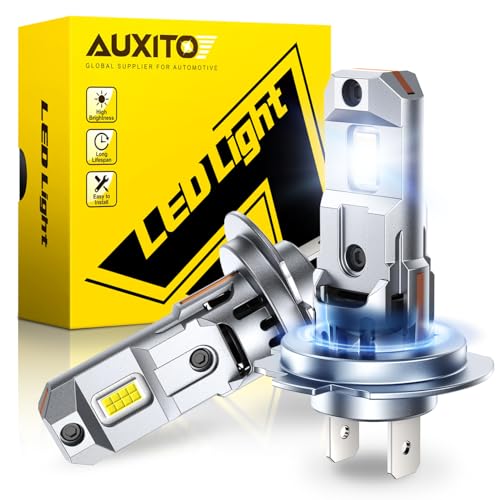
【Newly Upgraded Brightness】 AUXITO H7 LED bulbs have advanced chips that are 900% brighter than halogen. The 6500K beam offer the best light pattern and clarity for optimal visibility—no dark spots, shadow areas, blinding, or glare for oncoming drivers. With 50,000 lumens, they ensure a clear view in adverse weather

[Ultra Brightness - Ensuring Safety] Torchbeam H13 led bulb features the latest chip, delivering a brightness of up to 90,000LM—15 times that of a orginal bulb. With its 6,500K cool white light, it clearly illuminates the road ahead at night, ensuring your safety while driving.

1200% Exceptional Brightness: Featuring 16 advanced chips per bulb and an incredible 70,000LM brightness per set. Powered by the latest technology, these headlights efficient illumination, ensuring optimal visibility and safety during nighttime drives
Energy Consumption and Power Efficiency
Beyond durability considerations, electrical efficiency represents a defining differentiator between these technologies. You’ll find LEDs consume 95% less power than Xenon bulbs while converting up to 90% of energy into light versus Xenon’s 70-80%. LEDs achieve 233 lm/W compared to Xenon’s 92 lm/W, producing 8,000-10,000 lumens while drawing minimal current. Xenon requires high-voltage ballast systems that increase power draw and strain your alternator. This efficiency gap translates directly to energy savings—LEDs use 85% less power than halogens, while Xenon uses 75% less. You’ll notice reduced heat generation with LEDs, preventing housing damage and improving system longevity. For electric and hybrid vehicles, LED’s lower consumption delivers measurable environmental impact benefits, conserving every watt while eliminating Xenon’s warm-up power lag. The fundamental difference in how they operate—LEDs relying on diodes and electrons versus Xenon relying on gas—explains these stark performance variations.

【900% Upgrade】 Equipped with top automotive-grade chips, autoone upgraded h4 bulbs deliver an impressive brightness per pair at a cool 6500K. The super-focused pattern ensures a wider and longer lighting range, making the 9003/hb2/h4 bulb 9 times brighter thanstock bulbs

【1200% Brighter Output】 Enhance your drive with our advanced H4/HB2/9003 bulbs, equipped with 16 state-of-the-art per unit and producing an exceptional 60,000 lumens per pair. Leveraging innovative ZC01 tech, these H4/HB2/9003 lights provide outstanding, energy-efficient brightness for improved visibility and safety on anywhere

【900% Brighter - S1 Pro Bulbs】The SEALIGHT 9005 H11 bulbs combo feature 16pcs high-performance chips, delivering up to 8 times the brightness than stock bulbs. Upgrade your nighttime driving experience by replacing dim, narrow stock bulbs with SEALIGHT 9005/HB3 H11/H9/H8/H16 LED Bulbs Combo. Enjoy crystal-clear 6500K cool white light that cuts through the dark, giving you way better visibility for safer night drives
Cost Considerations and Long-Term Value
Purchase price differentials create immediate sticker shock when comparing these technologies. Your initial investment for LED headlights ($50-$350 per pair) exceeds Xenon HIDs ($40-$250), with premium LED systems reaching $1,320 versus Xenon’s $95 replacement bulbs. However, long term savings emerge through lifespan economics: LEDs deliver 30,000-50,000 hours compared to Xenon’s 2,000-15,000 hours, often outlasting your vehicle’s ownership cycle.
Installation complexity affects total cost—Xenon systems require ballasts, while LEDs install in 5-20 minutes. The energy efficiency of LED technology translates to reduced electrical system strain and lower fuel consumption over time. Different bulb technologies such as halogen, LED, and HID options each present distinct advantages affecting your overall replacement and maintenance expenses. Modern LED headlights provide superior beam pattern quality that minimizes replacement frequency compared to alternative technologies. Cost-per-lumen analysis shows Xenon at $0.10 versus LED’s $0.55, making HIDs initially superior. Yet LED durability eliminates frequent replacements ($468 per assembly versus routine Xenon swaps at $125), offsetting higher upfront costs through reduced lifetime ownership expenses and consistent brightness without degradation.

Easy Installation: 1:1 design, no external driver or connector required, plug and play


【10 Mins Easy Install】All-in-one fanless high low beam h4 led light. Mini body design, plug and play for H4, 9003, HB2 socket. Fit most of ATVs/UTVs without modification
Technology and Performance Characteristics
At their fundamental level, these technologies operate through entirely different physical mechanisms that determine their performance boundaries. LED technology differences center on semiconductor diodes producing electroluminescence through electron movement, delivering 8,000-10,000 lumens with instant activation. Xenon systems ionize gas using 24kV electrical discharge through ballasts, generating approximately 3,000 lumens but with superior peak intensity.
Performance metrics reveal LED’s dominance in efficiency—converting 90% of energy to light versus Xenon’s 70-80%—and longevity spanning 50,000 hours compared to Xenon’s 2,500-10,000 hours. However, Xenon’s concentrated beam pattern excels in penetration distance, requiring automatic leveling systems to prevent oncoming driver glare. LEDs offer wider illumination patterns and immediate full-output operation, while Xenon demands several seconds for arc stabilization and higher startup voltages. LEDs maintain brightness until failure, whereas Xenon bulbs gradually dim throughout their operational lifespan. Proper LED installations require LED-specific reflectors to ensure correct beam patterns and avoid safety issues with uneven light distribution. For on-road use, only DOT-approved LED headlights meet federal safety standards and comply with regulations governing color, brightness, and beam pattern.

Reflector design&Advanced chip: Reflector design offer an improved beam pattern with "Z-shaped" cut-off line and more light output, bring brighter but softer Light. Don't blind oncoming drivers and efficiently relieve driving fatigue. Advanced led chip, 500% times brighter than stock halogen and HID headlight, lower power consumption, helping drivers receive better views and road reflections. Very stable, the brightness remains the same after two years

[Perfect Fit]: The EZGO TXT Headlight Kit is a direct OEM replacement for 1996–2013 EZGO TXT Gas & Electric carts. Pre-assembled sides with a 3-pin connector ensure plug-and-play installation — No modifications needed

Fitment: Fit for most motorcycles with standard 7" headlights such as Street Glide, Road King, Ultra Classic, Electra Glide, Heritage Softail, Softail Slim, Softail Deluxe, Fatboy, Switchback, Ultra Limited, Tri, CVO Models, 1989-2019. NOTE: Don’t fit for 2018-2019 Heritage Classic & Softail Slim. Switchback, Road King, Street Glide, Electra Glide and Ultra Limited need a ring to fix firmly. If you need help, please contact us.
Light Quality and Color Temperature
Color temperature fundamentally defines your headlight’s visual character and functional performance, measured in Kelvin (K) where lower values produce warm yellow-red tones and higher values generate cool blue-white hues.
Xenon bulbs typically operate between 4300K-6000K, with OEM systems at 4300K maximizing clarity through neutral white output. You’ll find aftermarket kits reaching 6000K with bluish characteristics. LED technology offers broader customization from 3000K to 12000K equivalents, though most manufacturers target 5500K-6000K for ideal color perception. Xenon headlights provide superior illumination compared to traditional halogen bulbs, making them a popular choice for drivers seeking enhanced road visibility.
For light distribution and visibility, 5000K-6000K delivers maximum contrast in both technologies. Xenon’s 6000K produces pure white from the driver’s perspective despite blue tinting. LED at 5000K enhances human eye response, mimicking natural sunlight. Yellow 3000K penetrates fog and precipitation effectively, while temperatures exceeding 6000K prioritize aesthetics over functional performance.
Halogen headlights produce a soft yellow glow at 2700K-3000K, which is easy on the eyes but considered dated compared to modern xenon and LED alternatives.
Safety Features and Beam Control
While both technologies deliver superior illumination compared to halogen systems, xenon and LED headlights differ substantially in their beam control mechanisms and safety performance. You’ll find xenon systems typically include auto-leveling features for glare mitigation, compensating for their intense 3,000-lumen output that can blind oncoming drivers without proper adjustment. LED headlights offer superior adaptive systems through precise diode control, achieving 8,000-10,000 lumens while maintaining safer beam patterns. IIHS testing confirms LEDs outperform xenon in overall safety ratings, particularly for curve visibility and road reach. They’ve reduced nighttime crash rates by 20-29% through better illumination coverage. However, both technologies require compatible projector housings to prevent illegal glare hazards. LED’s instant-on capability and wider beam patterns provide immediate response in sudden low-light conditions, while xenon’s 2-5 second warm-up delays essential adjustments. LEDs also demonstrate superior durability against shock and vibration, making them more reliable for vehicles frequently encountering rough terrain or uneven road surfaces. Premium LED headlights distinguish themselves through advanced heat dissipation technology that maintains consistent performance and extends operational lifespan in demanding driving conditions.