
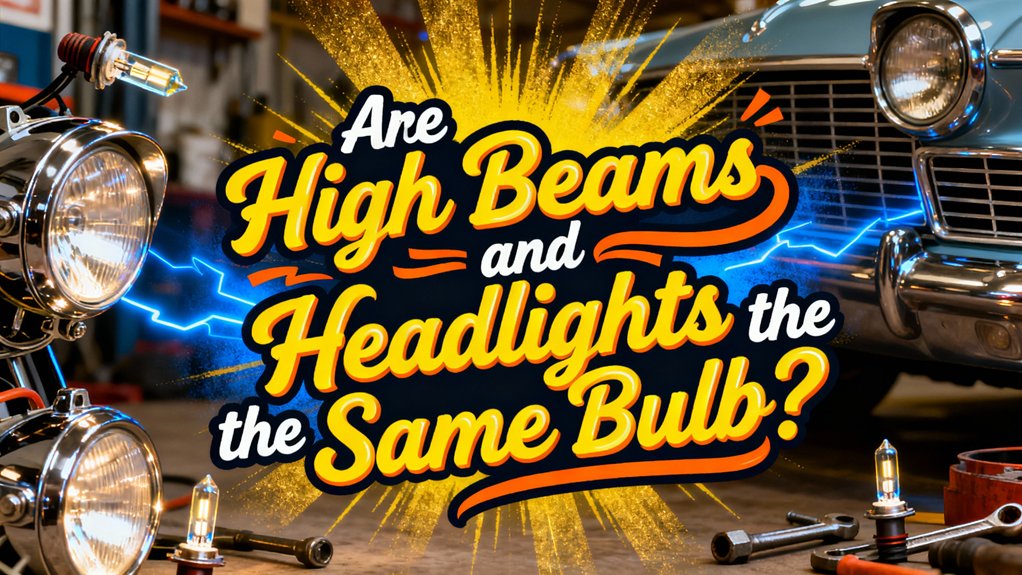
It depends on your vehicle’s design. If you’ve got a dual-filament bulb system (like H4, H13, or 9007), you’re using one bulb per headlight that switches between high and low beams through separate filaments. However, single-filament systems use four separate bulbs—two dedicated to high beams (often 9005) and two for low beams (typically 9006 or H11). You’ll need to check your owner’s manual or inspect your headlight assembly to determine which configuration your car uses, as this affects replacement procedures and bulb selection strategies.
Understanding the Difference Between High Beams and Low Beams
Your vehicle’s lighting system employs two distinct beam patterns that serve fundamentally different purposes on the road. Low beam characteristics include a 2-3 degree downward angle with an asymmetric cutoff at 45 degrees, producing 700-1,200 lumens to illuminate approximately 40 meters ahead. This wider field of view covers road shoulders while preventing glare to oncoming traffic. High beam functionality differs greatly—projecting light straight ahead or upward, generating 1,200-3,000 lumens for enhanced intensity. They extend visibility to 100 meters with a narrower, concentrated field focused on long-range illumination. You’ll activate low beams via your standard headlight switch for city streets and populated areas, while toggling high beams through your turn signal lever exclusively for dark rural roads without traffic. Many modern vehicles include an auto setting that automatically adjusts between low and high beams based on driving conditions and ambient light. High beams consume more power than low beams due to their increased brightness level, which can affect your vehicle’s electrical system. Proper beam pattern and housing design ensures that the lumen output translates effectively into usable road illumination rather than creating uncomfortable glare for other drivers.
Single Filament Bulb Systems Explained
Single filament bulbs perform one dedicated function—they’ll produce either a low beam or a high beam, but never both. Your vehicle uses four bulbs total: two for low beams and two for high beams. Common types include H11, 9005, and 9006, each designed for specific beam patterns.
You’ll identify these bulbs by inspecting the single internal filament visible through the glass. Check your vehicle’s manual or examine the socket’s pin configuration to confirm compatibility before replacement.
Single filament advantages include targeted performance enhancement and simplified troubleshooting. When one bulb fails, you’re replacing only the affected function. Following bulb replacement tips promotes safety: disconnect the battery, avoid touching the glass with bare hands, and verify proper socket alignment during installation for ideal beam patterns. Space constraints in certain vehicle designs may limit headlight assembly options for single filament configurations.

【Visual Enhancement】: The OKOENIEO h1 headlight bulb are 200% brighter than other halogen bulbs, providing drivers with a wider and farther field of vision. Offering a greater visibility, they allow drivers to spot deer, wildlife, falling rocks, or obstacles ahead of time, ensuring safer nighttime driving.

BRIGHT, CONSISTENT OUTPUT: Provides clear, reliable illumination for everyday driving conditions
Dual Filament Bulb Systems Explained
Unlike their single-function counterparts, dual filament bulbs house two separate filaments within one housing—each dedicated to a specific beam function. You’ll recognize these by their three-pin connector base and visual inspection revealing both filament types inside. Common configurations like H4, H13, and 9007 operate by independently energizing either the low beam or high beam filament through your vehicle’s switching controls.
This design offers critical advantages: you’ll only need one bulb per headlight assembly, reducing replacement costs and installation complexity. However, bulb lifespan affects both beam functions simultaneously—when one filament fails, you’re replacing the entire unit. Motorcycles and compact vehicles frequently employ this space-efficient system. You’re fundamentally running two distinct light sources within a single reflector housing, switched electronically without mechanical adjustment. These dual beam bulbs cannot replace single beam bulbs due to incompatible base designs and differing connector configurations.

Size: H4 HB2 9003

2 Pack dual filament halogen headlight bulb by Peak Lighting. These were commonly used on many of the small Honda 90cc bikes from the 60's and 70's. RoHS compliant.
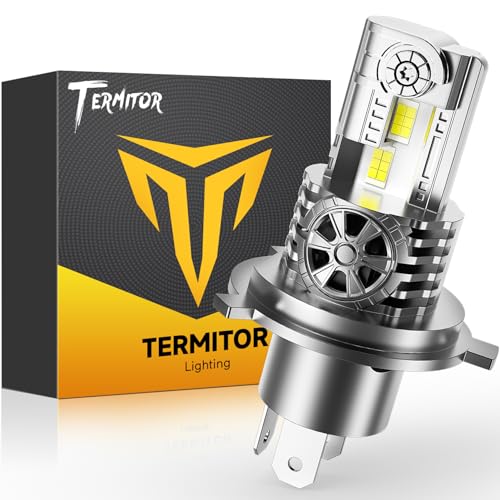
800% Brighter Than Halogen: Equipped with upgraded high-efficiency chips, the Termitor H4/9003 bulb delivers exceptional light output with a 6500K sharp xenon white glow, dramatically improving nighttime visibility and road safety for motorcycle riders
Common Bulb Types for Single and Dual Systems
Understanding which filaments your vehicle uses requires identifying the specific bulb configurations in your headlight assemblies. Single filament systems employ separate bulbs for each function: 9005 (HB3) handles high beams, while 9006 (HB4) and H11 manage low beams or fog lights. These designs guarantee bulb compatibility through dedicated housings.
Dual filament options combine both beams in one unit. The 9003 (H4), 9007 (HB5), and H13 (9008) incorporate twin filaments for integrated switching. This lighting technology simplifies installations but demands precise replacement matching.
Modern upgrades include HID variants like D2S and D4S, delivering 3200 lumens with 3500-hour lifespans. LED replacements offer superior efficiency—9005 LEDs reach 10,000 lumens per bulb at 6500K. However, HID bulbs cannot be used in halogen systems due to incompatible electrical requirements and housing designs. Always verify your vehicle’s requirements before installing aftermarket alternatives to maintain peak visibility and safety compliance.
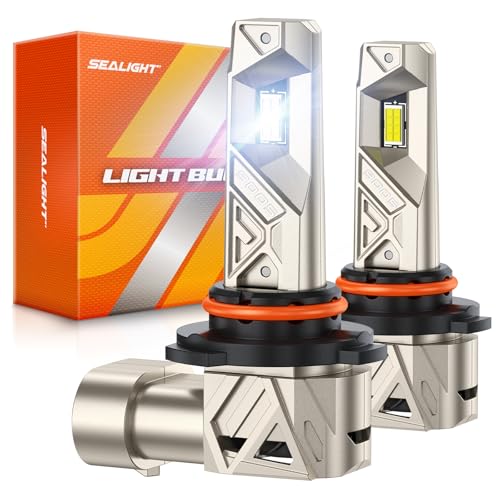
10X Breakthrough Brightness: 9005 bulbs use 16 advanced high-power chips,delivering 1000% brightness increase. With the latest technology, HB3 bulbs provide stable, high-efficiency illumination for enhanced visibility and maximum road safety

【500%+ Brighter & Advanced Fanless Cooling】 Upgrade your 9005 LED bulbs for night highway driving and dark rural roads. Marsauto M1C delivers 30,000LM of 6500K cool white light – 500%+ brighter than halogen HB3 bulbs. Our fanless passive cooling system provides 0 dB quiet operation with no moving parts to fail. Tail Light Lenses

【98%+ Vehicle Compatibility】FORENNER 9005 Headlight Bulb Retainers Equipped with the latest upgraded linear decoding technology and built-in intelligent IC driver, it is suitable for more than 98% of vehicles. CANbus ready, ensuring no errors, flickering, or radio interference. Please note: Some sensitive vehicle models may still require a CANbus decoder. Feel free to contact Forenner if needed
How Beam Angle and Distance Differ
When you activate your vehicle’s high beams, the light projects horizontally or at a slight upward angle, creating a focused beam that illuminates 400-500 feet (122-152 meters) ahead without a defined cutoff point. This beam intensity enables early hazard detection on unlit rural roads and highways. In contrast, low beams direct light downward at 2-3 degrees from horizontal, covering only 100 meters with intentional angle adjustment to prevent dazzling oncoming drivers.
High beams deliver a narrower, more intense field optimized for distance rather than peripheral coverage. Low beams provide broader illumination of road shoulders and immediate surroundings. You’ll need to switch from high to low beams when approaching traffic within 500 feet or following vehicles at 200 feet, as high beam intensity causes dangerous glare under shared road conditions. The symmetrical pattern of high beams illuminates both sides of the road equally, while low beams feature asymmetrical distribution designed to keep the driver’s side brighter than the passenger side for enhanced lane visibility. For additional visibility during daytime conditions, many vehicles include daytime running lights that activate automatically when the engine is running. Modern LED headlights offer superior brightness and beam pattern quality compared to traditional halogen bulbs, providing drivers with better visibility and safety during nighttime operation.
Brightness and Power Consumption Comparison
High beam bulbs deliver considerably greater luminous output than their low beam counterparts, with modern LED and HID systems producing 3,000-4,000 lumens compared to halogen bulbs’ sub-2,000 lumen performance. You’ll notice LED high beams provide 300% brighter output than traditional halogens while consuming considerably less power. The bluish spectrum of LED and HID lights enhances brightness perception for your eyes, improving visibility during night driving.
Energy efficiency varies dramatically across technologies. LED headlights draw less current through diode operation, while HID systems outperform halogens in power consumption. A typical 9005 LED high beam operates at 60W output, whereas halogens require higher wattage while delivering inferior illumination. This efficiency translates to reduced strain on your vehicle’s electrical system and extended component lifespan exceeding 50,000 hours for LED technology. Dual-beam bulbs typically draw more power than single-function bulbs, as they must accommodate both high and low beam operations within one unit.
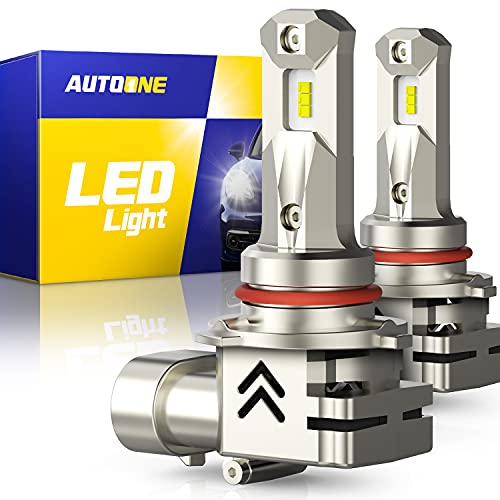
Compatible with Toyota 2003-2022 4Runner, 2004-2020 Sienna, 2007-2013 Tundra/Venza, 1992-2018 Camry/Corolla, 2008-2018 Sequoia, 1995-2012 Avalon, 1998-2005 RAV4/Celia, 1991-2017 Land Cruiser, 2003-2013 Matrix, 2010-2015 Prius; For Jeep Compass 2011-2021, Cherokee 2016-2019, Grand Cherokee 2005-2018, Commander 2006-2010; For Ram 1500/2500/3500 2011-2022; For Honda Accord 1990-2022, Pilot 2006-2022, Ridgeline 2017-2022, Civic 1988-2021, C-RV 2015-2020, Crosstour 2012-2015, CR-Z 2011-2016, HR-V 2019-2022, Odyssey 2005-2020; For GMC Yukon 2002- 2020 Sierra 2500 HD 2001-2020; For Ford F-150 2015-2022, Taurus 2008-2018,Explorer 2002-2019, Expedition 2003-2021

1500 FEET OF SUPER VISON: Upgraded 12 PCs Blade-X chips, 24,000 lumens and 110W high output arm your car with a farther & wider lighting field. Auxbeam 9005/HB3 light focus on super brightness, providing 700% more light and 300% more night vision than original halogen for confident driving anytime. Say goodbye to those yellow dim stock and see what you wanna see clearly with super bright light.

Super Bright & Long-lasting Rechargeable Batteries - Powerful premium LED generates a brilliant beam with daylight color and definition.
When to Use High Beams Safely
Proper high beam usage requires you to assess road conditions, traffic density, and visibility requirements before activation. High beam safety demands you switch to low beams within 500 feet of oncoming vehicles and 300 feet when following another vehicle. For rural driving on unlit roads, high beams enhance your ability to spot hazards like animals, pedestrians, and debris from greater distances. You’ll find them particularly effective on open highways with sparse traffic, illuminating wider road stretches ahead. However, you must disable them at intersections, curves, and uphill approaches where hidden traffic exists. In fog conditions, high beams reflect light back, severely compromising visibility. High beams can also be useful in construction zones where clearer visibility of road markings and equipment is essential for safe navigation. When replacing worn headlight components, ensure proper bulb installation procedures to maintain optimal beam functionality and safety. Consider using daytime running lights during dawn and dusk periods to enhance vehicle visibility to other road users. Above 25 mph in low-visibility situations, verify you can stop within your illuminated distance.
When to Use Low Beams
Low beams serve as your primary lighting system for most driving scenarios, offering controlled illumination that balances forward visibility with safety for surrounding traffic. You’ll need them between sunset and sunrise, regardless of road lighting conditions. Proper low beam usage becomes critical when visibility drops below 1,000 feet due to fog, rain, snow, or smoke—conditions where high beams create dangerous glare from light reflection. Switch to low beams when you’re within 500 feet of oncoming vehicles or following another car at 200-300 feet. Urban environments with street lighting require low beams to prevent dazzling other drivers. For ideal driving safety, activate low beams during dawn, dusk, or whenever you’re using windshield wipers, ensuring you remain visible to others. Low beams should illuminate the road approximately 150-200 feet ahead to provide adequate visibility while maintaining proper safety standards for nighttime driving. If you need to access or replace your low beam bulbs, ensure you have the proper tools needed for safe removal and installation. Given that nighttime driving contributes to half of traffic fatalities despite representing only one-quarter of total driving time, proper low beam usage becomes even more essential for reducing accident risk.
Legal Restrictions on High Beam Usage
Understanding when to use low beams sets the foundation for knowing when high beams become illegal. High beam regulations vary by state but follow consistent patterns. You must dim your high beams within 500 feet of oncoming traffic in most jurisdictions, though Oklahoma extends this to 1,000 feet. Dimming requirements for following vehicles typically range from 200 to 500 feet depending on your state—Florida mandates 300 feet while Wisconsin requires 500 feet.
Weather conditions trigger additional restrictions. You can’t use high beams in fog, rain, snow, or when visibility drops below 200 feet. Urban areas with street lighting prohibit high beam usage entirely. For vehicles requiring maintenance, replacing your headlight bulb ensures compliance with brightness standards. Technical standards limit brightness to 3,600 lumens with color temperatures between 2,500K and 6,000K under FMVSS 108 regulations. Violations of headlight regulations can result in fines ranging from $50 to $500 and potential vehicle impoundment.
Choosing the Right Bulb Setup for Your Vehicle
Which bulb type delivers the performance your vehicle needs? Start by verifying bulb compatibility through your owner’s manual or SYLVANIA’s bulb finder tool—match your exact make, model, and year. European vehicles typically require H7 single-beam bulbs with PX26d bases, while North American and Japanese cars use H11 or H16 configurations. Check power rating specifications; standard halogen runs 55W, while LED upgrades consume 30% less power.
For dual-beam systems, H4 bulbs with P43t bases handle both high and low beams simultaneously. Single-beam setups demand separate bulbs for each function. If you’re upgrading to LEDs or HIDs, confirm CANbus compatibility to prevent error codes. Projector housings optimize LED performance, achieving up to 400% brighter output than stock halogen. Reflective housings are ideal for halogens, ensuring proper light distribution without causing glare to oncoming drivers. The beam pattern significantly impacts nighttime visibility and safety during highway driving. Don’t overlook base differences—H11B’s protruding prongs won’t fit standard H11 sockets. Different bulb technologies offer varying brightness levels and color temperatures to match your specific lighting requirements.

[100,000LM Ultra-Bright Output & Daylight Clarity] Termitor H7powersports light bulbs deliver 100,000 lumens of crisp 6500K Daylight White light, significantly brighter than standard halogen options. This enhances contrast, reduces eye fatigue, and extends your visible range for safer off-road driving in fog, rain, or darkness. Pack of 2 offers a complete upgrade.
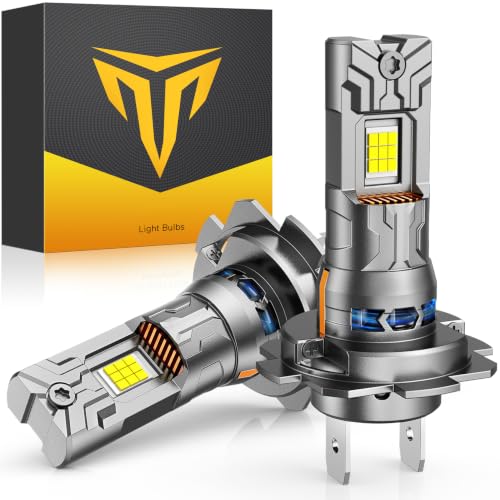
【13X Light Boost, 6500K True Day White】Packed with 24 advanced light cores to sustain steady light output, these H7 daytime-running-light-modules cranks up visibility tenfold over stock factory lamps. Its 6500K natural white glow restores authentic road tones, cutting through mist and wet pavement effortlessly. Flawless even light coverage gets rid of shadowed blind areas so roadside dangers pop up sooner on dim drives.

【1200% Brighter Output】 Enhance your drive with our advanced H7 bulbs, equipped with 16 state-of-the-art per unit and producing an exceptional 60,000 lumens per pair. Leveraging innovative ZC01 tech, these H7 lights provide outstanding, energy-efficient brightness for improved visibility and safety on anywhere


