A headlight ballast is an electronic control unit that transforms your vehicle’s 12V DC power into the high-voltage pulse (15-26 kV) needed to ignite HID xenon lamps. It regulates current through closed-loop control, maintaining stable arc discharge while preventing electrode damage. The ballast converts DC to high-frequency AC, ensuring consistent light output and extending bulb life by minimizing electrical stress. Understanding its key components—pulse width modulators, MOSFET regulators, and protection circuits—will help you diagnose failures and optimize your HID system’s performance.
Understanding the Role of a Headlight Ballast
A headlight ballast functions as the voltage and current regulator that enables HID (High Intensity Discharge) lamps to operate safely and efficiently. During startup, the ballast delivers a high-voltage surge to generate electrical arcs between electrodes within the HID bulb, initiating the gas-discharge process. Once ignition occurs, ballast function shifts to maintaining controlled current levels, preventing flickering and dimming while protecting against thermal runaway.
The component acts as a DC to AC converter, transforming your vehicle’s 12V or 24V DC supply into the alternating current that HID lamps require. By regulating power delivery throughout operation, the ballast prevents overcurrent conditions and electrode damage. It also manages cooldown periods, enabling rapid restarts after shutdown while optimizing energy consumption from your vehicle’s electrical system.
Modern ballasts incorporate electromagnetic interference filters to prevent disruption of other vehicle electronics, using shielding and careful circuit board layouts to minimize noise emissions that could affect radio reception or other sensitive systems.
How HID Ballasts Generate and Control Light
When your HID headlamp ignites, the ballast delivers a high-voltage pulse—typically 15 to 26 kV for automotive xenon systems—across the electrodes to strike the initial arc. These ignition pulses ionize the xenon or argon fill gas, enabling current flow before metal halides vaporize. Modern pulse-start ballasts generate controlled, short-duration pulses that reduce electrode erosion compared to older probe-start designs.
Once struck, the ballast shifts to arc stabilization mode, employing closed-loop current regulation to counteract the arc’s negative resistance characteristic. Electronic topologies—boost converters, resonant inverters—transform 12 V DC into high-frequency AC drive waveforms that maintain constant lamp current despite voltage fluctuations. This active control prevents thermal runaway, minimizes flicker, and guarantees stable lumen output throughout the warm-up period and lamp life. Quality ballasts also extend bulb life by protecting against electrical stress and maintaining consistent performance over time. After the arc is established, the igniter disconnects from the circuit, allowing the ballast to maintain regulated current flow.
Key Components Inside a Ballast System
Behind every ballast’s precise voltage and current regulation lies a coordinated assembly of power electronics working in tandem. Understanding ballast components reveals how these systems deliver consistent HID performance. The circuitry design centers on a pulse width modulator chip like the TL494s, which controls frequency while converting DC vehicle power to AC for HID operation. MOSFET regulators manage power distribution and integrate with the high-voltage transformer to generate the startup spike needed for arc formation. Capacitor elements store electrical charge, maintaining steady current post-startup and preventing flickering. The output coil enables charge-discharge cycles, while loop-back circuits monitor current flow. Short circuit protection, under-voltage safeguards, and over-voltage limiters prevent bulb burnout. These regulatory mechanisms work together to eliminate flickering or dimming that would otherwise compromise visibility during nighttime driving. Waterproof connectors guarantee moisture intrusion resistance throughout repeated duty cycles.

Power Wattage/Voltage 55W AC/12V

Power Transistor / Voltage Regulator Assortment, 82 pcs and 24 types

Power Transistor / Voltage Regulator Assortment, 95pcs and 27 types
Why HID Headlights Require a Ballast
Unlike conventional halogen headlights that operate directly on vehicle voltage, HID lamps demand a ballast because their arc-discharge chemistry requires an initial ignition pulse ranging from several hundred to several thousand volts—far exceeding the 12V your vehicle’s electrical system provides. This HID ignition sequence creates the primary arc between electrodes, shifting the lamp from non-conductive gas to ionized plasma. Post-ignition, the arc exhibits negative resistance, meaning current escalates unless the ballast enforces active regulation. Without continuous current limiting, electrode temperatures spike and destroy the lamp. The ballast additionally converts DC to high-frequency AC, stabilizing color temperature and reducing electrode erosion. Ballast compatibility with specific lamp chemistries guarantees proper waveform characteristics, overcurrent protection, and thermal management—critical for reliable operation and longevity in automotive environments. Proper ballast operation also helps reduce heat generation, maintaining safer operating temperatures and preventing accelerated component degradation. It is important to note that factory-installed HID headlights meeting federal safety standards are designed with ballasts that ensure compliance with FMVSS 108 requirements for proper light output and beam patterns.
Power Ratings and Specifications
HID ballast performance hinges on three interdependent electrical parameters: power rating, voltage conversion ratio, and current regulation precision. You’ll find standard configurations at 35W (5500 lumens), 45W, and 55W (8000 lumens), representing power efficiency gains of 600% over 1100-lumen halogens. Wattage comparison reveals that 55W systems double light output from the 35W baseline while maintaining stable operation through flyback converters that step 12V DC input to 85-90V AC output.
Current regulation prevents LED damage through constant current mode control, while 25kV ignition pulses enable initial bulb startup. High-frequency switching minimizes thermal losses through automotive-grade components rated for sustained operation. However, color temperature inversely affects output—8000K systems produce only 2600 lumens despite identical wattage, as higher color temperatures shift toward bluer light that appears less intense to the human eye. The brightest HID colors operate at 4300K, 5000K, and 6000K, with 6000K delivering optimal visibility and light output for most applications. Direct replacement ballasts guarantee plug-and-play compatibility across D3S, H4, 9005, 9006, and H11 configurations.

Each bundle contain 2 bulbs, 2 55W Platinum ballast, and accessories

Each bundle contain 2 bulbs, 2 ballast, and installation accessories
Each bundle contain 2 bulbs, 2 55W Platinum ballast, and accessories
Common Ballast Failure Symptoms
Despite ideal power specifications and voltage conversion ratios, ballast systems eventually degrade through component wear, thermal stress, and electrical transients. You’ll first notice flickering lights when current regulation circuits fail, causing rapid intensity variations that accelerate lamp burnout. Dimming issues manifest as progressive brightness reduction, often triggering safe-mode operation when the ballast can’t maintain proper power delivery. Audible indicators include abnormal buzzing from voltage regulation failure and constant restrikes. Delayed activation sequences signal deteriorating startup circuits, with headlights requiring extended warm-up periods or failing to ignite entirely. Physical inspection reveals burn marks, casing deformation, or oil leakage in capacitor assemblies. To definitively diagnose whether the ballast or bulb has failed, perform a bulb switch test using a known working headlight to isolate the defective component. These symptoms typically compound—flickering progresses to complete failure unless you address the underlying component degradation promptly.

FIT THE FOLLOWING VEHICLE - W3T19371 ballast replacement for 2006-2014 Acura TL TL-S | 2006-2014 Acura TSX | 2012-2014 Acura ILX | 2010-2013 Acura ZDX | 2013-2014 Acura RDX | 2010-2013 Acura MDX | 2009-2011 Acura CSX | 2011-2013 Honda CR-Z | 2004-2014 Honda Odyssey | 2012-2014 Mazda CX-5 | 2007-2012 Mazda CX-9 | 2007-2009 Mazda 3 | 2009-2012 Mazda 5 | 2007-2009 Mitsubishi Out lander | 2008-2012 Mitsubishi Lancer Evolution

HID HEADLIGHT BALLAST REPLACEMENT - Also known as headlight control unit, a crucial part of hid lighting system, provides the voltage needed to start the lamp and regulates the electrical current of the light once it is lit. A failed ballast will cause your bulb to burn. When the voltage is input, the output power of the ballast can be kept constant at about 35W or 50W to protect the HID bulb from damage. The ballast fits either the left or right hid headlights.

【Superior Function】: The xenon headlight ballast utilizes electrons to excite the gas that illuminates the HID xenon bulbs, significantly prolonging their service time while maintaining brightness levels. This makes it an optimal solution for enhancing visibility.
Troubleshooting Ballast vs. Bulb Problems
When diagnosing headlight system malfunctions, you’ll need systematic isolation procedures to differentiate ballast degradation from bulb failure—two components that share overlapping failure symptoms yet require distinct replacement strategies. Execute ballast testing techniques by swapping bulbs between functioning and non-functioning assemblies. If the working bulb illuminates in the failed position, you’ve confirmed ballast degradation. Conversely, if the suspect bulb fails in the working position, you’ve identified bulb failure. Before conducting swap tests, verify polarity orientation and connection integrity. Apply bulb inspection methods by examining filament condition for blackening or structural damage, including assessment of light output and color temperature characteristics that indicate proper bulb performance. Inspect ballast housing for cracks, moisture ingress, and mounting security. Check wiring harnesses for corrosion that mimics ballast malfunction. For vehicles like the GMC Acadia, accessing headlight components requires familiarity with fender liner and wheel well removal procedures. A faint buzzing noise emanating from the headlight area can indicate ballast instability before complete failure occurs. Remember that ballast failure prevents arc initiation entirely, while bulb failure allows ballast operation without light output.

35W HID Ballast: New DC Chip sest, IP68 Water Seald. It will work in any weather conditions. 0-30% brighter light than the standard ballast.

【HID headlight ballast replacement】Also known as Headlight Control Unit, a crucial part of HID lighting system, provides the voltage needed to start the lamp and regulates the electrical current of the light once it is lit. A failed ballast will cause your bulb to burn. It's Compatible with Infiniti g35 ballast is a perfect solution Compatible with Nissan 350Z 2003 2004 2005 2006 2007 2008 2009 2010 2011 2012 2013 2014 370Z Murano Altima Maxima Infiniti EX35 M45 FX 35 Q45 JX35

35W HID Ballast: This HID ballast adopts New DC Chip sest. It has over-voltage protection, low-voltage protection, no-load protection, short-circuit protection, etc. IP68 waterproof grade, which can work in any weather conditions
Maintaining Your HID Ballast System
Proper maintenance protocols extend ballast operational lifespan to 20 years while minimizing system failures that compromise illumination performance. Your ballast maintenance regimen must include scheduled visual inspections for physical damage indicators: burn marks, casing perforation, swelling, or oil leakage. Conduct electrical verification by measuring line voltage conformity with HID system specifications and confirming output parameters—85–120V AC during ignition, stabilizing at 35–65V AC. Inspect wiring for fraying, loose connections, or pinched leads that undermine circuit integrity. Verify capacitor ratings match ballast specifications; replace degraded components immediately.
Cleaning procedures require routine lens surface maintenance using mild detergent solutions to prevent light output reduction from accumulated contaminants. Before ballast servicing, inspect headlight assemblies for water or dirt intrusion. Check multi-tap ballast configurations to ascertain proper voltage matching. For outdoor applications requiring portable lighting solutions, consider supplementing fixed headlight systems with hands-free lighting options that provide flexibility during maintenance work. Testing the ballast with diagnostic methods like multimeters can confirm faults before committing to replacement. When handling HID bulbs during maintenance, avoid direct skin contact as finger oils cause overheating and premature bulb failure. These systematic protocols prevent premature component failure.

fully sealed for water proof
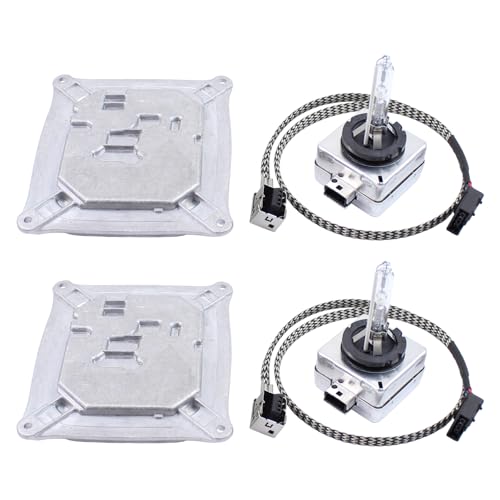
Fit for BMW X3 2007-2010; X5, 335i, 328i 2007-2011; M6, 650i 2008-2010; M3 2008-2013; 650Ci 2008-2011; 335xi, 328xi 2007-2008; 335is 2011; 335i xDrive, 328i xDrive 2009-2010; 335d 2009-2011;
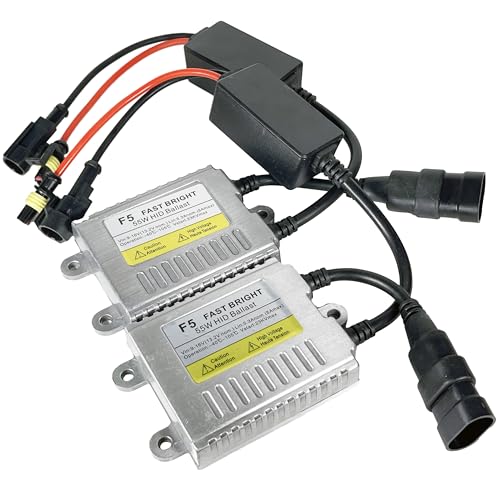
HIGH-OUTPUT 55W AC DIGITAL POWER: Features advanced AC digital technology with 23,000V striking voltage to deliver maximum power and stable light output without flickering or sudden power drops.