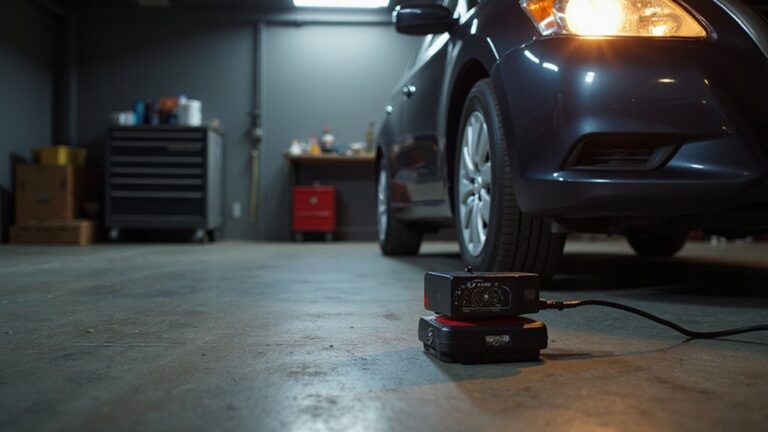
Park your bike on level ground 25 feet from a vertical wall, then mark horizontal lines at your headlight’s center height and 2 inches below it. You’ll need screwdrivers or hex wrenches to access the adjustment screws behind your headlight housing. Turn the vertical adjuster until your low beam’s sharp cutoff aligns with the lower mark, and center your high beam on the upper line using horizontal adjusters. This guide covers advanced techniques for achieving factory-specification beam patterns.
Gather Your Tools and Materials
Before adjusting your motorcycle headlight, assemble the essential tools to complete the job efficiently and safely. You’ll need a multi-tip screwdriver set or individual screwdrivers to access fairing screws and trim rings. Include wrenches and sockets for removing securing nuts and bolts—Harley-Davidson models typically require a 5/32 in ball end hex wrench. Powder-free nitrile gloves protect against skin contamination when handling quartz halogen bulbs. Add needle nose pliers for confined spaces and a small wire brush for cleaning corroded contacts. Stock dielectric grease, rubbing alcohol, and aerosol electric contact cleaner for electrical connections. Proper tool organization streamlines the adjustment process. Review your owner’s manual for model-specific requirements. Use a stable motorcycle stand to keep the bike secure and prevent tipping while making adjustments. These safety precautions guarantee you won’t damage sensitive components during adjustment.

Carburetor Ajdustment Tool Kit fits many brands including: Sears, Craftsman, Poulan, Weedeater, Echo, Toro, Ryobi, Homelite, and anything else that utilizes the splined.Also...
Prepare Your Motorcycle for Adjustment
Position your motorcycle on a flat, level surface in a shaded garage or perform this procedure at night—bright ambient light compromises your ability to assess beam patterns accurately. Proper motorcycle maintenance begins with correct positioning. Guarantee both tires rest on level ground with the front wheel aligned directly forward toward a vertical wall or garage door 25 feet away. Load the bike as you’d normally ride—wear your full gear and sit in your typical riding position to compress the suspension realistically. If you regularly carry a passenger or cargo, simulate that weight now. Inflate tires to manufacturer-specified pressure and verify all fluid levels—oil, coolant, and brake fluid—are correct. Understanding headlight importance means recognizing that suspension sag and tire pressure directly affect beam angle. Inspect the headlight assembly for damage or deformation before proceeding. Once the bike is properly positioned and loaded, roll it forward and compress the front suspension several times by applying the front brake and pushing down on the handlebars, then allow the motorcycle to settle naturally into its riding stance.
Set Up Your Wall Chart and Markers
Accurate beam alignment depends on precise wall markings that serve as optical reference points during adjustment. Position your motorcycle exactly 25 feet from a vertical wall or screen, measured from the front axle. Use a level to draw a horizontal centerline at your headlight’s measured center height, then add a second line 2 inches below it—this marks your low-beam cutoff target. Draw vertical lines through each headlight’s projected center to create left and right axis references. Mark your vehicle centerline on the wall as “C” for lateral positioning checks. For wall chart materials, painter’s tape works for temporary setups, while durable vinyl banners suit professional use. Measurement accuracy within a few millimeters guarantees consistent aim; verify all lines with a straightedge and level before proceeding. Ensure your motorcycle suspension is properly stabilized by bouncing the seat a few times and allowing it to settle naturally before taking final measurements.
Position Your Bike Correctly
Once you’ve established your wall reference marks, you’ll need to prepare the motorcycle itself to match actual riding conditions. Start with proper motorcycle maintenance by inflating all tires to manufacturer-specified pressures—this guarantees the bike sits at standard ride height. Load the motorcycle with your normal riding weight, including gear and passenger if applicable. Position the bike on level ground 25 feet from the wall, with both tires firmly planted and the front wheel pointing straight ahead. You’ll need to hold the motorcycle upright or have an assistant stabilize it vertically—avoid using a center stand unless both wheels contact the ground equally. This proper alignment of the bike’s centerline with your wall markers is critical for accurate headlight adjustment and safe nighttime visibility.

7" inch round headlight ring mount bracket adapter.

𝗦𝗟𝗘𝗘𝗞 𝗙𝗜𝗡𝗜𝗦𝗛: White nylon nuts pair with precision-threaded black automotive bolts for a clean look, blending easily with external hex bolts and other car repair components.

Wide Compatibility: Includes an adapter harness compatible with models like Talaria Sting R/MX4/MX3 Sur-Ron Segway X260, offering a flexible lighting solution for multi-bike users or upgrades
Access the Headlight Adjustment Mechanisms
With your motorcycle properly positioned and stabilized, you’ll need to locate and access the adjustment mechanisms that control headlight aim. Different headlight types require distinct adjustment techniques. Most reflector and projector units feature vertical and horizontal screws on or behind the housing—often concealed beneath rubber grommets or trim rings. Remove these grommets carefully with a small pry tool to expose Phillips, Torx, or Allen fasteners.
Fairing-mounted and dual sportbike headlights typically require partial or complete fairing removal to reach internal adjusters. Fork-mounted assemblies may need lower clamp bolts loosened first. Before disconnecting electrical connectors, note their orientation. LED retrofit units often place adjustment screws on sides, accessible after removing retaining rings. Earlier FLT models require specialized sockets for adjustment. Gather your tools—Phillips/flathead screwdrivers, T15/T20 Torx bits, and 6–8 mm Allen wrenches cover most applications.

1 unit of front headlight adjustment screw driver tool ONLY for 2018-2022 JL.

【Wide Application】Carburetor pilot screw adjusting tool is universal, suitable for ATV, UTV, snowmobile and so on.
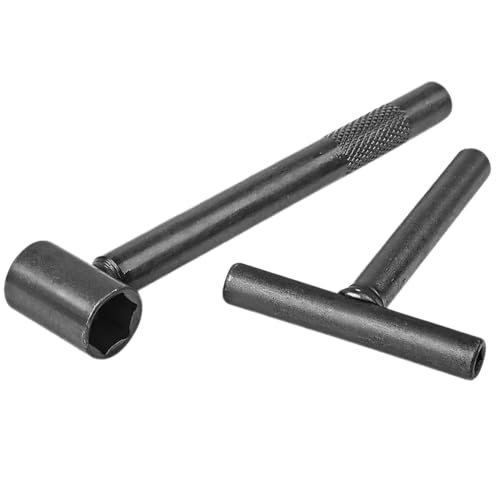
Package: 1pcs square hole tool and 1pcs hexagonal hole tool
Adjust the High Beam Pattern
Before adjusting the high beam, verify your motorcycle sits on level ground with tires inflated to specification and loaded to normal riding weight—including rider position, passenger if applicable, and typical cargo. Position the motorcycle 25 feet from a wall or screen. Turn the ignition to activate the headlight, then switch to high beam. Observe the concentrated hot spot within the broader beam pattern. The high beam brightness should center directly on the horizontal line marking your headlight’s center height—no downward angle like low beam requires. High beam lights should be level with the same height as the wall measurement. Using adjustment screws specified in your service manual, align the high intensity zone both vertically and laterally until it matches the marked centerline. Ensure your high beam bulb matches the factory specification to maintain proper reflector function and beam pattern. These adjustment techniques guarantee peak forward visibility without blinding oncoming traffic.

400% Brighter for Improved Visibility - The AUXITO H4 motorcycle light bulb offers 400% brightness, 6000K cool white, providing clearer, wider, and longer visibility at night in advance.
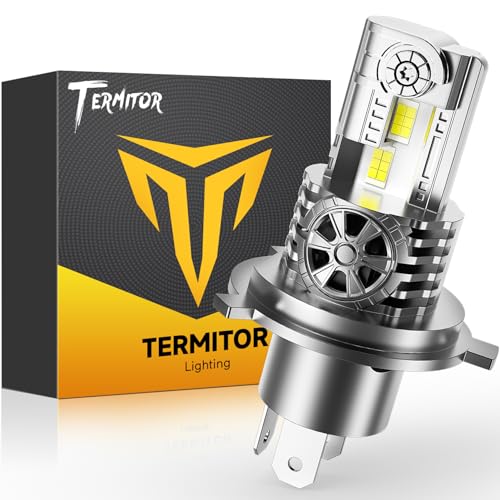
800% Brighter Than Halogen: Equipped with upgraded high-efficiency chips, the Termitor H4/9003 bulb delivers exceptional light output with a 6500K sharp xenon white glow, dramatically improving nighttime visibility and road safety for motorcycle riders

Drive with Confidence: See Farther, React Faster. Don't let poor lighting compromise your safety. The AUXITO H6M LED bulbs transform your night driving. With a 600% brightness boost over halogens, the 6500K daylight beam illuminates hidden obstacles instantly, giving you those extra seconds to react.
Adjust the Low Beam Pattern
After completing high beam alignment, shift your focus to the low beam, which requires a different aiming strategy to illuminate the road ahead without blinding oncoming motorists. Position the motorcycle 25 feet from the wall with proper load and tire pressure. Turn on the low beam and locate the sharp horizontal cutoff. Using the vertical adjustment screw, position this cutoff approximately 2 inches below the headlight centerline mark—this low beam adjustment maintains peak road visibility while meeting regulatory standards. Next, use the horizontal screw to center the hot spot on the vertical centerline mark. For dual-headlight systems, adjust each lamp independently, then verify both patterns align equally to create balanced motorcycle lighting. A laser level can improve the precision of your aiming measurements during this process. Recheck alignment after tightening all fasteners.
Verify Proper Beam Alignment
Once you’ve completed both high and low beam adjustments, verify the entire alignment pattern against the wall markings to validate regulatory compliance and ideal road illumination. Check that your low beam’s cutoff remains 2 inches below the horizontal centerline with beam intensity concentrated slightly right of the vertical axis. Confirm your high beam centers precisely on the intersection of horizontal and vertical lines, projecting equal light distribution in all directions. Measure the exact headlight position height and validate the corresponding wall projection matches specifications—typically 2 inches lower for low beams. Test both beams simultaneously if your motorcycle allows, verifying no conflicting patterns exist. Have someone sit on the motorcycle during final verification to maintain an upright position and ensure accurate beam height under normal riding conditions. Document final measurements and consult your service manual to validate alignment meets manufacturer standards and local traffic regulations before road testing.
Test Under Normal Riding Conditions
With static alignment verified, conduct a practical road test to evaluate headlight performance across varied riding scenarios. Start your engine with the headlight activated, ensuring continuous operation throughout your test ride. Navigate through traffic to assess visibility enhancement for other motorists under normal conditions. On straight roads, observe low beam cutoff behavior 25 feet ahead—proper adjustment prevents glare while illuminating road surface. Switch to high beam on dark highways without oncoming traffic, confirming long-distance throw and wide illumination span. Test beam clarity during turns and hills to verify consistent pattern maintenance. Monitor both daytime running light effectiveness and nighttime illumination quality. Any beam scatter, inadequate road coverage, or excessive upward projection requires readjustment before declaring alignment complete. Before declaring your headlight fully operational, verify that switching between beams activates the correct high and low beam functions without electrical issues.
Troubleshoot Common Alignment Issues
Road testing may reveal persistent alignment issues that require systematic diagnosis. If your beam sits too low—hitting 2 inches below center at 25 feet—twist the adjustment mechanism upward. Conversely, if the beam exceeds acceptable limits and appears too high, adjust downward until it falls within the red acceptance band, ensuring visibility without blinding oncoming traffic. For lateral misalignment, verify your front wheel points straight ahead, then center the concentrated beam on the vertical line. Stuck adjustment knobs require disassembly and lubrication of gears and sprockets. Always confirm your bike’s level position using blocks under both wheels if you’re using a center stand. Proper adjustment is critical for harnessing light effectively while maintaining safe aim during MOT inspections. Small adjustments at the headlight lead to significant changes in light projection, emphasizing the importance of fine-tuning for safety and compliance.