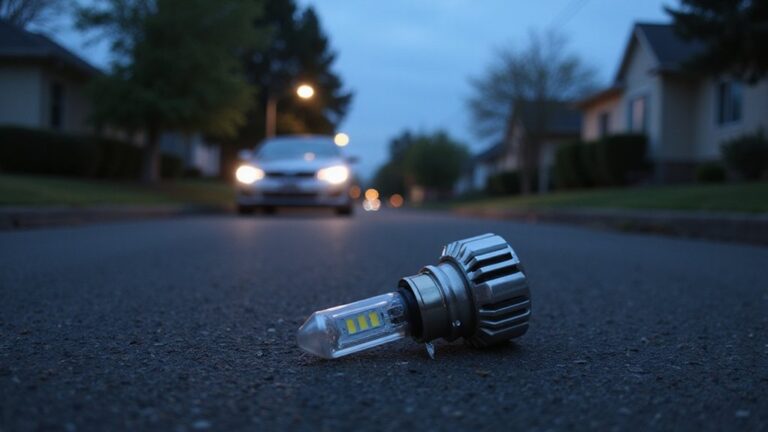
To adjust your Morimoto headlights, park your vehicle on level ground 25 feet from a vertical wall with wheels straight and tires properly inflated. Access the adjustment screws on the back of each headlight assembly by removing the rubber cover. Use the vertical screw for up-down movement and the horizontal screw for left-right alignment. Rotate adjustments carefully while checking the beam pattern against the wall until you achieve a sharp cutoff line at the proper height. The following sections provide detailed specifications and professional-grade verification methods.
Preparing Your Vehicle and Workspace for Headlight Alignment
Proper headlight alignment requires a controlled environment and precise vehicle positioning to achieve accurate results. Begin your vehicle maintenance by parking on a level, stable surface 25 feet from a vertical wall or garage door. Point your wheels straight ahead and guarantee tires are inflated to recommended pressures. Verify the vehicle is at normal driving weight with no excess cargo, as this affects suspension height and beam placement. Perform headlight care adjustments in low light or at night to clearly observe beam patterns. Clean any debris from headlight lenses for unobstructed projection, and consider applying protective clear coat to maintain lens clarity during this process. A clear cutoff line on the beam ensures you avoid blinding oncoming drivers while maximizing road illumination. Clear the workspace around and behind your vehicle for easy access to adjustment points. Keep the engine off throughout the process to prevent vibrations that compromise accuracy. Gather your tools including a screwdriver, needle nose pliers, and an 8mm socket with extension before beginning the adjustment procedure.

🚖Hole Alignment Tool:This clutch alignment tool can help you easily align the car clutch. The adjustment device and interchangeable cone can achieve the connection between the spring plate and the clutch, thereby quickly applying the entire component to the automotive flywheel.

UPGRADED 4-IN-1 WHEEL ALIGNMENT KIT: Unlike basic toe alignment tools that only measure toe-in and toe-out, this advanced wheel alignment tool kit features an adjustable magnetic camber gauge to measure four essential alignment angles: camber, caster, toe-in, and toe-out. Get a more complete suspension alignment solution with one versatile tool designed for accurate vehicle alignment measurements.
Tools and Equipment Needed for Morimoto XB LED Adjustments
Before you begin adjusting your Morimoto XB LED headlights, gather the necessary tools to confirm efficient and accurate work. You’ll need a panel removal tool for accessing headlight assemblies, an impact gun or socket set with 10mm socket for bolts, and a Phillips head screwdriver for trim pieces. An 8mm wrench enables fine vertical adjustment on certain models without disassembly.
For adjustment precision, confirm you have a level surface, measuring tape, and masking tape to mark beam cut-off lines on a reference wall. Equipment selection should include flathead pry tools for clips and protective gloves to prevent optical surface contamination. The vertical adjuster can be accessed via the top of the installed headlight for making beam height corrections.

Enhanced Visibility: Powerful LED projectors for improved nighttime driving.

Perfect Fitment for Ford F-150 2009-2014: This headlight conversion harness is compatible with all Ford F-150 models from 2009 to 2014, including 4.2L, 5.0L, 3.7L, 5.4L, 6.2L, and 3.5L engine variants. It works seamlessly with Morimoto XB LED headlights and most aftermarket LED headlight upgrades, ensuring a direct, error-free fit.

PERFORMANCE: We've always been blown away by the fact that the other brands don't even consider how well their headlights perform on the road at night. Most often, they're a downgrade compared to even the standard halogen setup, and that's a shame. The good news is that Morimoto's XB LED headlights produce a well defined beam pattern with a great amount of width, intensity, and a proper distribution of light.
Locating the Horizontal and Vertical Adjustment Screws
With your tools ready, you’ll now locate the adjustment screws on your Morimoto headlights. Access the back of each headlight housing and remove the rubber flap or cover secured by pins. This exposes the adjustment mechanism.
For screw identification, locate two main adjusters: the horizontal screw (left-right beam movement) typically positioned on the left side, and the vertical screw (up-down movement) usually on the right side when viewing the housing’s rear. Both appear as hex or Phillips head fasteners in recessed areas.
Some Morimoto XB LED models may lack both screws depending on your vehicle type. Certain designs require partially removing the headlight unit for proper access. Never use power tools—hand tools prevent overtightening and mechanism damage. Limit adjustments to three full rotations maximum to avoid stripping threads. Symptoms of broken adjusters include bouncing projectors or improper aiming during operation. If you need to replace your headlight bulbs entirely, be aware that LED bulb replacement can be more expensive than standard halogen options.

1 unit of front headlight adjustment screw driver tool ONLY for 2018-2022 JL.

【Precise 4mm Hex Ratchet Wrench】The 14540 Headlight Adjusting Ratchet with a 4mm hex head is specifically designed for Ford aerodynamic headlights featuring rear-mounted adjusters. This tool serves as a perfect professional replacement for OE Part #14540 / LIS14540

Fitment: Headlight Adjusters Kit is compatible with Chevy Impala, Biscayne & Belair 1962 Impala,1963 Impala, 1964 Impala ,1965 Impala,1966 Impala ,1967 Impala.
Step-by-Step Beam Alignment Process
Once you’ve located the adjustment screws, begin the beam alignment process by parking your vehicle on level ground facing a flat wall or garage door at exactly 25 feet (7.6 meters). Mark the headlight center height—typically 25 inches—with a horizontal line across the wall. Measure the distance between headlights and mark vertical reference points for symmetrical alignment. Rotate the Morimoto LED bulb until its flat sides align at 9 and 3 o’clock positions, ensuring a sharp cutoff line. Adjust vertical screws to align the beam cutoff with your horizontal mark, preventing glare. Center the beam horizontally using lateral adjustment screws. Make incremental turns, checking frequently for precision. The alignment benefits include improved visibility and headlight safety for oncoming traffic. For Morimoto 2-Stroke 2.0 bulbs, adjustments can be done manually without requiring any tools. Reinstall dust covers and test your adjustments on the road.
Testing and Verifying Proper Headlight Aim
After completing the alignment adjustments, verify your Morimoto headlights are aimed correctly by conducting an extensive beam test on level ground. Position your vehicle 25 feet from a vertical wall with tires straight and the suspension at normal driving weight. Turn on the low beams and examine the beam pattern; you should see a sharp cutoff line positioned slightly below the headlight center marks. Use a lux meter at standardized positions to confirm light intensity meets OEM specifications for your Morimoto model. Check that the beam pattern shows no scattered light or irregularities. Verify horizontal alignment centers the beam without lateral skew. For professional-grade alignment verification, consider using a dedicated wall aim banner that provides precise marks and aiming diagrams to ensure consistency. Finally, hand-tighten all adjustment screws and conduct a nighttime road test to confirm real-world performance before documenting your final measurements. For proper results, ensure the headlight assembly is fully secured before testing to avoid measurement inconsistencies.