Replacing your Jeep Wrangler’s headlights starts with identifying your platform generation: TJ models (1997–2006) use 7-inch sealed beams, JK variants (2007–2017) require H13 bulbs, and JL/JT platforms (2018–2025) accept H13 halogens or factory LED modules. You’ll need to match socket types precisely—some 2018–2019 units use H4/9003 instead. LED upgrades deliver 4,000–8,000 lumens with superior beam patterns, while aftermarket brands like Morimoto and KC HiLites offer DOT-compliant performance. Proper installation requires generation-specific adapters and systematic alignment procedures that guarantee peak visibility and longevity.
Understanding Jeep Wrangler Headlight Fitment by Model Year
Because Jeep Wrangler headlight assemblies have evolved across four distinct platform generations, selecting the correct replacement requires matching both bulb type and housing design to your specific model year. TJ-era Wranglers (1997–2006) used 7-inch sealed-beam units, limiting headlight brightness without aftermarket conversion. JK models (2007–2017) standardized on H13 plug-in bulbs, simplifying LED upgrades but often necessitating wiring modifications to prevent CAN-bus errors. Current JL/JT platforms (2018–2025) continue H13 fitment for halogen trims, while factory LED versions feature non-serviceable sealed modules. You’ll find legacy models through 2003 share the sealed-beam format with earlier YJ and CJ variants. Models equipped with halogen bulbs are compatible with aftermarket LED upgrade options. When evaluating brightness improvements, consider the lumens output and color temperature of replacement bulbs to maximize nighttime visibility. When performing the replacement, avoid touching the glass bulb to prevent premature burnout and ensure proper bulb alignment within the housing. Confirm your generation’s bulb size and connector type before purchasing—incorrect fitment triggers installation failures and electrical faults.
Halogen vs. HID vs. LED: Choosing the Right Technology
Once you’ve confirmed your Jeep’s bulb fitment, you must select the illumination technology that balances output, compatibility, and longevity for your specific housing. Halogen drawbacks include ~700–1,500 lm output, short 500–2,000 hour life, and poor lighting efficiency at 10–20%. HID advantages deliver 3,000–8,000 lm with improved beam pattern in projector housings, yet require ballasts and risk glare issues in reflector setups. LED longevity reaches 15,000–100,000 hours with superior efficiency (80–90% conversion), but retrofit challenges demand precise emitter geometry to replicate filament placement. Without correct heat management—active cooling or purpose‑built assemblies—junction temperatures degrade output and cause driver failure. Mismatched LED retrofits in halogen housings produce excessive scatter, failing cutoff tests and endangering oncoming traffic. LEDs turn on instantly without warm-up delay, whereas HID systems typically require 2–5 seconds to reach full brightness during ignition. Quality HID ballasts prevent flickering and ensure consistent light output by regulating electrical current to the bulb during startup and operation.
![True Mods H6054 H4 LED Headlight Wiring Harness [Negative Switched Conversion] [Fused] Universal H4 Head Light Relay Harness Kit for 9003 H6024 5x7 7x6 4x6 Subaru Toyota Jeep Sealed Beam Headlamp](https://m.media-amazon.com/images/I/51+wV9S2Q4L._SL500_.jpg)
YOUR VEHICLE NEEDS THIS - Swapping out old headlights for LED conversions on negative switched vehicles like Toyota, Subaru, Mitsubishi, or Suzuki, is not a simple job. But with our plug-and-play universal dual H4 headlight relay harness kit for high/low beam it can be! The compatible sockets include: 7x6 5x7 H6024 (2D1 H6054 H5054 H6054LL 6014 6052 6053)|H6024 (2D1)|4x6 6x4 (H4651, H4652, H4656, H4666, H6545)|H5006 (2C1) sealed beam headlights and more!
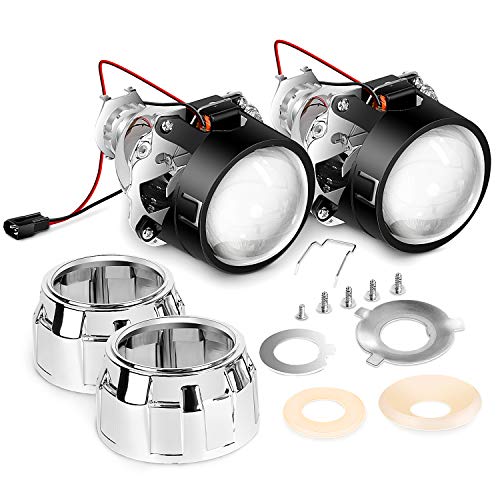
H1 mini projector kits (low/high beams), fit in tight spaces for quad retrofits or fog lamp upgrade

FIX DIM HEADLIGHTS & IMPROVE LIGHT OUTPUT: Upgrade your old factory headlight wiring with this H4 LED headlight relay harness kit. Fix common issues including dim headlights, flickering headlights, voltage drop, weak high beam/low beam performance and insufficient power supply. This fused relay wiring harness delivers stable battery power directly to your H6054 LED headlights, improving brightness and reliability during night driving.
Bulb Size Reference for 2018-2023 Wrangler JL Models
The 2018–2023 Jeep Wrangler JL platform employs H13 (9008) dual-filament bulbs for both low and high beams in factory halogen-equipped models, consolidating two functions into a single socket position per headlight assembly. Some 2018–2019 units shipped with H4/9003 in specific markets; verify your socket before ordering. Factory LED headlamp packages use sealed modular units that cannot accept bulb swaps—dealer service is required for OEM LED replacements.
Fog lights typically use PSX24W (2504) or 5202 bulb specifications; confirm your exact housing before purchase. Turn, parking, and reverse circuits commonly use 7440/7443 or 3156/3157 variants depending on dual-filament requirements. The license plate lights utilize T10/194/168 bulbs across most Wrangler model years for compact illumination requirements. Selecting quality bulbs from reputable manufacturers ensures longevity and energy efficiency for your lighting systems. Color temperature and beam pattern significantly influence both visibility and safety during various driving conditions. When planning lighting upgrades with aftermarket LED conversion kits, verify connector clearance, heat-sink dimensions, and CAN-bus compatibility to prevent bulb-out warnings or hyperflash.
Top Aftermarket Headlight Brands and Products
Aftermarket headlight assemblies for Jeep Wrangler platforms range from budget-conscious LED retrofits to premium projector housings that exceed OEM specifications in both output and beam pattern control. Brand comparisons reveal distinct performance tiers: Morimoto Super 7 leads product reviews with 970 Max Lux low beam and 980 Max Lux high beam, earning top marks in Headlight Revolution testing. KC HiLites Gravity LED Pro offers DOT-compliant CREE LED arrays with integrated daytime running lights at $874.99 per pair. Truck-Lite’s 27270C-MP delivers exceptional high beam performance at 1990 Max Lux while maintaining budget-friendly pricing. JW Speaker’s 8700 Evo 2 competes favorably in benchmark testing. Putco Luminix provides straightforward plug-and-play H13 compatibility with 12,000-lumen output and 50,000-hour longevity. Oracle Lighting presents configurations with or without halo rings that produce 3,600 raw lumens on low beam settings. Each option addresses different installation priorities and performance requirements, with considerations for color temperature and beam pattern quality affecting overall visibility during nighttime driving. To maintain optimal headlight performance over time, consider applying UV protectant sealant to your aftermarket assemblies to prevent oxidation and fogging that can diminish light output.

The Best Value Upgrade Headlights: Super bright ,Best beam pattern on the market: Uniform Light, no blind Area and dim spots;10000lm/7000lm high/low beam;Very Sturdy:4.63 lb/pair; Modern Look,Plug&Play,IP67 wateproof

UNI-SHINE 7 inch led headlight: 6000K high and low beam. Great replacement of original halogen and HID headlight. You can stay safe at night, foggy and rainy day. Package including: 2 pcs 7'' led headlights、2 pcs H4-H13 adapters、1pc installation instruction

The Best Value Upgrade Headlights: Super bright ,16000lm/8000lm high/low beam;Best beam pattern on the market: Uniform Light, no blind Area and dim spots;Very Sturdy:5.05 lb/pair; Modern Look,Plug&Play,IP67 waterproof
Benefits of Upgrading to LED Headlights
Visibility transforms fundamentally when you upgrade from halogen to LED headlights on your Jeep platform. LED advantages include light output reaching 3 times halogen intensity, with quality units delivering 4,000–8,000 lumens per bulb. Dual-beam configurations exceed 16,000 lumens total. You’ll experience sharper beam patterns with reduced glare and improved road illumination through whiter light that enhances contrast for hazard detection.
Lighting performance extends beyond brightness. LEDs consume less power, reducing electrical system strain and extending battery lifespan. You’ll benefit from tens of thousands of operating hours, minimizing replacement frequency. The vibration-resistant construction withstands off-road conditions effectively. LED headlights also generate less heat, which improves durability and reduces fire risk in harsh driving environments. The modern aesthetic enhances your vehicle’s overall appearance while maintaining superior functionality.
Safety improves through faster reaction times to road hazards. Focused beams cut through fog, rain, and darkness while minimizing eye strain. Most LED headlight systems feature multifunction controls that allow you to easily adjust between low beam and high beam settings for different driving conditions. You’ll reduce long-term costs through fewer replacements and lower fuel consumption from decreased power draw. Additionally, LEDs provide environmental benefits due to their lower energy consumption and absence of hazardous materials found in traditional bulbs.

The Best Value Upgrade Headlights: Super bright ,9500lm/6500lm high/low beam;Best beam pattern on the market: Uniform Light, no blind areas and dim spots;Very Sturdy:5.05 lb/pair; Modern Look,Plug&Play,IP67 wateproof

The Best Value Upgrade Headlights: Super bright ,Best beam pattern on the market: Uniform Light, no blind Area and dim spots;10000lm/7000lm high/low beam;Very Sturdy:4.63 lb/pair; Modern Look,Plug&Play,IP67 waterproof

Material & Build Quality: High-quality aluminum alloy housing with durable UV-resistant polycarbonate lens. Built for long-term reliability with strong impact resistance and stable performance across various driving conditions.
Adapter Solutions for Cross-Model Compatibility
When upgrading headlights across different Jeep generations, you’ll encounter electrical connector mismatches that prevent direct installation. Adapter solutions bridge these compatibility gaps without requiring wire splicing or harness modifications. The KC HiLiTES adapter engineered for 2018+ JL and JT models supports high beam, low beam, and halo light modes through plug-and-play functionality. DV8 Offroad’s BCABJL-01 demonstrates exceptional adapter versatility by fitting any 7-inch JK or TJ headlight onto JL and Gladiator platforms with included harness adapters. Morimoto LF630 adapters accommodate H13 or H4 inputs for JL wiring systems while offering adjustable vertical and horizontal aiming. These cross model solutions feature injection-molded ABS plastic construction for off-road durability, water-tight sealing, and heat-resistant properties. Installation requires no OEM wire modification, preserving your factory electrical system’s integrity. The BCABJL-01 kit provides adjustable mounting similar to OEM specifications, ensuring proper headlight alignment and beam pattern control. Proper connector soldering and waterproofing techniques enhance long-term reliability when integrating these adapters with your vehicle’s wiring harness. Selecting adapter solutions based on your specific driving conditions and desired light output levels will optimize both visibility and safety for your Jeep.

🔌 Compatible Models: The headlight connector compatible with Dodge, Ford, GMC, Chevrolet, Jeep part of the car, compatible with Jeep 1997-2006 Wrangler TJ, 2007-2017 Wrangler JK 2 Door, 2007-2017 Wrangler Unlimited JK 4 Door. Please check if the compatible models match before you buy.

NO-CUT INSTALL - Drawing power directly from the fuse box, our easy-to-use DRL adapter harness supplies power to your headlight's DRLs and halos without cutting into your stock wiring harness.
![Headlight DRL Adapter Harness Kit Compatible with Jeep Wrangler JL 2018 2019 2020 2021 2022 Adapter W/DRL 4th Wire Harness [Plug N Play]](https://m.media-amazon.com/images/I/51f0MG0p5BL._SL500_.jpg)
OEM Style, Halo, and Projector Headlight Options
Once you’ve solved connector compatibility, selecting the right headlight style determines both beam performance and your Jeep’s visual identity. OEM replacements like Diode Dynamics Elite Series maintain stock chrome reflectors while delivering plug-and-play installation with 8-year warranties. For halo customization, Raxiom Axial Series adds switchback turn signals and selectable DRL colors without compromising function. Projector advantages include deeper beam penetration and uniform light distribution—KC HiLiTES Gravity Pro and Morimoto Super 7 tie for top lux performance. In brightness comparison, Oxbeam Triple Ring achieves 1130 max lux versus 700 for KC reflectors. Projectors deliver sharp cutoffs and concentrated patterns, while halos enhance visibility through welcome sequences. When upgrading to LED or HID options, consider color temperature preferences alongside brightness levels to ensure optimal visibility and legal compliance with local regulations. Choose based on whether you prioritize stock appearance, customization features, or maximum beam control for specific driving conditions.
Installation and Compatibility Considerations
Proper headlight installation requires model-specific tool selection and procedural awareness before you disconnect factory wiring. For 2007-2012 Wranglers, you’ll need a star bit screwdriver to remove four headlight screws, while 2018-2024 JL/Gladiator JT models require a 10mm socket for three mounting bolts. JK grilles demand T15 Torx tools and flathead screwdrivers for locking tabs. Wiring compatibility varies by generation—some vehicles need DRL harnesses connected to keyed ignition sources, while others require turn signal integration with parking lights. Critical installation tips include aligning guiding pins before securing retainer rings, avoiding dielectric grease on connectors, and hand-tightening screws to prevent damage. Always test low and high beams post-installation to verify proper headlight operation. For LED upgrades with halo lights, ensure you have a wire crimper and fuse jumper to connect additional lighting features through your vehicle’s fuse box location.

All-in-One Tool Kit for Jeep Owners: Everything you need to quickly remove your Jeep’s hardtop, doors, and fold down the windshield—perfect for any adventure. Stay prepared for quick fixes or just to enjoy the open air.

[ Upgraded Leather Organizer ] Xislet Torx Tool Kit for Jeep Wrangler JL JK & Gladiator hard top hardware is made of high-quality chrome vanadium steel, provide over 60 HRC hardness after Heat treatment
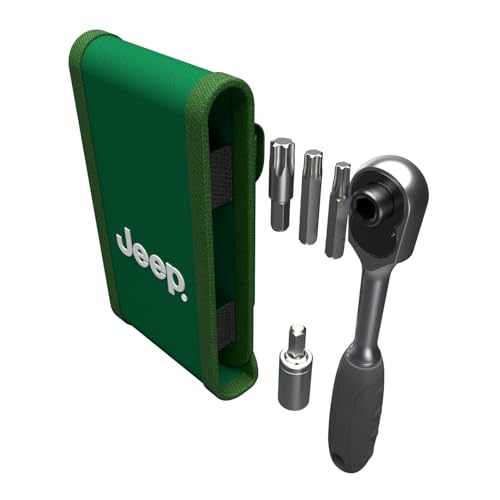
Tool Kit includes T-30, T-35, T-40 and T-50 torx bits, ratchet and storage pouch
Maintenance Tips for Extended Headlight Performance
Because headlight performance degrades gradually through environmental exposure and electrical stress, systematic maintenance extends both optical clarity and functional lifespan. For headlight longevity tips, wash lenses monthly with pH-neutral automotive soap and microfiber towels, then apply UV-resistant sealant every 6–12 months to slow polycarbonate yellowing. Among essential lens cleaning techniques, remove tar and insects promptly with appropriate solvents to prevent staining, and avoid household abrasives that increase surface porosity. Check housings for condensation after rain—persistent moisture signals seal failure. Inspect rubber gaskets every 6–12 months for cracks; replace them to prevent water ingress and electrical corrosion. Test output periodically with a lux meter; dimming indicates aging bulbs or voltage issues. Replace bulbs in matched pairs to maintain balanced illumination and color temperature across both headlights. For minor surface hazing between professional treatments, apply a small amount of toothpaste to a moistened cloth and rub into the lens using circular motions before removing all residue. UV exposure and oxidation are primary causes of lens degradation, making UV-resistant protection essential for preventing yellowing and maintaining optical clarity over time. For oxidation and yellowing that resist basic cleaning methods, headlight restoration products formulated with specialized active ingredients can remove cloudiness and restore optical clarity more effectively than household solutions.