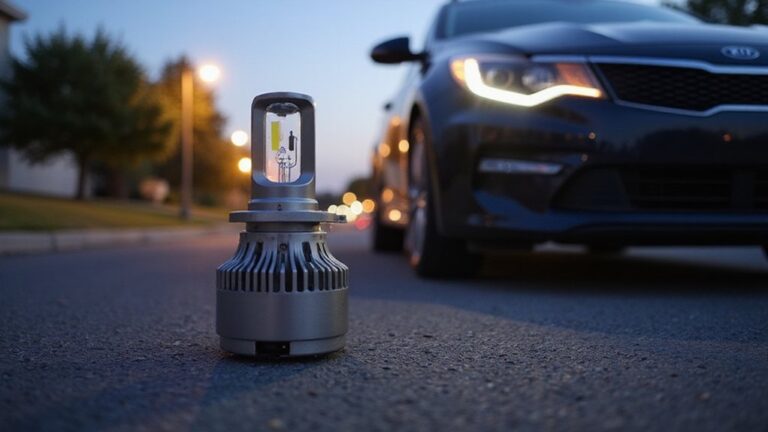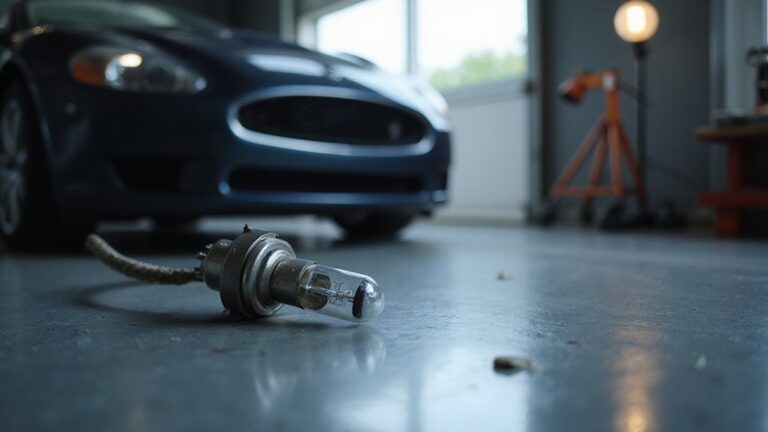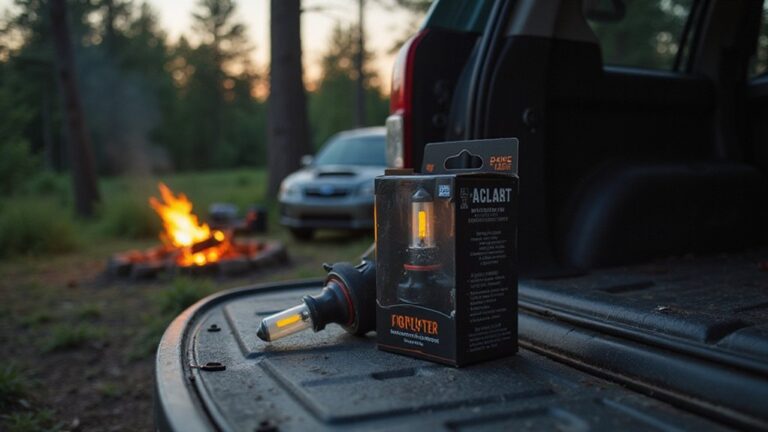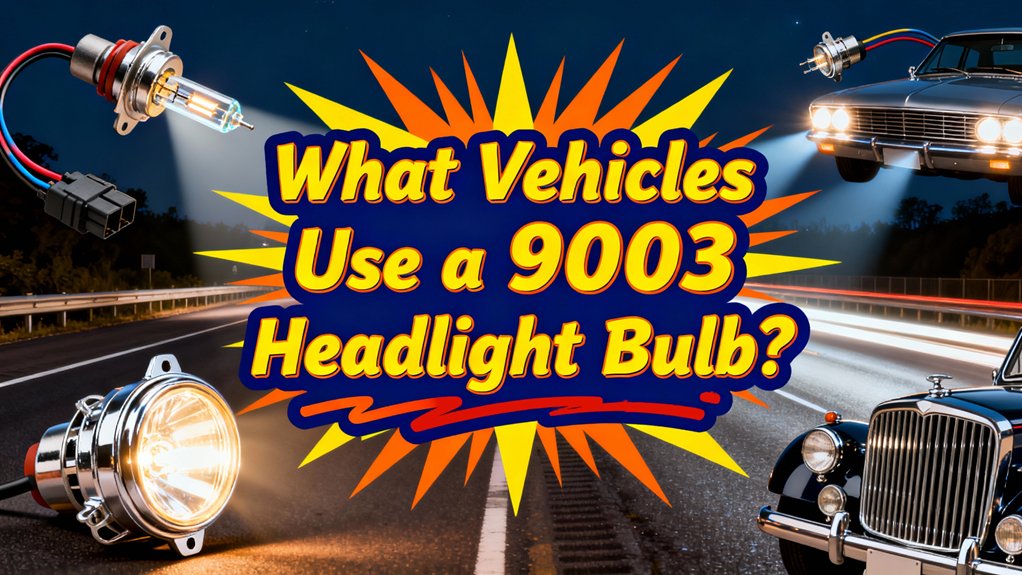
You’ll find 9003 (H4) headlight bulbs in numerous vehicles from the mid-1990s through mid-2010s, including Toyota 4Runner (1996-2002), Tacoma (2005-2015), Honda Odyssey (1995-2004), Accord (pre-2013), Ford Escape, Focus, and Aspire models from that era. The dual-filament P43t base design also fits select Nissan, Mazda, Infiniti, and European vehicles like Volkswagen Passat, Audi 90 Quattro, and Mercedes-Benz S-Class. Compatibility verification remains essential due to model year variations, and you’ll uncover specific fitment details and upgrade options below.
Understanding the 9003 Bulb Design and Compatibility
Because the 9003 bulb uses a dual-filament architecture within a single P43t base, it consolidates both high-beam and low-beam functions into one replaceable unit. This design, interchangeable with H4 nomenclature, emerged in bulb history as a space-saving solution for compact headlamp assemblies. You’ll find the P43t flange secures via a three-tab locking mechanism, ensuring correct rotational alignment for proper beam cutoff.
When evaluating compatibility, verify your vehicle’s socket accepts the P43t footprint and operates on a nominal 12 V system. Installation challenges arise with LED retrofits: you must confirm physical clearance for cooling fans or heatsinks, match emitter position to the original filament geometry, and check that beam patterns meet local regulations. The cooler operating temperatures of LED bulbs help prolong both the bulb lifespan and the headlight assembly itself. Many owners consider LED and HID conversions as superior alternatives to factory halogen bulbs for enhanced nighttime driving safety. To ensure you select the right bulb for your vehicle, consider evaluating lumens output, color temperature, and beam pattern to balance enhanced visibility with safe road use. Incorrect placement produces glare and scattered light, compromising both performance and legality.
Toyota Models That Use 9003 Headlight Bulbs
Several Toyota truck and SUV platforms rely on the 9003 bulb configuration for their headlamp assemblies, with specific model years dictating compatibility.
Toyota 4Runner Compatibility spans 1996-2002 models, where 9003 bulbs provide dual high and low beam functions through a single dual-filament design. You’ll find OE part numbers 42607-33011 and 42607-06011 referenced in service documentation. These bulbs are sold in pairs for complete headlamp replacement.
Toyota Tacoma Usage applies primarily to 2nd Gen models from 2005-2015, utilizing H4/9003 bulbs with plug-and-play installation. The Tacoma World forums frequently discuss LED upgrades, with Philips RacingVision GT200 H4 listed as a direct-fit performance option. For a secure and waterproof connection, many owners apply heat shrink tubing over their headlight connector joints.
Toyota Tundra headlights also accept 9003/H4 bulbs in compatible model years. The 9003 bulb features a P43t base that ensures proper fitment and secure connection in these Toyota headlight assemblies. When selecting between OEM and aftermarket bulb options, consider factors like light output measured in lumens, color temperature, and durability to ensure optimal headlight performance. Always verify fitment using your vehicle’s year, make, and model before purchasing replacement bulbs.

Lights Dim Over Time, Replace In Pairs: Your lights are a pair, one is never turned on without the other. If one bulb burns out, the other isn't far behind. Replace your 9003 XtraVision Halogen bulbs in pairs for optimum performance.

【800% Brighter - Newly Enhanced】SEALIGHT H4/9003/HB2 bulbs feature 24 high-performance chips, delivering up to 9 times the brightness of standard halogen bulbs. Enhance your nighttime driving experience by replacing dim, yellow stock bulbs with SEALIGHT H4/9003/HB2 Bulbs fog lights, offering superior illumination and enhanced visibility with a crisp 6500K cool white light for optimal light transmission

1000% Super Brighter: Upgraded 24 PCS CSP 7535 LED chips, 60,000LM super brightness H4/9003 bulb per pair. Enhance your driving safety during low light or adverse weather conditions
Honda Vehicles Compatible With 9003 Bulbs
Honda models utilize 9003/H4 bulbs across multiple vehicle platforms, with the Odyssey representing one of the primary applications. Odyssey models from 1995-2004 employ H4 headlight bulbs, directly equivalent to 9003 specifications. The dual-filament design combines high and low beams through a shared P43t base configuration.
Accord configurations vary by model year. Pre-2013 variants accept dual-beam 9003/H4 bulbs in select setups, while 2013 models shifted to H11 low beams in certain configurations. You’ll need to verify fitment through your vehicle manual due to these variations.
Pilot models from 2006-2013 use 9003/H4-compatible bulb setups in their headlight assemblies. The H4 equivalence applies specifically to high/low beam housings during these production years. Before installing a replacement bulb, avoid touching the glass of the new bulb to prevent damage during the installation process.
You can upgrade to LED 9003 bulbs in compatible Honda vehicles, enhancing brightness while maintaining DOT compliance without wiring modifications. The 9003 bulb serves as a direct replacement for factory bulbs with no modifications needed.

400% Brighter for Enhanced Visibility - AUXITO H4 Light Bulb Motorcycle delivers 400% brightness, 6000K cool white, providing clearer wider and further visibility at nights in advance.

【2000% INCREASE IN BRIGHTNESS】 Elevate your driving experience with our high-performance H4 light bulbs, featuring 32 advanced chips per bulb and delivering a staggering 96,000 lumens per set. S6-Pro 9003 bulbs offer superior, efficient illumination, ensuring enhanced visibility and safety during nighttime driving.

【10 Mins Easy Install】All-in-one fanless high low beam h4 led light. Mini body design, plug and play for H4, 9003, HB2 socket. Fit most of ATVs/UTVs without modification
Ford and Subaru Applications for 9003 Headlights
Ford’s compact and mid-size vehicle lineup from 1995-2004 represents the primary application range for 9003 headlight bulbs across three distinct models. You’ll find Ford compatibility confirmed for Aspire (1995-1997), Escape (2001-2004), and Focus (2000-2004) models. These applications accept direct OE replacement halogen bulbs and aftermarket LED 9003 equivalents that meet DOT regulations and SAE standards. Installation requires no modifications, though you should replace bulbs in pairs to maintain equal brightness and color temperature across both headlamps. The 9003 halogen bulb produces 910 lumens of brightness at a color temperature of 3200 Kelvin for standard lighting output. When upgrading to LED alternatives, consider how color temperature affects visibility in different driving conditions to ensure optimal nighttime performance. LED conversions also offer advantages in longevity and energy efficiency compared to traditional halogen options.
Subaru limitations are evident in compatibility documentation. No specific Subaru models appear in verified 9003 cross-reference guides or manufacturer compatibility charts. While general aftermarket 9003/H4 LED options exist, Subaru applications remain unconfirmed. Custom LED conversions may be possible but lack verification for proper fitment and electrical compatibility.

Next-Gen Luminescence: Engineered with 32 premium ultra-dense chips, these H4 bulbs achieve a staggering 600% brightness boost, casting a crystal-clear beam that pierces through the darkest nights for unparalleled road safety. For Top Clearance Marker Assemblies.

【Super 36000LM Brightness】SEALIGHT H4 LED bulbs use double-sided prime enhanced chips to deliver up to 8X illumination of other bulbs, providing clear vision for nighttime driving and earlier detection of obstacles ahead, giving you a safe and reliable lighting experiencethese

【12X Brighter & 60000 Lumens】Upgrade your night vision with advanced AUXITO H4 LED bulbs. Utilizing the latest LED chips, each set delivers a staggering 60,000 lumens of brightness—12 times brighter than stock halogen bulbs. This powerful illumination floods the road ahead, eliminates dark spots, and ensures you can see pedestrians, road signs, and animals from a much greater distance for maximum driving safety.
Nissan, Mazda, and European Car Models Using 9003 Bulbs
Beyond domestic manufacturers, Japanese and European automakers specify 9003/H4 bulbs across multiple model lines spanning 1993-2019.
Nissan models include the Navara with H4/9003 LED configurations and Versa (2007-2019) using H4 9003 HB2 replacements. Infiniti’s luxury division employs 9003 bulbs in the G20 (1999-2002), G35 (2003-2006), QX4 (1999-2000), and Q45 (1993-1998), maintaining 60W wattage and 1000lm brightness standards.
Mazda compatibility extends through the RX-7 (1993-2002), Tribute, MPV, Protege, and 626 (1993-2014), all utilizing 9003/H4 configurations.
European applications include Mercedes-Benz S-Class variants (S420, S500, S600 from 1994-1996), Audi 90 Quattro and Cabriolet (1993-1998), Volkswagen EuroVan (1992-2003) and Passat (1998-2001), plus Volvo 850 (1993-1994). LED upgrades offer IP68 waterproof ratings with dual filament high/low beam functionality. These LED replacements feature built-in cooling fans that extend bulb lifespan up to 50,000 hours compared to traditional halogen options. When comparing options, consumers should evaluate lumens output and performance across different aftermarket brands. Understanding color temperature differences between LED and halogen technologies helps drivers select the most suitable upgrade for their specific visibility requirements and driving conditions.

PAIN POINT OVERRIDE 1500% BRIGHTER VISION: Emitting 90K LM ultra-bright 6500K cool white light with 8 latest CSP chips, these 9003 light bulbs deliver high brightness over extreme distances without blind spots, dark spots, or flickering over time.

【1200% Brighter Output】 Enhance your drive with our advanced H4/HB2/9003 bulbs, equipped with 16 state-of-the-art per unit and producing an exceptional 60,000 lumens per pair. Leveraging innovative ZC01 tech, these H4/HB2/9003 lights provide outstanding, energy-efficient brightness for improved visibility and safety on anywhere

15X Ultra Brighter - Newly Enhanced: The Termitor H4/9003/HB2 fog light bulbs feature 32 high-performance chips, delivering up to 10 times the brightness of standard halogen bulbs. Upgrade your nighttime driving experience by replacing dim, yellow stock bulbs with Termitor H4/9003/HB2 fog light bulbs, offering superior illumination and enhanced visibility with a crisp 6500K cool white light for optimal light transmission
Motorcycle and Powersports Applications for 9003 Bulbs
When upgrading motorcycle headlights, H4/9003 LED bulbs deliver 3200LM to 24000LM output ranges—significantly exceeding halogen brightness while maintaining plug-and-play compatibility with standard housings. You’ll find compact designs accommodate tight motorcycle headlight assemblies without requiring large heatsinks. These motorcycle upgrades feature 6000K to 6500K color temperatures for enhanced nighttime visibility and beam patterns that mimic halogen filaments to eliminate dark spots. IP67 waterproof ratings guarantee durability in demanding riding conditions, while fanless cooling operates quietly. Single-bulb packs support individual headlight replacements in bikes and ATVs, with 9-32V DC compatibility across various powersports applications. Powersports lighting upgrades achieve 50,000+ hour lifespans and draw approximately 1.5A per beam. Many bulbs are CANbus ready to minimize flickering issues that can occur with motorcycle electrical systems. Note that most LED conversions aren’t DOT-compliant, restricting use to off-road applications only.
Technical Specifications and Performance Characteristics
Understanding the performance capabilities of LED and halogen upgrades for motorcycles requires examining the core technical specifications that define 9003 bulb functionality. You’ll find halogen variants deliver 1000-1300 lumens at 55W/60W filament ratings, while LED conversions produce 6000-18000 lumens per set using 25-100W configurations. Performance benchmarks show LEDs outperform halogens by 3-10x in brightness output.
Your bulb’s operating voltage spans DC 9-24V with color temperatures ranging 6000-6500K for ideal visibility. The dual-filament P43t base ensures direct fitment without modifications through 1:1 OEM design compliance. Advanced LED models incorporate fan dissipation systems to manage heat effectively and extend operational lifespan. Proper alignment of your upgraded bulbs is critical to ensure both optimal performance and safety for other drivers on the road.
Bulb durability specifications reveal stark contrasts: LEDs achieve 30,000-50,000 hours versus halogens’ 300-500 hours. IP67/IP68 waterproof ratings and -40°C to 80°C operating ranges guarantee reliable performance across demanding conditions with CE, RoHS, and DOT certifications confirming regulatory compliance.
Upgrading to LED 9003 Bulbs: Benefits and Installation Tips
LED 9003 bulbs deliver measurable performance gains across four critical parameters: luminous output, operational lifespan, power consumption, and environmental durability. You’ll achieve up to 30,000LM brightness with 6000K-6500K color temperature, while models like LS Plus H4 provide 60,000-hour lifespans versus halogen’s standard duration. Power consumption ranges from 80W to 100W per set, reducing heat generation and extending battery life. IP67-rated housings with aluminum construction and 12,000 RPM cooling fans guarantee weather resistance. Installation requires plug-and-play compatibility verification and potential CANbus decoder integration to prevent error codes. Since H4 and 9003 bulbs are interchangeable, you can use either designation when searching for replacement options for your vehicle. Proper beam pattern alignment after installation ensures you avoid blinding oncoming traffic while maintaining regulatory compliance. Bulb maintenance decreases considerably due to extended operational hours. The cost comparison favors LED technology through reduced replacement frequency and lower energy consumption, though initial investment exceeds halogen alternatives by several hundred dollars depending on full headlight assembly type and vehicle year. Adjust beam patterns post-installation to maintain regulatory compliance and optimum visibility.

Precision-Focused Safety Beam: The newly upgraded Termitor H4/9003 exterior light bulbs feature enhanced light projection, delivering a sharply defined focused beam with distinct boundaries. It significantly enhances illumination without causing glare to oncoming vehicles, providing a safer driving experience for you and others.

[1300% Ultra Bright & Clear Night Vision]: Our H4/9003 fog light bulbs feature 20 high-performance chips, delivering 60000LM per set and 900% brighter illumination than stock halogen bulbs. The 6500K cool white light mimics natural daylight, cutting through fog, rain, and darkness to provide a farther, wider, and clearer field of vision-ensuring safer night driving and better detection of road signs, animals, and obstacles

1200 FEET OF SUPER VISION: Upgraded 24 PCs Blade-S chips, 20,000 lumen high output arms your car with a farther & wider lighting field. The H4/9003/HB2 foglight fuse super brightness with good affordability, providing 600% more light and 250% more night vision than original halogen for confident driving anytime. Say goodbye to those yellow dim stock halogen and see clearly with super bright light.