Your daytime running lights (DRLs) emit 8-20 watts to enhance vehicle visibility during daylight, consuming minimal energy while producing 200-800 lumens. Headlights generate considerably higher output at 110 watts with 2,000-4,000+ lumens, specifically designed to illuminate roads in low-light conditions. DRLs activate automatically when you start your engine and disengage when you switch on headlights, which operate through manual controls. While DRLs reduce daytime crashes by 5-10%, headlights provide essential 360-degree visibility. Understanding these technical specifications and regulatory requirements will help you maximize both systems’ safety benefits.
Purpose and Primary Function
Daytime running lights (DRLs) and headlights serve fundamentally different roles in vehicle lighting systems, distinguished primarily by their intended operational contexts and functional objectives. DRLs maximize daytime visibility by enhancing your vehicle’s conspicuity to other road users—drivers, pedestrians, and cyclists—without illuminating the road ahead. They operate at reduced wattage optimized for daylight conditions, improving vehicle recognition in overcast weather, shaded areas, and twilight environments where vehicles blend into backgrounds. Conversely, headlights illuminate roadways and surroundings to improve your own visibility during nighttime or low-light conditions. They activate at higher brightness levels alongside tail lights, enabling safe navigation by revealing road details, hazards, and obstacles directly ahead. Headlights serve dual purposes: making your vehicle visible while providing essential forward illumination across various modes including low beam, high beam, and fog configurations. DRLs are designed to automatically activate when the vehicle’s engine is running, requiring no manual intervention from the driver.
Activation Methods and Operating Systems
Beyond their distinct functional purposes, DRLs and headlights differ fundamentally in how they activate and operate within vehicle electrical systems. DRLs employ automatic activation technology that engages when you start your engine, requiring no manual input and typically offering no deactivation switch. Conversely, headlights provide extensive driver options through manual switches or dials, enabling you to select low beam, high beam, or automatic modes based on conditions. While advanced headlight systems integrate ambient light sensors for automatic dusk activation, DRLs lack this capability. Critically, headlight activation simultaneously engages rear taillights through coordinated wiring, ensuring complete vehicle visibility. DRLs activate only front-facing lights without rear illumination, creating safety limitations during low-visibility conditions. This wiring distinction underscores why headlights remain legally mandated for nighttime operation. Headlights utilize two primary modes to adapt illumination range, with low beams designed for near visibility and high beams engineered for distant sight coverage.
Light Intensity and Beam Output
When examining automotive lighting systems, light intensity represents the most measurable distinction between DRLs and headlights. DRLs emit 8-20 watts using LED technology, producing a soft outward-facing glow for visibility enhancement without road illumination. They’re calibrated to avoid dazzling oncoming drivers while maintaining vehicle conspicuity. Headlights deliver notably higher power output through focused beams directed straight ahead, enabling you to detect distant obstacles and hazards. Their light modulation capabilities include low and high beam settings, adjusting intensity based on driving conditions. DRLs consume minimal energy, contributing to improved fuel efficiency during daylight hours. Conversely, headlights prioritize maximum illumination at higher power usage, essential for your forward vision in low-light conditions. You’ll find headlights illuminate both near and distant road features effectively, while DRLs solely enhance your vehicle’s presence. DRLs typically disengage when headlights are activated to prevent unnecessary power drain and lighting redundancy.

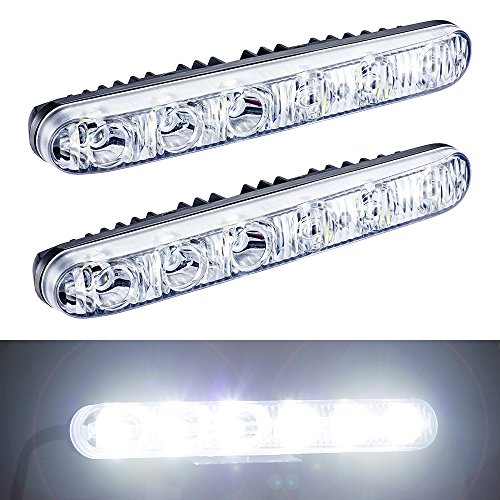
❤️ High brightness --- Imported high-purity LED high-power light source five lamp beads structure design;
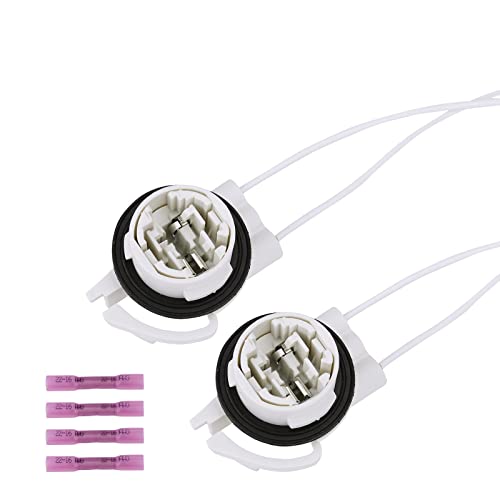
REPLACEMENT Light Socket Repair Kit-Heavy duty bindings offer a greater hold against vibration, abrasions, and moisture

【High-quality materials】The light bar is made of high-quality silicone and LED, waterproof and durable, and has a long service life. High quality can not only provide a safer guarantee for your life, but also high quality materials can prolong the service life of the product.
Road Illumination Capabilities
Road illumination represents the fundamental operational difference between DRLs and headlights, as each system serves distinct visibility objectives. Your DRLs produce 200-800 lumens with diffused beam patterns that enhance your vehicle’s conspicuity to others but don’t illuminate road surfaces, obstacles, or hazards ahead. This limited output can’t reveal potholes, pedestrians, or animals in low-light conditions. In contrast, your headlights generate 2,000-4,000+ lumens using advanced optical systems like LED Bi-Projector designs that deliver focused, directionally-aimed beams covering the road ahead. This illumination efficiency enables you to identify road signs, curves, and terrain details effectively. While DRLs improve road visibility for other drivers judging your distance and speed, they lack the intensity and beam directionality required for nighttime driving safety. Most U.S. states recommend headlights around 3,000 lumens to balance visibility and safety by preventing glare. Headlights incorporate specific beam patterns engineered to prevent dazzling oncoming drivers while maintaining optimal road coverage.

【40000LM High Brightness】Our upgraded Core-12 LED bulbs feature 6 advanced LED chips and higher power output, delivering up to 40,000 lumens per set—about 10× brighter than halogen bulbs. The powerful and focused beam greatly improves visibility for night driving, rain, fog, and other low-visibility conditions

【3000 Lumens Bright Output】 Extremely Bright! 2 pieces high illumination and high power 3570 LED chips offer 1500 lumens per H3 LED fog light bulb, total 3000 lumens per pair. Voltage: 12-24V, Color: 6000K Xenon White.

【800% Hyper Bright Illumination】Built with premium high-density CSP chips, our 9005 9006 LED bulbs output ultra-high 80000LM luminous flux and crisp 6500K cool white light. It sharpens night vision, strengthens penetrating power, and fully safeguards your night driving, fog travel and off-road driving safety
Energy Consumption and Power Requirements
Energy efficiency distinguishes DRLs from headlights through measurable power consumption differences that directly affect your vehicle’s electrical system load. LED DRLs consume approximately 10 watts, while standard low-beam headlights draw 110 watts—an 11-fold difference. This disparity in power efficiency translates to reduced alternator load, minimizing mechanical drag on your engine. The lower energy impact of DRLs results in negligible fuel consumption increases compared to headlights’ more substantial electrical demands.
Your vehicle’s alternator must work harder under headlight operation, requiring additional engine power and slightly increasing emissions. Modern LED DRL technology offers lifespans exceeding 15,000 hours while generating minimal heat, optimizing energy conversion efficiency. The extended lifespan of LED DRLs reduces the frequency of bulb replacements, providing long-term maintenance advantages over traditional lighting systems. Though both systems draw from your electrical supply, DRLs’ reduced current demand maintains superior fuel economy during daytime operation without compromising visibility standards.

[Perfect Fitment] The led daytime running light compatible with 6th gen CR-V CRV 2023 2024 2025 2026
Powered by 6 pieces xenon white LED lights — 3 LED High Beam and 3 LED Low Beam .

Compatible with 2016-2022 1st Gen Honda HR-V (aka Vezel)
Front and Rear Lighting Coverage
Coverage patterns between DRLs and headlights differ fundamentally in both illumination zones and intensity distribution across your vehicle’s lighting envelope. DRLs provide focused, narrow-beam front visibility during daylight, illuminating 0 feet of road surface with intentionally low intensity (typically 500-1,500 candela). You’ll get no rear lighting activation. Headlights deliver thorough coverage: low beams illuminate 200-300 feet forward, high beams extend to 500 feet, and they automatically activate tail lights for rear safety. This dual-zone activation proves critical during reduced visibility conditions. Modern vehicles with automatic headlight systems detect ambient light conditions and switch between DRLs and full headlights based on darkness levels. Your DRLs can’t replace legally mandated headlight use in rain, fog, or darkness because they lack peripheral illumination, adjustable intensity, and rear light integration. Unlike fog lights which emit a wide, flat beam pattern, DRLs are designed with a narrow focus for daytime visibility rather than adverse weather conditions. DRLs typically use LEDs for energy efficiency, consuming significantly less power than traditional headlight systems. Full headlight activation ensures 360-degree visibility to surrounding traffic.

▼▼▼IMPORTANT NOTICE: 1. We have upgraded the appearance of these 3157/3156 led bulbs, you may randomly receive the old or new bulbs. 2. Please add 50W 6ohm load resistor to solve hyper flash/fast blinking/no flash/error message on dashboard if it occurs. 3. The bulbs Don’t built in resistor and package Doesn’t come with resistor!!!
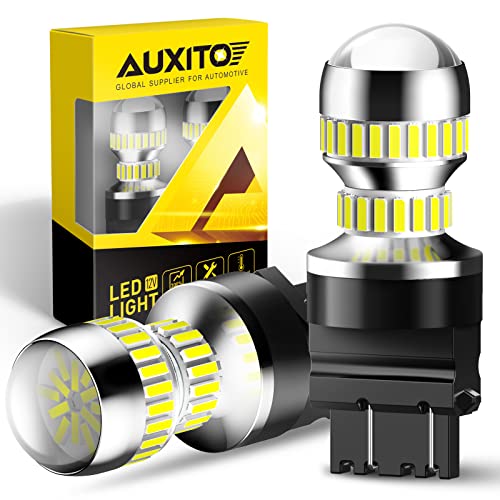
Resembling halogen bulb shape design and sequencing 54 pieces 4014-SMD LED chips precisely around the 3157 led bulb. Delivering 360° high luminous efficiency with full 6000K white light, see more clearly and safely when reversing

Super bright and low consumption: 3157 LED bulb Adopt 24pcs high quality 2835 LED chips, unique 360 degree lighting design, high brightness, perfect beam pattern, no blind spot, 400% brighter than halogen light.
Safety Benefits and Accident Reduction
Statistical evidence demonstrates that DRLs deliver measurable crash reduction across multiple collision scenarios, with effectiveness varying by light conditions and crash type. You’ll find DRLs reduce multi-vehicle daytime crashes by 5-10%, with two-vehicle frontal and side impacts showing up to 28% reduction. During low-ambient conditions like dawn or dusk, crash statistics reveal a 20.3% risk reduction, while clear daylight still yields 5-10% safety enhancements.
For vulnerable road users, you’ll see a 12% decrease in pedestrian and cyclist-related fatal crashes. Motorcycle conspicuity improves dramatically, with daytime crashes reduced by 32% when DRLs are equipped. Rural frontal and cross-traffic collisions drop 7-8%, while opposite-direction crashes decrease 5%. These safety enhancements prove most significant in head-on and angle collision scenarios involving multiple vehicles. In higher-speed environments exceeding 75 km/h, DRLs demonstrate a 13.8 percent crash reduction, while zones under this threshold still achieve 7.7 percent risk reduction.

Lights Dim Over Time, Replace In Pairs: Your lights are a pair, one is never turned on without the other. If one bulb burns out, the other isn't far behind.

Lights Dim Over Time, Replace In Pairs: Your lights are a pair, one is never turned on without the other. If one bulb burns out, the other isn't far behind

White DRL & Amber Turn Signal: Bright white daytime running light with dynamic startup effect and sequential amber turn signal for enhanced visibility and style.
Visual Identification Features
Beyond the quantifiable safety improvements DRLs provide, you can identify whether a vehicle operates with daytime running lights or full headlights through distinct visual characteristics. Vehicles with DRLs show only front lights illuminated while tail lights remain off, whereas full headlights activate both front and rear lighting systems. DRLs typically appear as a soft, fixed glow—often white or amber LED strips integrated within headlight housings to satisfy lighting regulations while complementing design aesthetics. Headlights display stronger, more focused beam patterns that may visibly switch between low and high settings. The presence of illuminated marker and tail lights definitively indicates headlight operation rather than DRL use. These visual cues help you quickly distinguish operational modes, ensuring compliance with lighting regulations while maintaining manufacturer-specific design aesthetics. DRLs are designed to make vehicles more noticeable to other drivers, particularly enhancing vehicle recognition in traffic situations where cars might otherwise blend with their surroundings.
Legal Requirements and Regulatory Standards
While DRLs enhance vehicle visibility through design and functionality, their implementation hinges on compliance with jurisdiction-specific regulations that vary considerably across global markets. The European Union mandates DRLs on all vehicles since February 2011, while Canada’s requirement dates to 1990. You’ll find the U.S. lacks federal DRL mandates, though FMVSS No. 108 establishes photometric standards for voluntary installations. State-level regulations impose different headlight requirements—many enforce “wipers on, lights on” laws requiring full headlights, not DRLs, during adverse weather. Legal compliance demands understanding that DRLs must emit white or amber light at specified intensities and automatically deactivate when headlights engage. Studies indicate that vehicles equipped with DRLs experience a 7% reduction in crashes compared to those without this safety feature. These regulatory implications affect vehicle design, aftermarket modifications, and operational protocols across different jurisdictions, requiring manufacturers and drivers to navigate complex, often conflicting standards.