Projector headlights deliver superior performance over halogen reflector systems, producing up to 471 lux compared to halogen’s 221 lux maximum. You’ll get sharper cutoff lines that reduce glare by 30% and concentrated beam patterns with defined horizontal edges. Projector assemblies accept halogen, HID, or LED bulbs, while traditional halogens convert 80% of energy to heat, creating yellowish, unfocused light. The elliptical reflector and shutter mechanism in projectors guarantee precise light distribution that halogen’s scattered beams can’t match—critical details for optimizing your vehicle’s illumination system.
Understanding the Core Technology Differences
While both projector and halogen headlights illuminate the road ahead, they represent fundamentally different optical approaches that greatly impact performance metrics. Understanding projector technology reveals an elliptical-shaped reflector that focuses light toward a lens, creating a precise beam with sharp cutoff. This assembly houses replaceable bulbs—including halogen, HID, or LED sources—within a sophisticated optical system.
The halogen differences stem from their incandescent filament design, where tungsten burns within a halogen gas envelope. This older technology converts 80% of energy to heat rather than illumination, producing yellowish light with significant power consumption. However, halogen’s low manufacturing costs make it economical. When you compare projector assemblies using halogen bulbs (39-51 lux at 9 feet) against HID-equipped projectors (140,000 lux), the technological gap becomes quantifiable through lux measurements. Proper headlight alignment techniques help ensure that upgraded projector systems maintain safe beam patterns without blinding oncoming traffic.
Projector headlights excel at reducing glare for oncoming drivers through their precisely engineered shutter mechanism that controls light distribution. This design advantage makes them increasingly popular among car enthusiasts seeking both performance and safety improvements.
Beam Pattern Quality and Distribution
The optical architecture differences between these technologies directly determine how light distributes across the road surface. Projector housings deliver superior beam focus through elliptical reflectors that concentrate light onto a narrow focal point, producing an even, semi-circular pattern with sharp cutoff lines. You’ll measure approximately 11 lux at 50 feet with halogen projectors, maintaining consistent light distribution below the cutoff threshold. The cutoff shield design prevents light from shining into the eyes of oncoming traffic, enhancing safety for opposing drivers.
Conversely, halogen reflector systems generate unfocused beams with poor width control and irregular dispersion patterns. Despite achieving 221 max lux readings, reflector housings produce incredibly uneven distribution that’s characteristically higher toward oncoming traffic lanes, increasing glare potential. The scattered light pattern lacks the definitive horizontal cutoff line that projectors maintain, resulting in compromised road illumination and reduced visibility control for opposing drivers. When combined with LED bulbs, projector housings can deliver superior illumination with less power consumption than traditional halogen setups. Traditional reflector designs utilize a hollow hemisphere configuration with reflective chrome and mirrors, which contributes to their characteristic wide but unfocused beam spread.

Super Bright. This D2H bulbs have High brightness light source. High-power, 6500K Cool White Light. Beam pattern standard, safe driving

Safety-Focused Optics-Precision 1.5mm beam focusing and maintained halogen alignment ensure AUXITO 9003 bulb delivers optimal illumination without creating glare hazards
Brightness Measurements and Lux Performance
How do actual brightness measurements translate to real-world illumination performance between these competing technologies? When examining lux output comparison, halogen reflector setups measure 221 max lux, while BiLED projectors reach 471 lux—delivering four times the intensity. Your halogen H11 projectors produce approximately 1200 lumens baseline, whereas LED projectors achieve 1750 lumens, outperforming halogen by 46%. This projector efficiency advantage stems from focused light concentration on target areas rather than dispersed illumination. Halogen projectors demonstrate even beam distribution with sharper cutoffs, enhancing lux efficiency despite lower raw output. HID projectors with xenon bulbs exceed halogen measurements substantially. LED projectors sustain consistent lux without dark spots, maintaining superior brightness levels across distances. You’ll find projectors concentrate 30% more light effectively, translating numerical advantages into tangible road illumination improvements. Projector designs provide a distinct cutoff line that enhances safety for oncoming drivers while maintaining optimal beam control. LED technology offers longer lifespan and reduced energy consumption compared to traditional halogen systems, contributing to overall cost-effectiveness over time. To ensure reliable electrical contact and optimal performance, proper connector routing and management should be incorporated during headlight system installation.
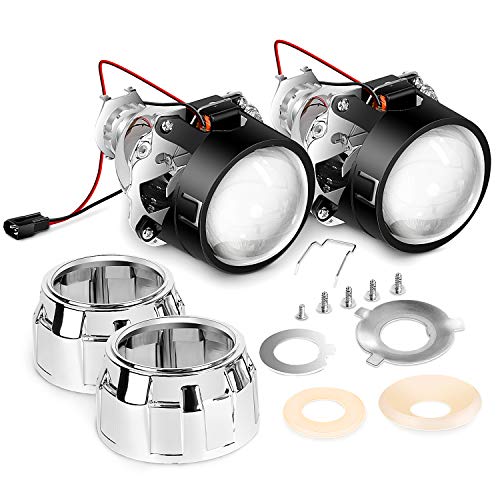
H1 mini projector kits (low/high beams), fit in tight spaces for quad retrofits or fog lamp upgrade

【DOT COMPLIANCE,STREET LEGAL】This headlight conversion kit with DOT compliance designed reflector and focus lens,the focus beam with perfect cut off line will never blind oncoming driver,No Shadows,No Dark Spot,Maximize Ensuring you and other driver safety.

>>Item Type: 1set 360 degree Evil Eyes for 2.5/2.8/3.0inch Projector Lens Decoration , 12V 3528 led chips, Dynamic Streamer RGB,Lifespan: 50000+ Working Hours,Lumens: 120LM/Pcs
Glare Control and Oncoming Driver Safety
Sharp cutoff shields in projector headlights fundamentally alter glare dynamics by creating a hard horizontal boundary that contains light below the beam pattern, preventing upward scatter toward oncoming drivers. Empirical lux measurements demonstrate projector systems produce markedly less vertical luminance above the cutoff line compared to halogen reflectors, directly reducing discomfort glare risk and temporary blindness incidents. This glare reduction translates to measurable safety implications: controlled studies correlate tighter beam edges with fewer near-miss events and glare-related complaints. Your driver comfort improves when encountering properly aimed projectors versus scattered halogen beams. However, beam alignment remains critical—misaligned projectors negate cutoff advantages and create hazardous conditions, similar to how improper headlight assembly installation can compromise optical performance. Over time, plastic headlight lenses can develop oxidation and yellowing that degrades optical clarity in both projector and halogen systems, compromising their light distribution properties. Aftermarket HID/LED retrofits in reflector housings particularly violate beam-pattern regulations, exponentially increasing measured glare despite similar lumen output, underscoring projector optics’ superiority in containing high-intensity sources. Reflector headlights suffer from less precise light control, which contributes to potential glare issues for other drivers on the road.

KIT INCLUDES: 1 - Disc Pad Holder, 3.25 in (8,2 cm) 6 - 3M Gold Sanding Discs 500 Grit, 3 in (7,6 cm) each 4 - 3M White Finishing Discs 800 Grit, 3 in (7,6 cm) each 1 - 3M Trizact Refining Disc 3000 Grit, 3 in (7,6 cm) 2 - 3M Quick Headlight Clear Co

KIT INCLUDES: 1 - 3M Trizact Refining Disc 1000 grit, 3 in/7.6 cm 1 - 3M Trizact Refining Disc 3000 grit, 3 in/7.6 cm 2 - 3M Quick Headlight Clear Coat Wipes 1 - Foam Pad with 3M Hookit Attachment, 3 in/7.6 cm 1- Disposable Glove

【Unique Angel Eyes Shrouds】3.0Inch spiral shrouds is exquisitely crafted and heat resistant,unique appearance makes your car look more attractive.
Long-Distance Light Projection Capabilities
Halogen projectors max out at 221 lux but suffer from uneven beam patterns and rapid intensity decline beyond 40 feet, limiting effective range despite marginal improvements over reflector housings. At 42 inches, halogen bulbs maintain higher intensity output at 144 lux compared to LED alternatives that deliver only 128 lux at the same distance.
Bulb Technology Options: Halogen, HID, and LED
Three distinct bulb technologies power modern projector headlights, each delivering noticeably different photometric performance characteristics. Halogen bulbs represent legacy technology—affordable but generating lower luminous intensity than alternatives. HID (high-intensity discharge) systems produce considerably brighter, whiter light output, making them the best upgrade for projector assemblies. You’ll find HID performs superior to LED in projector housings, where LEDs typically underperform against stock halogen configurations.
LED technology offers exceptional energy efficiency and extended bulb lifespan, consuming minimal power while outlasting both halogen and HID alternatives. However, LEDs excel in reflector assemblies rather than projector applications. For projector-equipped vehicles, HID presents the most effective brightness enhancement, particularly when matching 6000K color temperature. Each technology functions within projector housings, though performance metrics vary greatly across applications.
Projector headlights utilize a condenser lens that focuses light more efficiently than reflector designs, creating a sharper, more controlled beam pattern.

Each bundle contain 2 bulbs, 2 55W Platinum ballast, and accessories

Plug and Play - Compatible replacement for LED headlights accepting D2S/D2R/D2H bulbs. easy to install and no modification required

Each bundle contain 2 bulbs, 2 ballast, and accessories, this bulb is not dual xenon, high beam is halogen (for dual xenon, please select bixenon option)
Real-World Visibility and Night Driving Experience
When evaluating actual road performance, projector headlights demonstrate measurably superior beam control compared to reflector-based halogen systems, though absolute distance metrics reveal critical limitations. You’ll notice projectors eliminate the scattered light that causes halogen reflector glare, improving night vision for oncoming drivers through sharper cutoff geometry. However, halogens reach 150 meters while projectors dim considerably beyond 65 feet due to their 1-inch lens constraint. Standard LED configurations achieve 200+ meters—25% farther than halogens—enabling earlier hazard detection across varying road conditions. Projector uniformity surpasses halogen’s uneven 221-lux distribution, yet HID projectors at 3200 lumens deliver 82% more output than LED alternatives. The tungsten filament construction in halogen bulbs contributes to their lower initial cost but results in reduced operational efficiency compared to semiconductor-based alternatives. LED headlights offer reduced power consumption of 50-80% compared to halogen bulbs, making them a more efficient choice for extended night driving. Your visibility depends on balancing beam pattern precision against absolute intensity requirements for specific driving environments.
Upgrade Considerations and Best Recommendations
Understanding night driving performance metrics leads directly to evaluating modification pathways that’ll maximize your vehicle’s lighting output while maintaining legal compliance. Your upgrade decisions hinge on projector compatibility—HID bulbs require projector housings to prevent scattered light that blinds oncoming drivers, while reflector installations remain illegal in many jurisdictions. LED conversions offer plug-and-play simplicity, installing in under an hour without ballasts. Bulb lifespan comparisons reveal halogen’s 500-1,000 hours versus HID’s 2,000-2,500 hours, though LEDs exceed both considerably. Recommended options include Philips H11 NightGuide or Alla Lighting H8/H11 LEDs for projector setups. For halogen retention, OSRAM Night Breaker Laser delivers 150% brightness increases legally. The 2014 F150 uses 9005 and 9006 bulb sizes in its factory headlight assembly. LED projectors achieve 106+ Lux versus halogen’s 39-51 Lux, justifying the investment despite initial retrofit costs. Projector headlights produce a sharp cutoff line that minimizes glare for oncoming traffic while maintaining superior beam control.

【Unique Angel Eyes Shrouds】3.0 Inch angel eyes switchback Shrouds comes with turn signal feature,unique appearance makes your car look more attractive.

【Perfect Beam Pattern】The H4 car bulb is designed with doulbe lens,both high beam and low beam lenses. With Mini Projector Lens, it makes the spot light more concentrated, never blind oncoming drivers.Safe dirving!

Sharp, Safe 3D Lens Beam The secret to a safer beam? Our built-in 3D poly lens. This AUXITO H4 bulb creates a sharp cut-off line that lights up the road without blinding other drivers. Get a wider and farther-reaching view than your old reflectors with the AUXITO 9003 bulb