

You’ll find four main headlight bulb types available for your vehicle: halogen bulbs offer 1,400+ lumens at 3,200-4,500K for 600-2,000 hours; LED bulbs deliver 4,000-10,000 lumens at 5,000-6,500K lasting 6-25 years; HID (Xenon) bulbs produce 2,800-8,000 lumens at 4,300-6,000K for approximately 2,500 hours; and laser technology achieves 170 lumens per watt with 600+ meter projection. Each technology requires specific fitment types based on your vehicle’s make, model, and year, with distinct performance characteristics, installation requirements, and cost considerations that’ll help you choose the best lighting solution.
Halogen Headlight Bulbs: The Traditional Standard
Halogen headlight bulbs have dominated automotive lighting for decades through their straightforward tungsten-filament design enclosed in heat-resistant quartz or aluminosilicate glass. When you apply current, the filament heats to approximately 540°C, producing 1400+ lumens with color temperatures between 3200K-4500K. Common types like H1, H4, H7, and H11 typically consume 55-70W standard power.
Halogen advantages include affordability, universal compatibility, and adequate beam projection reaching 150 meters. The halogen cycle redeposits evaporated tungsten, extending lifespan to 600-2000 hours depending on wattage. When selecting halogen bulbs, you should consider important factors like lumens output, color temperature, and beam pattern to balance enhanced visibility with safe road use. Professional replacement of halogen bulbs typically costs between $30 and $100 at a shop, making them an economical choice for most vehicle owners.
Halogen disadvantages manifest as yellowish light output, significant heat generation, and reduced efficiency compared to modern alternatives. Higher-wattage variants (80-100W) increase brightness but drastically shorten lifespan. You’ll need careful installation—skin oils create hot spots that compromise bulb longevity. However, these bulbs are being phased out globally due to lower energy efficiency compared to LED alternatives.

UP to 300% Brighter—Clearer Warm White Light Vision: Littlelucky H7 halogen bulbs output a 3800K,4000LM warm white light, experience up to 300% brighter for clearer vision in low-light and fog etc conditions, enhancing driving safety and visibility
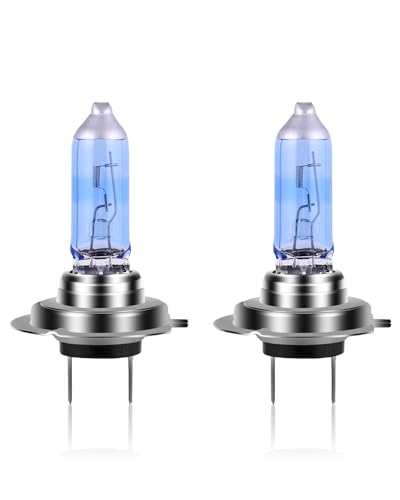
【Super Bright】Our H7 headlight bulbs deliver a brightness of more than 1500LM, up to 5000K color temperature, providing the best visibility in foggy and rainy weather, Our headlight bulb filled with more than 45% Xenon gas to be more brighter and whiter, Blue ion membrane filters yellow light and gets super white light.
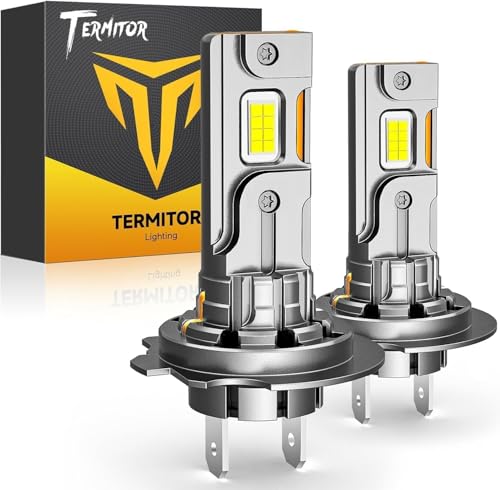
【15X Brighter Than Halogen—Ultimate Night Vision】Experience a revolutionary leap in illumination with our high-density chips, delivering a staggering 90,000LM per set. Engineered to be 15X brighter than stock halogen lamps, these H7 bulbs provide an ultra-long lighting range and crystal-clear road visibility. Say goodbye to dim yellow lights and drive with the confidence of high-efficiency, stable brightness that cuts through the darkest nights.
LED Headlight Bulbs: Modern Efficiency and Longevity
LED headlight bulbs deliver 4,000-10,000 lumens per bulb through solid-state semiconductor technology, surpassing halogen output by 2-6x while consuming just 23-65W compared to halogen’s standard 55-60W draw. This energy efficiency reduces your vehicle’s electrical load considerably. You’ll experience 5,000K-6,500K color temperatures that replicate daylight conditions, enhancing road sign and obstacle recognition during night driving.
Quality LED bulbs feature precision-engineered beam patterns that mimic halogen filament positioning, minimizing glare to oncoming traffic. Operational lifespans extend 6-25 years versus halogen’s 1-2 years, supported by aluminum alloy 6063 heatsinks, copper cooling tubes, and ball-bearing fans maintaining chip temperatures under 150-160°F. Modern LED headlights also offer improved visibility through superior optical design compared to traditional lighting systems. IP68-rated weatherproofing protects against moisture and dust intrusion. CANbus-compatible models with integrated resistors prevent error codes on modern vehicles, ensuring seamless installation across standard sizes like 9005, H11, and H9. Before upgrading, verify legal compliance requirements in your region to ensure your new LED headlights meet local regulations. LED technology provides intense and focused lighting that significantly improves visibility for enhanced modern driving safety.

【800% Breakthrough Brightness】Marsauto 9005 bulb shine 800% brighter than traditional bulbs. M1S 9005 HB3 bulb uses non-traditional chip technology, and its light output is much higher than other chips on the market. At the same time, the number of lamp beads on a single side has been increased from one to two, which solves the problem of low lumen caused by one lamp bead and can also increase the width of illumination, escorting car owners at night.

14X BRIGHTER THAN HALOGEN - AUTOONE 9005 led bulbs feature high-performance LED chips, delivering a crisp 6500K cool white light that is up to 14X brighter than standard halogen bulbs. The superior illumination and enhanced visibility ensure safer and more confident night driving

【Ultimate Brightness】 RCJ 9005 bulbs combo use high-end matrix chips, luminous efficiency increased by 500%. Offers 16000 lumens output and 6000K cool white colour temperature. Providing further and wider visibility for night driving to ensure the front is well lit, improving driver safety
HID (Xenon) Headlight Bulbs: Superior Brightness and Performance
HID xenon bulbs generate 2,800-3,000 lumens in standard 35W configurations and reach 8,000 lumens in high-output 55W systems, delivering 3-6x the luminous intensity of halogen bulbs through electrical arc technology rather than filament combustion. You’ll experience maximum HID brightness advantages in the 4,300K-6,000K color temperature range, which produces daylight-white illumination with beam projection extending 250 meters for enhanced night visibility.
HID installation requirements include compatible ballasts providing 23,000V ignition voltage and 8,000V operating regulation, plus application-specific wiring harnesses. Common bulb types—D1S/D2S/D3S/D4S—vary in integrated versus external ignitor design. Bi-Xenon configurations utilize electromagnetic solenoids for dual-beam switching. You can expect 2,500-hour operational lifespans (3-5 years) from quartz-encased bulbs containing pressurized xenon gas and vaporized metal salts. After successful HID installation, ensure all covers and clips are properly secured to maintain optimal performance. Like premium LED headlight options such as Sylvania LED technology, HID systems offer significantly longer operational life and improved visibility compared to standard halogen alternatives. Higher Kelvin ratings like 8000K+ prioritize aesthetic appearance over functional brightness and produce significantly lower light output than white-spectrum HIDs. Consider regional DOT/SAE certification requirements before installation.

【IMPORTANT】Replacement for factory D2S HID bulb only, NOT fit if your car stock Halogen headlight bulb even system say "fits".
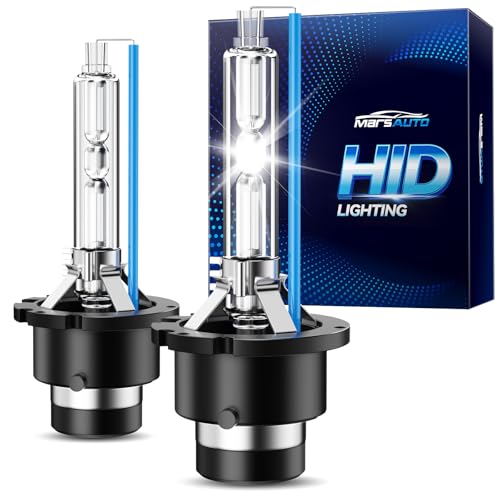
Perfect Beam Quality:D2S Xenon Headlight HID Bulbs ultra-bright light with 99.99% pure xenon gas and APL capsules—no glare, no dark spots. Higher efficiency and pure color for crisp visibility. Fit for RV Light Bulbs.

Vehicle Compatibility: Only compatible with factory installed D2S HID xenon bulbs. NOT fit stock Halogen bulb even system say "fits". Please verify your original bulb size before purchase.
Understanding Bulb Sizes and Fitment Types
Automotive headlight bulbs follow standardized alphanumeric designation systems—H11, 9005, H4/9003, H7—that define precise mechanical fitment, electrical specifications, and mounting configurations rather than mere size classifications. You’ll find that bulb identification techniques require examining base types (PX26d, P43t, bayonet), prong configurations, and part number cross-references; H11 equals H8/H9, while 9005 matches HB3. Vehicle compatibility importance can’t be overstated—your make, model, year, and trim dictate exact fitment requirements. Even subtle differences like H11 versus H11B prong designs prevent interchangeability. You should verify specifications through your owner’s manual or existing OEM bulb markings, as incompatible connectors won’t seat properly regardless of apparent size similarity. Base mismatch causes poor lighting performance, electrical connection failures, and potential assembly damage. Different bulb technologies like halogen, LED, and HID offer varying brightness levels and color temperatures suited to different driving conditions. When considering upgrades, LED conversions offer improved nighttime visibility and longer lifespan compared to traditional halogen alternatives. Modern LED conversion bulbs like the S1 and S2 series are engineered to match these standardized bulb configurations, offering plug-and-play installation for H11, 9005, and H7 applications.

Night & Day Difference - AUXITO H11 LED fog light bulbs adopt 12 pcs highly bright CSP LED chips each bulb, providing total 120W, 60000LM light output per set. 1200% brighter than stock bulbs. 6500K cool white. Let you see everything at night. A huge upgrade for halogen bulbs.

Marsauto H11 Fog Light Bulbs

【500% Brighter – 30000LM 6000K Cool White】Upgrade your H11/H8/H9/H16 LED bulbs. 30,000LM per pair, 500% brighter than halogen. Fanless passive cooling (Copper Base + Aluminum Housing) delivers 0 dB quiet operation and no moving parts to break.
Laser Headlight Technology: The Future of Automotive Lighting
While conventional LED and HID systems have dominated automotive lighting evolution, laser headlight technology represents a fundamental shift in light generation methodology—employing focused laser diodes to excite phosphor substrates rather than direct semiconductor or gas discharge illumination. You’ll find laser technology delivers 170 lumens per watt versus LED’s 100, projecting effective illumination beyond 600 meters while consuming 15–20% less energy. The BMW i8 and Audi R8 LMX pioneered production implementation, integrating adaptive lighting systems that modulate beam patterns based on traffic conditions. Compact laser diodes enable flexible headlamp packaging and secondary infrared functionality for LiDAR integration. The parallel beam characteristic makes laser headlamps 1000 times more intense than their LED counterparts while maintaining controlled output patterns. Despite their advantages, laser headlights still require consideration of lifespan and replacement costs, similar to how LED technology has evolved as a more efficient alternative to traditional halogen bulbs. However, you’re still facing evolving regulatory frameworks—NHTSA recently permitted adaptive configurations, though manufacturers must incorporate phosphor diffusers and beam-shaping safeguards to prevent retinal hazards from direct laser exposure.

Instructions for Use: The first yellow drill attachment installed on the drill, cushion pad white surface and drill attachment black surface paste, use the first in the lamps on the spray water and then use the cleaning pad to dry in a circle, and then according to the grain size from small to large in order to use the waterproof abrasive disc on the lamps for polishing, and finally use the sponge polishing pad for polishing

【Super Brightness】: The HID xenon bulb uses high-pressure ionised xenon gas discharge to produce a strong light, which is much brighter than traditional halogen bulbs, and is able to provide longer, wider and more even road illumination, which significantly improves driving visibility at night and under low-light conditions, and enhances driving safety.
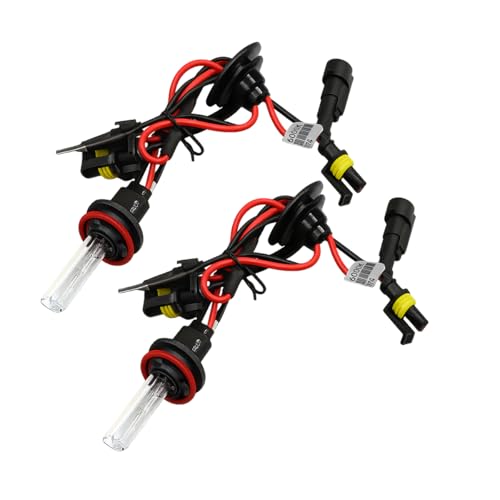
High Quality Material: This automobile bulb is made of high-quality quartz tube material, which has excellent high-temperature resistance and can maintain a stable structure during long periods of illumination. At the same time, the quartz tube has strong impact resistance and can withstand minor vibrations, providing reliable protection for the long-term use of the lamp bulb.


