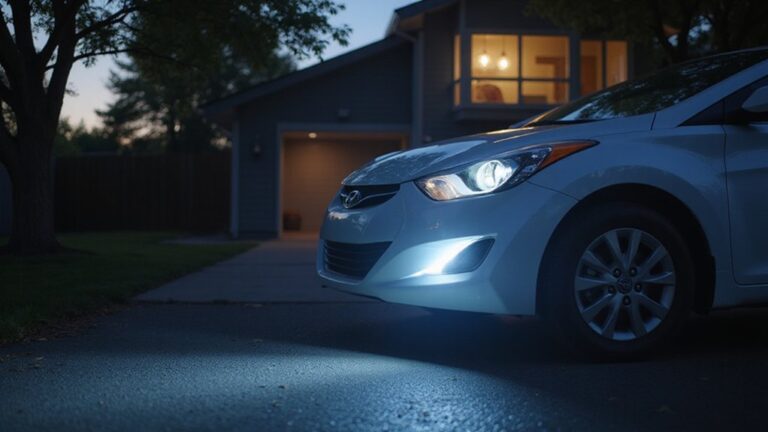
Projector headlights are precision optical systems that use four core components—a light source (halogen, HID, or LED), an elliptical reflector, a cutoff shield, and a convex lens—to deliver controlled, focused beams. They provide 40-60% better forward illumination than traditional reflector designs while eliminating glare through sharp horizontal cutoff lines. You’ll find them consuming 15-65W depending on technology, with LED variants lasting 15,000-30,000+ hours. The market’s projected to grow by USD 3,723.2 million through 2028 as adaptive systems become standard. Understanding their installation requirements and performance metrics will help you optimize visibility.
How Projector Headlights Work: Design and Core Components
Projector headlights function through a coordinated assembly of four primary components: a light source, an elliptical reflector, a cutoff shield, and a convex projection lens. The projector design begins with your light source—halogen, HID, xenon, LED, or laser diode—generating initial illumination. Your elliptical reflector, coated with aluminum or silver, collects this light and redirects it toward a focal point. Between the reflector and lens, a metallic cutoff shield blocks upper light rays, creating the characteristic horizontal beam pattern that prevents glare to oncoming drivers. Finally, your convex lens—crafted from polycarbonate or glass—magnifies and collimates the shaped light into a tight, controlled beam. The cutoff shield shapes light for proper road focus, ensuring the beam illuminates the roadway effectively without creating bright spots or dim areas. Over time, polycarbonate lenses can become foggy or yellowed, which diminishes the effectiveness of the projector design and reduces nighttime visibility. These core components work in precise coordination, with bi-xenon systems adding a solenoid-actuated movable shield for seamless low-to-high beam shifts.
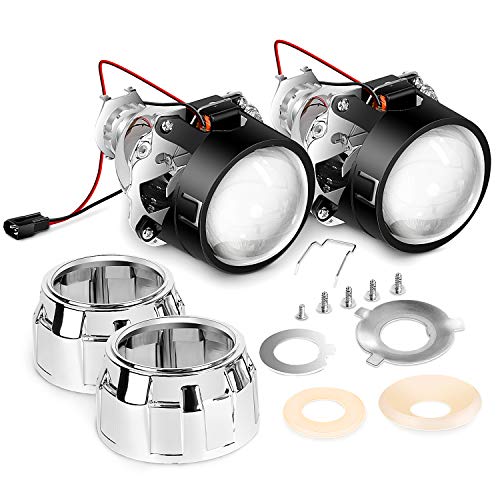
H1 mini projector kits (low/high beams), fit in tight spaces for quad retrofits or fog lamp upgrade

【Unique Angel Eyes Shrouds】3.0 Inch angel eyes switchback Shrouds comes with turn signal feature,unique appearance makes your car look more attractive.
Optical Performance and Beam Pattern Characteristics
While total light output matters, your projector headlight’s optical performance hinges on beam pattern precision and light distribution geometry. Superior projectors deliver razor-sharp horizontal cutoff lines that concentrate light exactly where you need it—preventing upward scatter that creates glare for oncoming drivers. This optical clarity translates to measurable advantages: lux values at distance indicate true visibility performance, unlike inflated lumen claims. You’ll notice wide, even beam consistency extending edge-to-edge across your field of view, eliminating the tunnel vision effect of inferior designs. The hotspot—your beam’s brightest central zone—should appear well-defined and properly positioned. Projector headlights using HID or LED bulbs can achieve significantly higher brightness and superior beam control compared to traditional halogen reflector systems. To maintain optimal performance, proper heat management is essential when using advanced bulb technologies in projector assemblies. Color temperature between 5500K–6500K provides daylight-matching white light for best contrast and obstacle detection. Understanding the full optical system ensures you select projectors engineered for safe and effective beam output rather than cosmetic appeal alone. Together, these characteristics determine whether your projectors genuinely outperform reflector systems.
Halogen, HID, and LED: Light Source Options for Projector Systems
Your projector housing’s optical precision means nothing without the right light source powering it. Halogen bulbs draw 55–65 W with poor halogen efficiency (2700–3500 K, 450–1,000 hours), making them the budget baseline. HID systems use 35–55 W xenon arcs through ballasts, offering 4300–6000 K color temperature and 2,000–3,000+ hour lifespans—but 55 W kits increase HID glare risk if emitter placement misaligns with your projector’s focal point. LED modules consume 15–50 W with superior LED longevity (15,000–30,000+ hours at 5000–6500 K), yet demand active thermal management to prevent lumen degradation. Real-world testing demonstrates that HID provides focused light beams with greater projection distance compared to LED configurations, which tend to produce scattered output patterns. LED headlights also require DOT compliance verification to ensure they meet regulatory standards for safe road use. Popular aftermarket brands like Sylvania, Philips, and HIKARI offer replacement bulb options engineered to optimize performance within projector housings across various vehicle models. Conversion success hinges on emitter geometry: mismatched arc or diode positioning scatters light beyond the cutoff shield, negating your projector’s beam control and blinding oncoming traffic.
Advantages Over Traditional Reflector Headlights
Against conventional reflector designs, projector headlights deliver measurably sharper beam focus through their lens-and-shutter architecture. You’ll gain improved long-range illumination because the defined cutoff concentrates lumen output on the roadway rather than scattering it. This glare reduction benefits oncoming drivers—the sharp upper boundary limits upward light spill and dazzle compared with reflector scatter patterns.
You’ll also notice more uniform spatial distribution across the beam, with fewer hot and cold spots. The controlled geometry improves peripheral visibility for detecting pedestrians and road-edge hazards. Repeatability is another advantage: projector optics maintain consistent beam shape across units and bulb changes, reducing aiming variability.
Finally, projectors accommodate advanced technologies—HID, LED modules, adaptive leveling, and steering beams—more readily than many reflector assemblies, supporting integration of dynamic lighting functions. The larger and intricate construction of projector systems enables this compatibility with modern lighting innovations.

FIX DIM HEADLIGHTS & IMPROVE LIGHT OUTPUT: Upgrade your old factory headlight wiring with this H4 LED headlight relay harness kit. Fix common issues including dim headlights,...
Limitations, Retrofit Considerations, and Common Pitfalls
Despite these performance gains, projector headlights introduce several constraints that affect ownership economics and installation complexity. You’ll face 40-60% higher manufacturing costs compared to reflector systems, driven by precision-engineered lenses and multi-component housings. Limitation impacts extend to beam geometry—narrow forward projection sacrifices peripheral illumination by 25-30 degrees, reducing roadside visibility.
Retrofit challenges demand technical proficiency: you must install ballasts for HID compatibility, achieve ±0.5-degree alignment precision, and integrate cutoff shields to prevent glare. LED bulbs designed for reflectors create thermal management problems in projector enclosures, potentially reducing lifespan by 50%. Common pitfalls include misalignment causing scattered light patterns, incompatible bulb selection yielding lower output than baseline halogens, and inadequate ventilation triggering premature component failure. For those comfortable with DIY work, understanding bulb replacement procedures can help identify when professional retrofit installation becomes necessary. Projector headlights deliver enhanced driver visibility in adverse weather conditions where concentrated beam patterns penetrate rain and fog more effectively. LEDs in projector systems can reduce power consumption by 50-80% compared to traditional halogen alternatives while providing a whiter, more focused beam. Specialized maintenance requirements increase service intervals and labor costs greatly.
Applications, Market Trends, and Regulatory Compliance
Across diverse vehicle segments, projector headlights now serve distinct functional requirements that drive adoption patterns. Commercial vehicles leverage projector advantages for highway illumination, while luxury cars deploy Bi-LED systems for enhanced safety. Electric vehicles integrate micro-LED matrix technology like EVIYOS™ HD25 for adaptive beam shaping. Market dynamics reveal USD 3,723.2 million growth potential from 2024-2028 at 4% CAGR, with Asia-Pacific leading adoption. You’ll find LED projectors shifting from premium to mid-range segments—Toyota’s Corolla has featured LED projectors since 2014, moving 1 million units monthly. Regulatory compliance mandates sharp cutoff beams to minimize glare, while DLP systems utilize over 1 million addressable pixels for precise light distribution. Europe’s entry-level segments evolved to low-cost LED solutions by 2022-2023, standardizing energy-efficient configurations. The cutoff shield in projector assemblies controls vertical light distribution to prevent glare for oncoming drivers. Modern LED headlight upgrades offer improved visibility for drivers seeking better nighttime driving performance without requiring complete projector system replacement. Proper installation of these advanced headlight systems requires careful handling during removal of the headlight assembly to avoid damage to sensitive electrical components.