H6054 headlights fit numerous vehicles from 1978-2001, including Jeep Cherokee XJ (1984-2001), Wrangler YJ (1987-1995), and Comanche pickup (1986-1992). You’ll find them in Chevrolet El Camino (1978-1981), Buick Century (1978-1981), and Pontiac Phoenix (1977-1984). Mercedes-Benz models like the 190D, 190E (1984-1986), 300SD (1981-1985), and 380SE (1984-1985) also use this 5×7-inch rectangular sealed beam specification. The article below breaks down specific compatibility details, installation requirements, and upgrade options for your particular vehicle.
Understanding H6054 Headlight Specifications
The H6054 headlight conforms to a standardized rectangular sealed beam format measuring 142mm x 200mm (approximately 5-1/2 inches x 8 inches), establishing its physical compatibility parameters for vehicle applications. You’ll find this unit operates at 12.8V with dual-filament configuration delivering 65W high beam and 35W low beam output. The three-lug contact base provides electrical connection while maintaining DOT and SAE compliance standards. The headlight utilizes borosilicate glass construction for enhanced durability and thermal resistance.
Your replacement options include traditional halogen sealed beams with 150-320 hour lifespan or modern LED conversions offering 15,000-hour longevity. LED variants deliver 6000K cool-white illumination with IP67 waterproof rating, while maintaining plug-and-play compatibility. The headlight features integrated high/low beam functionality in one assembly, with H6052 cross-compatibility for broader application coverage across multiple vehicle platforms.
Jeep Models That Use H6054 Headlights
Several Jeep models from the 1980s through early 2000s feature factory 5×7-inch sealed-beam housings that accept H6054 headlights as direct replacements. The Cherokee XJ (1984–2001) and Wrangler YJ (1987–1995) represent the most common applications for Jeep compatibility, using native 5×7 sealed-beam configurations. The Comanche pickup (1986–1992) also employed 5×7 housings when equipped with sealed beams. Older Wagoneer and Cherokee SJ variants from the late 1970s to early 1980s occasionally appear in fitment charts when specified with 7×6 lamps.
You’ll need to verify housing dimensions and connector types before purchasing headlight upgrades. Wrangler TJ models typically require aftermarket adapters rather than direct installation. Confirm wiring harness compatibility—some applications need H4-to-sealed-beam adapters for proper electrical connection. When evaluating replacement options, consider the brightness levels and color temperature of modern LED alternatives to ensure optimal visibility and safety. Modern LED replacement headlights often feature H4 Plug and Play adapters that simplify installation without requiring extensive rewiring. Over time, headlight clarity can diminish, so consider applying UV headlight sealant after installation to maintain long-term visibility and prevent future yellowing or hazing.

The Best Value Upgrade Headlights: Super bright ,9500lm/6500lm high/low beam;Best beam pattern on the market: Uniform Light, no blind areas and dim spots;Very Sturdy:5.05 lb/pair; Modern Look,Plug&Play,IP67 wateproof

BRONCO STYLE LOOK - Your classic car with rectangle 2b1 headlights deserves better than those old 7x6 inch OEM halogen bulb headlamps. Give it a mean new attitude with a new pair of bright 5x7 headlight bulbs with DRL running light and turn signals that'll ensure your ride shines as bright as the sun.
![True Mods H6054 H4 LED Headlight Wiring Harness [Negative Switched Conversion] [Fused] Universal H4 Head Light Relay Harness Kit for 9003 H6024 5x7 7x6 4x6 Subaru Toyota Jeep Sealed Beam Headlamp](https://m.media-amazon.com/images/I/51+wV9S2Q4L._SL500_.jpg)
YOUR VEHICLE NEEDS THIS - Swapping out old headlights for LED conversions on negative switched vehicles like Toyota, Subaru, Mitsubishi, or Suzuki, is not a simple job. But with our plug-and-play universal dual H4 headlight relay harness kit for high/low beam it can be! The compatible sockets include: 7x6 5x7 H6024 (2D1 H6054 H5054 H6054LL 6014 6052 6053)|H6024 (2D1)|4x6 6x4 (H4651, H4652, H4656, H4666, H6545)|H5006 (2C1) sealed beam headlights and more!
American Car Brands Compatible With H6054
American automakers extensively adopted H6054 sealed-beam technology across their model lineups during the late 1970s through mid-1990s, with General Motors brands dominating compatibility applications. Chevrolet models from 1978-1995, including the El Camino (1978-1981), utilized standard 5×7 inch rectangular H6054 bulb features for direct replacement. Buick’s Century (1978-1981) and Regal (1978-1980) incorporated identical sealed-beam specifications. Pontiac Phoenix models spanning 1977-1984 employed H6054 multi-purpose headlights across all production years. American Motors equipped their 1978 Concord with compatible housings. You’ll find cross-reference numbers H6054ST, H6054XV, H6052, and 6053 interchange seamlessly with OE H6054 designations. Equivalent part numbers include PLC H6054C1, PLC6052C1, GE H6054, and PLC H5054, ensuring broad aftermarket availability across diverse car model variations within these American manufacturers. When upgrading these older sealed-beam systems, consider LED conversion options that provide improved brightness and longevity compared to original equipment. Modern LED conversion options like the HKP™ 57 H6054 offer plug-and-play installation for vehicles originally equipped with sealed beam housings.

【Package Include】This item include pair 7x6 inch H6054 Glass Square Headlight Housing(with 2 wire harnesses) and pair inside H4/9003 led bulbs. Please confirm your original housing model before purchasing.

Direct fit 5x7 Sealed Beam Conversion Kit.

Please Pay Attention: Housing has removable bulb sockets for you to install the new led bulbs,for most of vehicles, these headlights are plug and play,just a little of models need to mark and file a tab slot into your headlight bucket or grind off the tab. If you have any issues regarding product,please contact us to get help and solutions
Mercedes-Benz Vehicles Requiring H6054 Headlights
While domestic manufacturers favored H6054 sealed-beam technology throughout their lineups, German engineering brought this standardized format to select Mercedes-Benz models during the 1980s. Your 190D and 190E (1984-1986) require H6054 headlights for both high and low beam functions, operating at 12.8V with dual filament configuration. The primary filament draws 5.08A at 65W (40,000 candlepower), while the secondary consumes 2.73A at 35W (35,000 candlepower). Mercedes-Benz models like the 300SD (1981-1985), 380SE (1984-1985), and 210 (1981-1982) also specify H6054 compatibility. These sealed beams feature a 3-lug contact base, 5×7-inch rectangular housing, and 35×7-degree beam spread. You’ll find cross-references including H6054ST and H6054XV for upgrades, with LED replacements offering plug-and-play installation. Proper installation techniques ensure optimal performance and help avoid common issues like glare or premature bulb failure. When considering replacements, evaluate the color temperature and beam pattern quality to ensure optimal nighttime visibility and safety. Modern LED upgrades deliver superior 6000K white light for enhanced style and durability compared to traditional halogen sealed beams.

✔ Legal and safe on the road.Easy to install,just plug and play. KASLIGHT 5x7 7x6inch LED headlights yj headlights are designed to upgrade any sealed beam truck headlight to LED lights; provide more light,a whiter light,and ensure you do not have to deal with burn out headlights, ensuring driver's safety; bright 5inch x 7inch 6054 led head light provide you with both low and high beam technology with no modifications required.

Material & Build Quality: High-quality aluminum alloy housing with durable UV-resistant polycarbonate lens. Built for long-term reliability with strong impact resistance and stable performance across various driving conditions.

√ Package Includes: 2 pcs 5x7 LED headlights (also compatible with 7x6 headlight size); 2 pcs H4 adapters. Provides super white high and low beam illumination. Relay is not included and is available separately.
LED Vs Halogen H6054 Options
Choosing between LED and halogen H6054 headlights fundamentally impacts your vehicle’s performance across five critical metrics: luminous output, power consumption, operational lifespan, beam characteristics, and installation requirements.
For brightness comparison, LED H6054 options deliver 2-3 times more light output than halogen’s 700-1,200 lumens per bulb. SYLVANIA H6054 LED produces 6000K cool-white light, enhancing road sign visibility and lane marking contrast.
Regarding energy efficiency, LED H6054 consumes 75% less power than halogen variants, which convert most energy to heat. This reduction markedly decreases electrical system strain and preserves battery range in electric vehicles.
LED H6054 bulbs last 5,000-6,500 hours versus halogen’s 500-1,000 hours. However, you’ll need proper alignment to prevent glare for oncoming traffic and guarantee DOT/SAE compliance with direct plug-and-play installation. For LED upgrades, ensuring correct alignment of parts during installation is critical to maintaining safe beam patterns. Moisture intrusion can degrade headlight performance, so inspect your headlight housing for condensation or cracks that may require professional attention.
High wattage halogen options like 80/100 halogen bulbs deliver substantial brightness improvements over standard bulbs, though they draw considerably more amps than LED alternatives.
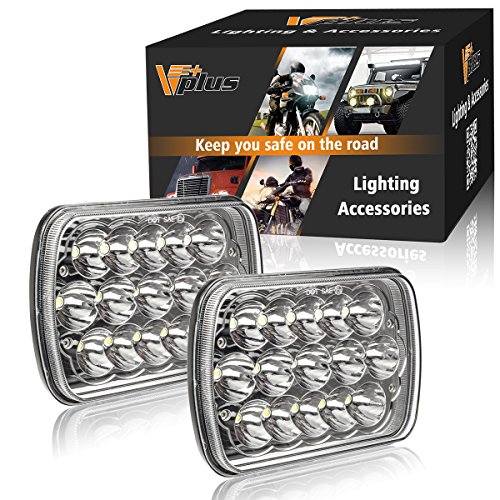
Partsam LED headlights for vehicles with 7x6 sealed beam type headlights (also known as 5x7). Update the look of your vehicle while improving your visibility with little to no modification; Helps to reduce traffic accidents cause by bad weather or adverse road condition. Ensuring driver's safety (High beam 5600 lumens, Low beam 2500 lumens). Low beam and High beam in the same light; Aluminum Shell Body and Heatsink; Easy Installation-Plug and Play.

HIGH-POWER BULB: Includes an integrated 6.96/19.2-watt, 12-volt 6000K LED light, offering consistent lumen output with less energy consumption

NOTICE THE DIFFERENCE - Boasting a whopping 3,375 lumens of 6,000k pure white light, our 7x6 / 5x7 LED headlight redefine the meaning of nighttime cruising. With staggering high beam and low beam in LED, these universal-fit H6054 LED headlights for truck and van fire up the road with clarity keeping you and your loved ones safe. Get the H6054 2B1 sealed beam headlight bulbs that'll have you saying "that's a night and day difference".
How to Verify H6054 Compatibility for Your Vehicle
Before purchasing H6054 headlights, you must verify compatibility through your vehicle’s documentation and physical specifications. Consult your owner’s manual for headlight types listings or cross-reference the OE part number against H6054 standards. Measure your existing housing—it should be 5×7 or 7×6 inches rectangular. Examine the wiring harness connector to confirm direct plug-in compatibility without adapters, though H4/9003/HB2 adapters work for most applications.
For installation tips, disconnect your battery before removal. Test-fit the new sealed beam unit in the mounting bucket, verifying the four-screw retention pattern aligns correctly. Check clearance if upgrading to LED variants, as they’re thicker than halogen versions. After installation, verify correct orientation by matching any dot indicators on the light to ensure proper alignment. Activate low and high beams to assess beam pattern cutoff and brightness symmetry before final installation.

H4 Relay Wiring Harness Kit 1SET for 5x7 7x6 H6054 Headlights Heat Ceramic Wiring Harness H4 9003 Relay Harness Compatible with to-yota 95-97 Tacoma Pickup Fix Dual Ground Problem

FIX DIM HEADLIGHTS & IMPROVE LIGHT OUTPUT: Upgrade your old factory headlight wiring with this H4 LED headlight relay harness kit. Fix common issues including dim headlights, flickering headlights, voltage drop, weak high beam/low beam performance and insufficient power supply. This fused relay wiring harness delivers stable battery power directly to your H6054 LED headlights, improving brightness and reliability during night driving.

【Package Include】This item include pair 7x6 inch H6054 H6054 H5054 H6054LL 69822 6052 6053 Glass Square Headlight Housing(with 2 wire harnesses) and pair inside H4/9003 led bulbs. Please confirm your original housing model before purchasing.