You can physically install LED bulbs in halogen headlight housings since they’re designed with compatible bases like H11 or 9005, but this conversion violates Federal Motor Vehicle Safety Standard (FMVSS) 108. The modification creates dangerous beam distortion because LED diodes don’t align with halogen filament positions, producing glare that blinds oncoming drivers. While LED bulbs offer superior efficiency and longevity, improper retrofitting compromises safety and legality. Understanding proper installation techniques, cooling requirements, and legal compliance will help you make an informed decision about this modification.
Understanding LED and Halogen Bulb Compatibility
When considering LED bulbs for halogen headlight assemblies, you’ll find that physical compatibility exists across most standard base types. LED bulb types including H11, 9005, and HID conversions feature plug-and-play designs that match halogen reference numbers directly. Halogen compatibility extends to common household bases like GU10, GU5.3, E26, and E27, requiring no wiring modifications for installation.
However, you must verify voltage and base matching before installation to guarantee safe operation. Some vehicles, particularly Dodge and Jeep models, may trigger Canbus errors requiring resistor decoders. Your existing transformers need verification to support lower LED wattage and prevent flickering. While physical interchange works seamlessly, electrical compatibility demands attention to vehicle-specific requirements. Most halogen housings accept LED replacements without modifications, though you’ll need conversion kits with appropriate LED drivers for ideal vehicle integration. LED conversion kits include heat management components that ensure longevity and optimal performance of the bulbs. It’s important to note that many aftermarket LED bulbs are not DOT-approved and thus illegal for street use, particularly when retrofitting halogen housings, as they can create excessive glare and safety hazards. When upgrading your headlights, consider how color temperature and beam pattern affect visibility and safety in different driving conditions.
How to Identify Your Current Headlight Bulb Size
Before replacing your headlights with LED bulbs, you’ll need to identify the exact bulb size your vehicle requires. The most reliable bulb size identification method involves physically removing your existing bulb to check the part number stamped directly on it. Alternatively, consult your vehicle service manuals for manufacturer-specified bulb listings. Online bulb finders allow you to enter your year, make, and model for accurate results.
Common sizes include H11 (equivalent to H8/H9), 9005 (HB3), and H7. You’ll encounter variations like H11B with protruding prongs used in Hyundai and Kia applications. Using incorrect sizes risks wiring damage and poor light focus. Automotive bulb cross-reference guides help identify equivalent sizes, but always verify compatibility with vehicle-specific charts before purchasing LED replacements. Trusted manufacturers like Sylvania, Philips, and GE offer reliable LED options that maintain proper beam pattern alignment. Checking that your replacement bulbs meet DOT regulations for legal road use ensures your vehicle remains compliant with local automotive lighting standards. Pay close attention to the locking tabs and plug type when comparing bulbs, as these are key aspects that determine whether different part numbers are truly equivalent.
Step-by-Step LED Conversion Installation Guide
Access the headlight assembly by removing rubber dust caps and disconnecting the wiring harness from halogen bulbs. Twist retaining clips counterclockwise to extract old bulbs. When installing LED replacements, handle only the base—never touch LED surfaces. Align tabs precisely with housing slots, ensuring diodes position perpendicular to mounting brackets for proper beam pattern.
Critical installation tips: position wiring at manufacturer-specified angles (typically 1:00 left, 7:00 right), connect ballast harnesses securely, and verify beam cut-off alignment before finalizing installation. LED conversion kits offer improved visibility and energy efficiency compared to traditional halogen bulbs, making proper installation crucial for optimal performance. After completing the installation, conduct a test drive to evaluate the performance and road illumination provided by your new LED headlights.
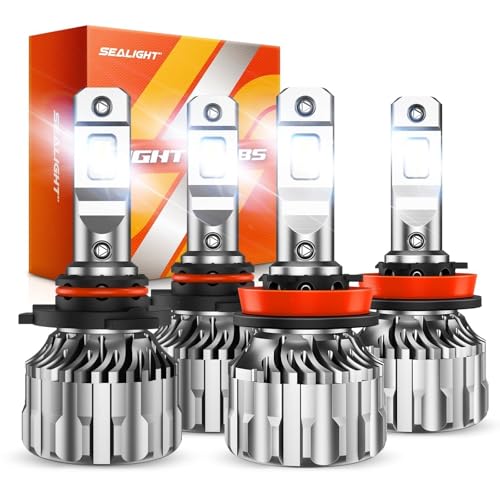
Better Driving Experience- The h11 9005 bulbs provide super bright illumination, offering a safer and more enjoyable driving experience

10X Great Brightness: SEALIGHT 9012 LED bulbs are equipped with superior chips. Provides excellent 360° illumination and 1000% output with no dark spots or shadow light
Performance Advantages of Upgrading to LED Headlights
LED headlight upgrades deliver measurably superior illumination compared to halogen systems, with typical aftermarket and OEM LED assemblies producing beam patterns that extend road visibility to approximately 300 meters versus halogen’s 100-meter range in standardized comparison tests. This brightness performance stems from LEDs converting 80–90% of electrical input into light, dramatically outpacing halogen’s 10% efficiency rating. You’ll benefit from energy efficiency through reduced wattage draw—15–25 W per LED unit versus 55–65 W for halogen—lowering alternator demand and improving fuel economy. The lifespan advantage is equally significant: quality automotive LEDs typically last 30,000–50,000 hours compared to halogen’s 500–1,000 hours, cutting replacement frequency and maintenance costs. Their daylight-spectrum output (4,000–6,000 K) enhances visibility contrast, improving road marking detection and hazard recognition during night driving. LEDs achieve instant brightness without requiring warm-up time, providing full illumination immediately upon activation.
![True Mods H6054 H4 LED Headlight Wiring Harness [Negative Switched Conversion] [Fused] Universal H4 Head Light Relay Harness Kit for 9003 H6024 5x7 7x6 4x6 Subaru Toyota Jeep Sealed Beam Headlamp](https://m.media-amazon.com/images/I/51+wV9S2Q4L._SL500_.jpg)
YOUR VEHICLE NEEDS THIS - Swapping out old headlights for LED conversions on negative switched vehicles like Toyota, Subaru, Mitsubishi, or Suzuki, is not a simple job. But with our plug-and-play universal dual H4 headlight relay harness kit for high/low beam it can be! The compatible sockets include: 7x6 5x7 H6024 (2D1 H6054 H5054 H6054LL 6014 6052 6053)|H6024 (2D1)|4x6 6x4 (H4651, H4652, H4656, H4666, H6545)|H5006 (2C1) sealed beam headlights and more!

Great Brightness - 70000 Lumens

【Perfect Beam Focus】Termitor Upgraded H11/H9/H8 9005/HB3 Light Bulbs Combo or Electronic Flashers feature an ultra-thin 0.03-inch chip pitch, significantly enhancing beam focusing performance. They project a concentrated, precise beam that forms a super-focused light pattern with no dark zones or shadows, effectively eliminating glare for oncoming vehicles. This ensures a wider and longer nighttime field of vision, enhancing driving safety.
Common Problems When Converting to LED Bulbs
Despite these performance benefits, retrofitting LED bulbs into halogen headlight housings creates significant technical and safety problems that undermine the upgrade’s intended advantages.
Beam distortion occurs because LED diodes can’t replicate the centered halogen filament position. This directional light fails to illuminate reflector surfaces uniformly, particularly the upper rear portion designed for distance projection. The result is severely compromised beam patterns with poor cutoff control.
Glare issues emerge when LEDs scatter light above the horizon, blinding oncoming drivers. Without proper projector optics, you’ll lose horizon beam control entirely. The increased intensity in the foreground may improve your immediate visibility while simultaneously reducing distance illumination compared to halogen bulbs. LEDs produce a whiter beam that can be more disorienting to other motorists than the yellowish halogen light. The whiter color temperature of LEDs, around 6,500K compared to halogen’s 3,400K, may contribute to increased driver discomfort.
Overheating problems develop since halogen housings lack adequate ventilation for LED heat dissipation. Removing dust boots causes condensation and moisture damage.
You’ll also encounter inconsistent output—flickering, fading, and power failures—creating dangerous safety hazards that violate DOT compliance standards.

Halogen to LED headlight adapter conversion harness, left and right, driver side and passenger side

【Package Include】This item include pair H4/9003 high low dual beam LED headlight bulbs and pair 7 inch H6024 Glass Round Headlight Housing.Please confirm your original housing model before purchasing.

Solving Canbus Error Codes and Flickering Issues
When you install LED bulbs in halogen housings, your vehicle’s Controller Area Network (Canbus) system frequently interprets the reduced power draw—typically 20-30W versus the expected 55W from halogens—as a bulb failure. This triggers dashboard warning lights in 10-20% of conversions, particularly in post-2010 Dodge, Jeep, and Chrysler models with sensitive ECUs.
Diagnosing flicker requires checking voltage stability and driver compatibility. Pulse-width modulation and incompatible transformers cause intermittent cycling, worsening during cold starts. LED bulbs offer superior illumination quality and longer lifespan compared to traditional halogen technology, making proper installation crucial for maximizing these advantages of LED technology. For 2008 Honda CR-V owners considering upgrades, LED options provide measurable improvements in brightness levels measured in lumens compared to factory specifications.
To resolve Canbus errors, select bulbs with integrated drivers that mimic halogen resistance profiles. Plug-and-play resistor decoders eliminate 90% of error codes by adding appropriate load resistance. Install inline resistors between the bulb harness and LED, matching your specific bulb type (H11, 9005). Dual-resistor kits address both low and high beams simultaneously, preventing voltage fluctuations. AUXITO offers CanBus-compatible bulbs designed to minimize flickering through seamless integration into vehicle electrical systems.

【⚡ TRUE 90,000LM BRIGHT OUTPUT】Termitor 9005/HB3 light bulbs are built with high-power chips and 120W per pair output, delivering a clear 6500K cool white lighting effect with stronger brightness and sharper detail. Compared with ordinary straight-insert bulbs, this upgraded 9005 HB3 bulb design provides more stable, realistic and powerful illumination without weak or scattered output.

【900% Brighter - S1 Pro Bulbs】The SEALIGHT 9005 H11 bulbs combo feature 16pcs high-performance chips, delivering up to 8 times the brightness than stock bulbs. Upgrade your nighttime driving experience by replacing dim, narrow stock bulbs with SEALIGHT 9005/HB3 H11/H9/H8/H16 LED Bulbs Combo. Enjoy crystal-clear 6500K cool white light that cuts through the dark, giving you way better visibility for safer night drives

1000% Breakthrough Brightness: The brightness of SEALIGHT H7 bulbs S3 series is 10X than traditional bulbs. We use high-power 7035 lamp beads, and the number of lamp beads in one reaches 16
Heat Management and Cooling Systems in LED Bulbs
Unlike traditional halogen bulbs that dissipate most energy as radiant heat, LED headlight bulbs concentrate thermal output at the junction between the semiconductor chip and its mounting board, creating temperatures that routinely exceed 85°C during operation. You’ll find two primary cooling approaches: active systems incorporating 12,000 RPM fans for superior airflow, and passive designs using aviation aluminum heat sinks with high fin density. Fan efficiency varies with dust accumulation and mechanical reliability, while passive copper braid strips conduct heat faster than aluminum alternatives. Every 10°C above ideal temperature reduces your LED’s lifespan by 50°. Advanced thermal management includes vacuum liquid-cooled copper tubes and phase-change material pockets absorbing 180 kJ/kg. Proper installation within sealed assemblies protects cooling systems from debris while maintaining junction temperatures below the critical 120°C threshold. External drivers positioned away from the bulb housing remove additional heat from the LED chip area, improving overall thermal performance. Before upgrading to LED bulbs, ensure the ignition is off to prevent electrical issues during installation. When upgrading from stock options, comparing LED and HID conversion kits can help you understand the different thermal demands of each lighting technology.
Beam Pattern and Light Distribution Considerations
The beam pattern quality of your LED conversion depends fundamentally on how precisely the light source replicates the original halogen filament’s position within the reflector assembly. Misaligned focal points cause light scattering and dangerous glare for oncoming traffic. You’ll need LEDs with concentrated width between 1-4mm—matching halogen’s tight wound coil—to maintain proper beam positioning. CSP chips (Y19, Y22, 1860, 5530, 7035) outperform COB chips notably in pattern replication. Adjustable collars positioned at 3 and 9 o’clock enable focal point optimization, while fixed collars typically scatter light uncontrollably. Post-installation, measure your cutoff height and aim headlights downward-right to replicate factory specifications. Quality LEDs maintain sharp cutoffs without sacrificing near-to-far light distribution, prioritizing road safety over maximum brightness. Unlike projector housings with superior beam control, reflector assemblies struggle to contain the focused light from LED conversions. Bi-LED technology combining both high and low beam functions in a single bulb can further enhance beam control and visibility consistency. Beyond the bulb itself, your vehicle’s housing design significantly impacts how LED light reflects and directs onto the road, with projector-style housings generally providing superior glare control compared to reflector assemblies.
Legal Requirements for Headlight Modifications
Before installing LED bulbs in your halogen headlights, you must understand that federal motor vehicle safety standards explicitly prohibit this modification. FMVSS 108 requires DOT markings on complete headlight assemblies—not individual bulbs—making replaceable LED bulbs in halogen housings non-compliant for legal compliance.
State regulations vary greatly. California prohibits LED retrofits in halogen housings entirely, while New York bans modifications altering original performance. Pennsylvania and Illinois enforce DOT compliance during inspections. You’ll face penalties for missing DOT stamps, excessive brightness exceeding 3,000-4,000 lumens, or blue/purple tints.
Only factory-installed or DOT-approved complete LED assemblies meet legal compliance nationwide. Check your state’s vehicle codes before modifications. While NHTSA doesn’t regulate individual modifications, non-compliant retrofits cause inspection failures, fines, and dazzling other drivers—creating serious safety and legal risks. To ensure your headlights remain in optimal condition, consider using headlight restoration sprays to maintain clarity and visibility on compliant assemblies. Legal LED headlights must also comply with regulated brightness and color temperature ranges to ensure proper illumination without creating hazards. Installing LED bulbs in halogen reflector housings creates glare and beam scatter that endangers other motorists.
Choosing the Right LED Conversion Kit for Your Vehicle
Understanding legal compliance sets the foundation, but selecting an LED conversion kit that works properly in your halogen housing requires careful attention to compatibility specifications. Start by identifying your vehicle’s specific LED bulb types using your owner’s manual or manufacturer application lists—common designations include H4, H7, H11, and 9005. Verify vehicle compatibility through these manufacturer-provided databases to assure plug-and-play installation without modifications.
Choose LEDs engineered specifically for halogen reflector housings, featuring precision filament geometry that prevents glare and scattered light. Modern LED systems can integrate adaptive beam technology that dynamically adjusts light distribution based on driving conditions. Premium kits include integrated CANbus compatibility, built-in cooling systems, and error cancellers. Standard kits provide two bulbs with necessary ballasts and wiring harnesses. Look for specifications showing 6000K color temperature, 3,200+ lumens output, and thermal foldback drivers. Confirm DRL compatibility if applicable—your LEDs should dim to 50% brightness at 6V like factory halogens. Quality LED bulbs deliver up to 700% brighter illumination while maintaining a lifespan exceeding 50,000 hours. The energy efficiency advantages of LED technology include reduced power consumption compared to traditional halogen bulbs, which benefits your vehicle’s electrical system and fuel economy.

Provides more luminous low and high beam

FIX DIM HEADLIGHTS & IMPROVE LIGHT OUTPUT: Upgrade your old factory headlight wiring with this H4 LED headlight relay harness kit. Fix common issues including dim headlights, flickering headlights, voltage drop, weak high beam/low beam performance and insufficient power supply. This fused relay wiring harness delivers stable battery power directly to your H6054 LED headlights, improving brightness and reliability during night driving.

Compatible with JW Speaker 8700, Truck-Lite 27270C and any other 7-Inch Round Shape LED lamps, Also compatible with Jeep 1997-2017 Wrangler JT, 1976-1986 CJ7 and 1960-1983 CJ5, etc