LED headlight bulbs offer you 1,600-2,600 lumens of brightness compared to halogen’s 670-1,000 lumens, while consuming just 15-25 watts versus 55-90 watts. You’ll get 25,000-60,000 hours of lifespan with proper installation, which requires battery disconnection and precise chip alignment at 3 and 9 o’clock positions. Common sizes include H1, H4, H7, 9005, and 9006, with compatibility determined by your vehicle’s make, model, and year. This guide covers bulb selection, installation procedures, and performance optimization for maximum visibility.
Why LED Headlight Bulbs Outperform Traditional Halogen Options
When comparing LED headlight bulbs to traditional halogen options, the performance gap becomes immediately apparent through measurable efficiency metrics. LED advantages include energy conversion rates of 80-90% versus halogen’s mere 10-20%, translating to 15-25 watts consumption compared to halogen’s 55-90 watts. You’ll experience brightness outputs reaching 1,600-2,600 lumens per bulb—triple halogen’s 670-1,000 lumens. Operational lifespans extend 25,000-60,000 hours versus halogen’s 800-1,200 hours, reducing replacement frequency dramatically. Halogen shortcomings become evident through inferior lumen-per-watt rates of 16-25 compared to LED’s 75-200+. The whiter light output (3000K-6500K) enhances visual acuity and road hazard detection beyond halogen’s yellowish projection. You’ll notice reduced alternator drag, improved fuel economy, and superior durability under vibration stress—quantifiable performance differences that justify LED adoption. LEDs provide instant lighting with full output upon activation, eliminating the warm-up period required by other lighting technologies. This crisp white light at higher color temperatures improves road marker recognition compared to halogen’s softer yellow glow. Proper maintenance of your headlight housing is essential, as moisture accumulation in headlights can impair light output and damage LED components over time.

【900% Brighter - S1 Pro Bulbs】The SEALIGHT 9005 H11 bulbs combo feature 16pcs high-performance chips, delivering up to 8 times the brightness than stock bulbs. Upgrade your nighttime driving experience by replacing dim, narrow stock bulbs with SEALIGHT 9005/HB3 H11/H9/H8/H16 LED Bulbs Combo. Enjoy crystal-clear 6500K cool white light that cuts through the dark, giving you way better visibility for safer night drives

Easy Installation: 1:1 design, no external driver or connector required, plug and play
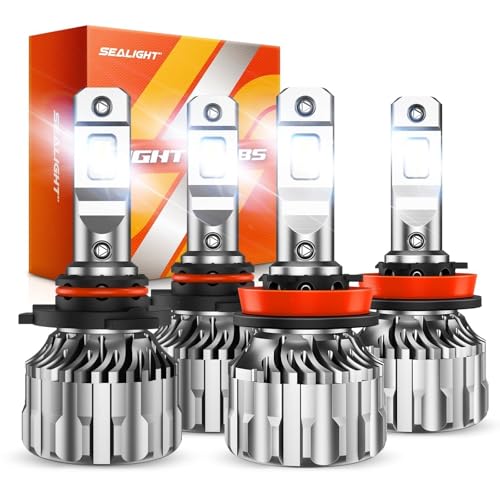
Better Driving Experience- The h11 9005 bulbs provide super bright illumination, offering a safer and more enjoyable driving experience
Understanding Bulb Sizes and Vehicle Compatibility
Understanding automotive LED headlight bulb compatibility requires precise identification of standardized bulb sizes that correspond to specific vehicle applications. You’ll encounter common sizes like H1, H4, H7, 9005/HB3, and 9006/HB4, each featuring distinct base types—P43t for H4, PX26d for H7—that dictate mechanical fit and electrical connection. Vehicle compatibility factors depend on your specific make, model, year, and trim level, as manufacturers often use different bulb configurations even within the same model line.
Bulb identification methods include physically inspecting your existing bulb for printed part numbers or consulting your owner’s manual for specifications. Cross-reference charts help decode equivalencies: H11 = H8 = H9, and 9005 = HB3 = H10. Different bulb technologies including halogen, LED, and HID offer varying brightness levels and color temperatures that affect both performance and compatibility. LED replacements function as plug-and-play solutions matching original halogen base configurations, eliminating complex modifications while ensuring proper beam alignment and regulatory compliance. Specialty automotive light websites offer comprehensive bulb finder tools that simplify the selection process for your specific vehicle.
Exploring Different Types of LED Headlight Technologies
LED headlight technology encompasses several distinct architectures, each engineered to meet specific beam pattern requirements and vehicle applications. You’ll encounter single beam bulbs optimized for either high or low beam operation, while dual beam and Bi-LED variants integrate both functions within one unit using multiple LED chips or mechanical switching mechanisms. Matrix technology represents an advanced implementation, utilizing individually controllable LED arrays that selectively dim elements to prevent oncoming driver glare while maintaining maximum road illumination. Adaptive features incorporate sensors and electronic controls to modify beam patterns dynamically based on steering angle, vehicle speed, and ambient conditions. Laser-assisted LED systems extend visibility ranges up to 600 meters with 30% improved energy efficiency. Color temperature typically measures 6000K, delivering daylight-spectrum output that enhances visual clarity compared to 3400K halogen emissions. LED bulbs achieve full brightness instantly, eliminating the warm-up period required by traditional lighting technologies. These advanced lighting systems provide longer lifespan and reduced energy consumption compared to conventional halogen alternatives, making them an increasingly popular choice for vehicle owners seeking improved visibility and safety on the road. Most vehicles feature headlight controls on the dashboard or steering column that allow drivers to easily switch between different lighting modes and beam patterns.

🔥【𝟏𝟓𝟎𝟎% 𝐁𝐑𝐈𝐆𝐇𝐓𝐄𝐑 · 𝟐𝟎𝟐𝟔 𝐏𝐑𝐎-𝐆𝐑𝐀𝐃𝐄 𝐂𝐇𝐈𝐏𝐒—𝟏𝟒𝟎,𝟎𝟎𝟎𝐋𝐌 𝐔𝐥𝐭𝐫𝐚-𝐕𝐢𝐬𝐢𝐛𝐢𝐥𝐢𝐭𝐲】Designed for uncompromising quality, Termitor H13/9008 LED Light Bulbs adopt advanced 2026 Pro-Grade high-power chips, delivering 15X brighter light than stock halogen bulbs at 140,000 lumens per pair. With Hi/Lo Dual Beam, **they** remove dark spots and expand vision range over 800m. Precise beam cutoff avoids glare to oncoming vehicles for clear night vision. Stable performance in rain, fog and snow. Perfect for countryside road trips and serves as a handy spare bulb for self-driving tours. Replace dim factory lamps and drive safely even on remote dark roads.

【900% Brighter - Newly Enhanced】SEALIGHT 9007/HB5 LED bulbs feature 24 high-performance chips, delivering up to 9 times the brightness of standard halogen bulbs. Upgrade your nighttime driving experience by replacing dim, yellow stock bulbs with SEALIGHT 9007/HB5 LED Bulbs fog lights, offering superior illumination and enhanced visibility with a crisp 6500K cool white light for optimal light transmission

【Precise Beam & Zero Glare】Engineered with 12 high-power chips, FITMOTORS H4 fog light bulbs deliver a sharply focused beam that eliminates dark spots and glare—so you get a wider, clearer view without blinding oncoming traffic. Drive safer at night with light that stays where it should.
Brightness Levels and Beam Pattern Performance
Automotive LED headlight brightness spans a performance range of 3,000 to 12,000 lumens per bulb in standard configurations, with specialized high-output units exceeding 15,000 lumens for demanding applications. You’ll find brightness efficiency varies from 120 to 180 lumens per watt in premium LEDs versus 60 to 100 lumens per watt in lower-tier options.
Beam pattern performance depends critically on LED chip positioning and optical design precision. Quality bulbs produce well-defined hotspots with sharp cutoff lines, delivering superior distance vision without creating hazardous glare. Proper beam control becomes essential as lumen output increases—excessive brightness without correct adjustment blinds oncoming traffic. When selecting LED bulbs, verify compatibility with your vehicle’s factory specifications to ensure optimal performance and safety.
Your headlight housing type matters considerably; premium LEDs perform effectively in both reflector and projector configurations when engineered with appropriate focal geometry and controlled light dispersion characteristics. Lower-wattage LED installations reduce alternator load and improve overall vehicle fuel efficiency.
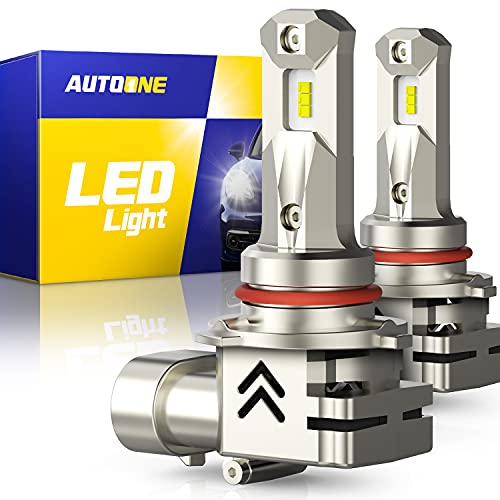
Compatible with Toyota 2003-2022 4Runner, 2004-2020 Sienna, 2007-2013 Tundra/Venza, 1992-2018 Camry/Corolla, 2008-2018 Sequoia, 1995-2012 Avalon, 1998-2005 RAV4/Celia, 1991-2017 Land Cruiser, 2003-2013 Matrix, 2010-2015 Prius; For Jeep Compass 2011-2021, Cherokee 2016-2019, Grand Cherokee 2005-2018, Commander 2006-2010; For Ram 1500/2500/3500 2011-2022; For Honda Accord 1990-2022, Pilot 2006-2022, Ridgeline 2017-2022, Civic 1988-2021, C-RV 2015-2020, Crosstour 2012-2015, CR-Z 2011-2016, HR-V 2019-2022, Odyssey 2005-2020; For GMC Yukon 2002- 2020 Sierra 2500 HD 2001-2020; For Ford F-150 2015-2022, Taurus 2008-2018,Explorer 2002-2019, Expedition 2003-2021

6500K Daylight Clarity: Radiant 6500K color temperature delivers a crisp cool white beam that instantly sharpens contrast on dark roads and foggy mornings. This 9005/HB3 H11/H9 combo cuts through haze and shadow so you spot hazards sooner, giving you the confidence to push through low-light conditions without second-guessing what's ahead

96,000LM High Output 6500K White: Each bulb delivers 96,000LM of 6500K Cool White light. The focused beam pattern enhances road visibility without creating excessive glare for oncoming traffic, ensuring safer night driving conditions
Installation Requirements and Long-Term Value
Before installing LED headlight bulbs, you’ll need to disconnect your vehicle’s battery to prevent electrical shorts and component damage. Essential installation tools include screwdrivers, pliers, socket wrenches, and dielectric grease for connector protection. Wear protective gloves to prevent oil contamination, which compromises bulb lifespan.
Align LED chips horizontally at 3 and 9 o’clock positions for ideal beam patterns. Some vehicles require anti-flicker adapters or voltage regulators to prevent error codes. Always verify bulb compatibility and adjust beam angles using adjustment screws.
LED bulbs last 2-3 times longer than halogens, reducing replacement frequency. Consider checking color temperature preferences when selecting among available aftermarket options. Different brightness levels and beam patterns will impact your nighttime visibility and road coverage. Key maintenance tips include regular beam alignment checks and secure mounting to prevent vibration damage. Though initial costs exceed halogen alternatives, improved durability and energy efficiency deliver superior long-term value through reduced maintenance expenses. After installation, test both high and low beam settings to ensure proper functionality.