You’ll choose between H9 and H11 based on your lighting application: H9 operates at 65 watts producing 2100 lumens, making it ideal for high-beam systems requiring maximum visibility range, while H11 runs at 55 watts delivering 1350 lumens, optimized for low beams and fog lights. The bulbs aren’t interchangeable—H9 uses a PGJ19-5 base with a blocking tab, whereas H11 features a PGJ19-2 base. Your vehicle’s housing design dictates compatibility, as H11 assemblies typically lack the heat dissipation capacity for H9’s higher wattage. Understanding these specifications guarantees you’ll select the proper bulb for your requirements.
Understanding the Key Technical Differences Between H9 and H11 Bulbs
While H9 and H11 bulbs appear nearly identical at first glance, their technical specifications reveal critical differences that determine their distinct automotive applications. You’ll find the primary distinction in wattage: H9 operates at 65 watts while H11 runs at 55 watts, both at 12 volts. This specification comparison extends to filament design—H9’s lower-resistance filament draws higher current for increased brightness but reduced lifespan, whereas H11’s cooler-running filament prioritizes longevity.
The base design presents another critical difference. Both use PGJ19-style bases with different positioning catches and locking tabs, preventing direct interchange without bulb modifications. H9’s small plastic tab blocks insertion into H11 sockets, an intentional safeguard against mismatched installations. The base locking designs are specifically PGJ19-5 for H9 and PGJ19-2 for H11, which manufacturers engineered to avoid accidental mismatching between the two bulb types. These engineering distinctions align with their applications: H9 for high beams requiring maximum output, H11 for low beams and fog lights demanding controlled dispersion. Proper installation techniques are essential to prevent damage to your vehicle’s electrical system when upgrading headlight bulbs. Understanding beam patterns and brightness levels helps ensure you select the appropriate bulb type for your vehicle’s specific lighting needs and driving conditions.

This bulb is H9, NOT H8 or H11. Although H8, H9, and H11 bulbs look very similar, they are not interchangeable in all applications.

[OEM-Grade Performance Built for Reliability] Built with OE-level quality standards to deliver stable, long-lasting illumination for dependable nighttime driving performance.
Comparing Brightness and Light Output Performance
When evaluating automotive lighting performance, luminous output serves as the definitive metric distinguishing H9 from H11 bulbs. H9 bulbs deliver approximately 2100 bulb lumens at 65 watts, while H11 bulbs produce 1350 lumens at 55 watts—representing a 50% brightness differential. This lumen variation directly impacts beam patterns: H9 projects focused, long-distance illumination optimized for high beam applications, whereas H11 emits wider, controlled dispersion suitable for low beams and fog lights.
LED upgrades substantially enhance both configurations, exceeding 6000 lumens while maintaining energy efficiency. Your brightness requirements depend on application-specific needs: H9’s intensity maximizes distant visibility on rural highways, while H11’s moderate output reduces glare in urban environments. The power-to-lumen relationship determines thermal management considerations and electrical system compatibility in your vehicle’s lighting architecture. When selecting bulbs for your specific vehicle model, ensure compatibility with OEM replacement specifications to avoid installation issues. Understanding halogen, LED, and HID technologies helps you choose the bulb type that best balances performance with your budget constraints. The operational lifespan differs significantly, with H9 bulbs lasting 400 to 1000 hours compared to H11’s extended 500 to 1500 hours due to reduced thermal stress.

16 Premium LED Chips for Super Brightness: 80000LM per pair, 15X brighter than halogen, covers road thoroughly, ensures quick response to obstacles for safe night driving.

126,000LM 6500K Crisp White Beam: Experience unparalleled visibility with our 2026 upgraded Termitor H11 H9 Hi/Lo bulbs, delivering a dazzling 6500K crisp white beam that cuts through darkness for safer night driving

【98%+ Vehicle Compatibility】Termitor H11/H9/H8 Electronic Flashers Equipped with the latest upgraded linear decoding technology and built-in intelligent IC driver, it is suitable for more than 98% of vehicles. CANbus ready, ensuring no errors, flickering, or radio interference. Please note: Some sensitive vehicle models may still require a CANbus decoder. Feel free to contact Forenner if needed
Lifespan Expectations and Heat Management Factors
Beyond brightness capabilities, thermal characteristics and operational longevity fundamentally distinguish H9 from H11 bulb performance profiles. You’ll find H9 halogen bulbs typically deliver 240-400 hours of bulb lifespan, while H11 variants achieve 270-500 hours—primarily because H11’s lower 55W power rating generates less heat accumulation than H9’s 65W output. This wattage differential creates significant thermal stress differences affecting filament degradation rates. However, your usage patterns matter considerably: H11 low beams operate more frequently than H9 high beams, potentially offsetting their thermal advantage. Quality variations introduce additional variance, with premium halogen bulbs reaching 500 hours regardless of designation. When selecting replacement bulbs, consider color temperature preferences that affect both visibility and vehicle aesthetics. Both bulbs share the same connector type and physical dimensions, making them mechanically interchangeable despite their different power specifications. Standard halogen replacements from reputable manufacturers like Philips and Sylvania offer reliable performance for most driving conditions. LED or HID conversions transform these metrics entirely, delivering 45,000-50,000 hours through advanced heat sinks and active cooling systems that eliminate traditional filament-based thermal failure modes.
Primary Applications: High Beam Vs Low Beam and Fog Lights
Understanding your vehicle’s lighting requirements begins with recognizing that H9 and H11 bulbs serve distinctly different functional roles within automotive lighting systems. H9 bulbs excel in high beam applications, delivering 2100 lumens at 65 watts for maximum long-range visibility on dark highways. Their focused beam pattern projects farther but generates excessive heat for continuous use. Conversely, H11 bulbs operate at 55 watts producing 1350 lumens, making them ideal for low beam headlights where controlled illumination prevents oncoming driver glare. Fog light considerations strongly favor H11 bulbs—their moderate brightness and wider beam pattern provide excellent short-range visibility without dangerous light scatter. H9’s higher intensity proves counterproductive in fog conditions, where diffused lighting outperforms concentrated beams. You’ll find H11 bulbs offer plug-and-play compatibility across most vehicles’ low beam and fog light applications. For proper installation, ensure correct bulb alignment by matching the bulb’s dimple with the groove in the socket. Like H7 bulbs, H9 and H11 bulbs feature distinctive socket designs that ensure fitment compatibility with specific vehicle models and production years.

【Visual Enhancement】: The OKOENIEO H11 headlight bulb are 200% brighter than other halogen bulbs, providing drivers with a wider and farther field of vision. Offering a greater visibility, they allow drivers to spot deer, wildlife, falling rocks, or obstacles ahead of time, ensuring safer nighttime driving.

【Super Bright】Our H11 headlight bulbs deliver a brightness of more than 1500LM, up to 5000K color temperature, providing the best visibility in foggy and rainy weather, Our headlight bulb filled with more than 45% Xenon gas to be more brighter and whiter, Blue ion membrane filters yellow light and gets super white light.
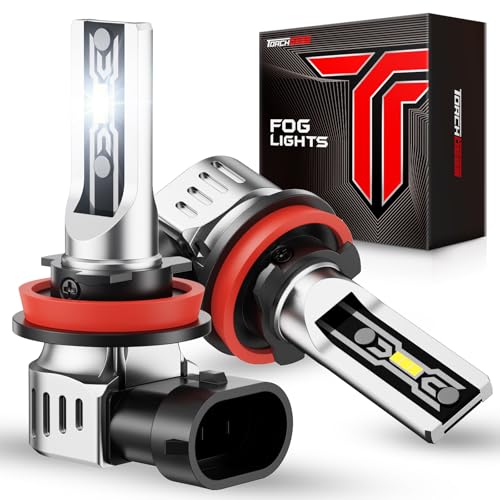
12,000 Lumens Ultra-Bright for All Weather Driving: Cut through dense fog, heavy rain, and snowy roads with 12,000LM of brilliant output—600% brighter than original fog lights. The TF2 Series H11 LED bulb deliver crystal-clear visibility for cars, trucks, and SUVs, keeping you safe in even the toughest driving conditions.
Electrical Efficiency and Power Consumption Analysis
The electrical efficiency equation reveals a clear 10-watt disparity between H9 and H11 halogen bulbs—65 watts versus 55 watts respectively—translating directly into your vehicle’s power consumption profile. These power ratings correspond to measurable brightness outputs: H9 delivers approximately 2100 lumens while H11 produces 1350 lumens, establishing a 50% differential in luminous efficacy.
LED alternatives fundamentally transform this efficiency calculation. You’ll find H11 LED replacements consuming merely 30 watts while generating 6000-8000 lumens per pair, dramatically improving energy efficiency compared to halogen variants. This reduced electrical load minimizes heat generation—halogen bulbs convert substantial energy into thermal waste rather than useful light output. Both bulb types support HID upgrade options that can yield light output improvements of up to 300% without requiring modifications to the housing.
Component lifespan directly correlates with power consumption metrics: halogen H9 bulbs average 240-500 operating hours, while LED versions extend beyond 45,000 hours, reducing replacement frequency and optimizing long-term energy utilization.
Installation Compatibility and Vehicle Requirements
Beyond mechanical compatibility considerations, you must evaluate your vehicle’s thermal and electrical infrastructure. H9 bulbs draw 65 watts versus H11’s 55 watts, potentially stressing wiring, fuses, and connectors not rated for higher power demands. Your H11-designated housings may lack adequate heat dissipation for H9’s elevated operating temperatures, risking melted connectors or housing damage. OEM specifications align each bulb type with specific beam patterns and housing geometries—modifications can compromise illumination performance and violate vehicle lighting regulations. H9 bulbs also produce whiter light at higher color temperature, which can enhance visibility but may not be compatible with your vehicle’s original design parameters. Before attempting installation, familiarize yourself with the retaining clip mechanism that secures your bulb to avoid damaging the assembly during removal or reinstallation.

Material : This fog light connector is made of high-quality plastic and metal. It is sturdy in texture, wear-resistant and durable, anti-corrosive and anti-rust, has excellent electrical conductivity, is not prone to deformation or breakage, and can keep good performance even after long-term use

Application: This Wiring harness is designed for fog lights. The socket connector is compatible with H11 H9 H8 886 889 892 PG13 PGJ13 880 889 862 881 884 885 894 898 899 Fog light bulbs. The wiring harness kit can be connected to the light source within 180W. If your power supply is 24V, please replace the original 12 V relay with a 24V relay.
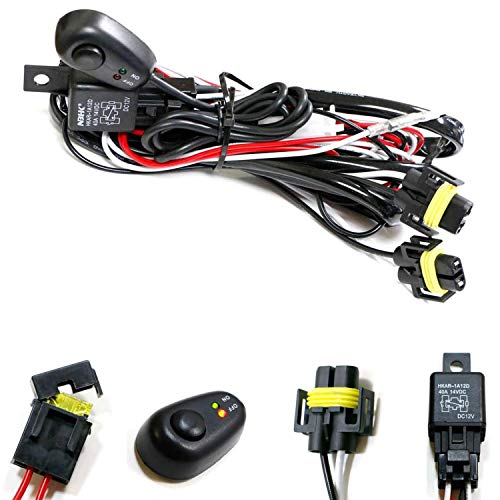
One relay wiring harness set includes a 4-pin SPST relay module box, in-line safety fuse box, pushbutton switch, input +/- terminals, and dual H11/H8/H9 outputs for reliable and efficient electrical connections
Upgrading Options: LED and HID Alternatives
When evaluating modern alternatives to halogen H9 and H11 bulbs, you’ll find LED and HID technologies deliver considerable performance advantages through fundamentally different light-generation mechanisms. LED technology provides 14,000–28,000 lumens compared to halogen’s 2100 (H9) and 1350 (H11) lumens, while consuming considerably less power—typically under 30W versus 65W (H9) or 55W (H11). HID advantages include roughly double the brightness of halogens with superior energy conversion efficiency, though they require additional ballasts. Both alternatives offer 4300K–6000K color temperatures, producing whiter light that enhances nighttime clarity compared to halogen’s yellowish output. LED bulbs feature cooler operation and lifespans exceeding 10,000 hours versus halogen’s 250–1000 hours. The extended lifespan of LED technology means fewer replacements over your vehicle’s lifetime, reducing maintenance costs and inconvenience. Superior brightness from these modern alternatives significantly improves nighttime visibility and safety during low-light driving conditions. Many manufacturers design universal LED bulbs compatible with H9 and H11 types, simplifying the upgrade process. You’ll need to verify plug-and-play compatibility or prepare for adapters and CAN bus decoders to prevent electrical system errors.

UPGRADE CANbus TYPE: Nilight H11/H9/H8 LED CANbus Decoder is upgraded with a resistor and capacitor design to provide a more stable and reliable performance. The aluminum case enhances heat dissipation and safety protection, ensuring a longer lifespan.

Easy Installation: 1:1 design, no external driver or connector required, plug and play

【1200% Brighter Than Stock Bulb– Drive with Superior Clarity】FORENNER H11 9005 bulbs are equipped with 16 high-output CSP chips, delivering up to 1200% more brightness than stock bulbs. The 6500K cool white light provides visibility and reduces eye strain, helping you see farther and at night for , more confident driving in any low-light condition.
Making the Right Choice for Your Driving Needs
Understanding LED and HID upgrade potential matters little if you select the wrong halogen baseline for your vehicle’s specific operational requirements. Your personal driving style determines best bulb selection: frequent highway commuters benefit from H9’s 2100-lumen output and extended beam distance, while urban drivers require H11’s 1350-lumen diffused pattern to minimize glare. Weather conditions greatly influence this decision—H11’s wider, lower beam excels in fog and rain by reducing light scatter, whereas H9’s concentrated throw proves counterproductive in precipitation. Consider operational voltage compatibility (both operate at 12V) and power consumption differences (H9: 65W vs. H11: 55W) when evaluating electrical system impact. Match bulb characteristics to documented application standards: H9 for high beams requiring maximum visibility range, H11 for low beams and fog lights demanding controlled, shorter-range illumination without oncoming traffic interference. Before selecting between these options, ensure proper bulb alignment during installation to maximize performance regardless of which type you choose. The H9’s lower filament resistance directly contributes to its superior light output but creates additional thermal stress on the bulb assembly. Transitioning to either H9 or H11 LED alternatives offers improved visibility and longer lifespan compared to traditional halogen technology, making them worthy considerations for drivers seeking enhanced nighttime performance.