To fix a car headlight, you’ll first diagnose the issue—check if the bulb’s burned out, the lens is clouded, or there’s an electrical problem using a multimeter to verify 12.6V battery power. For cloudy lenses, wet-sand progressively from 600 to 3000 grit, then polish and apply UV-resistant clear coat. Replace burned bulbs without touching the glass, and address moisture by resealing gaskets with urethane sealant. Regular alignment checks guarantee ideal beam positioning. The sections below provide detailed technical procedures for each repair scenario.
Diagnosing Common Headlight Problems
Before replacing components or investing in expensive repairs, you’ll need to systematically identify which part of your headlight system has failed. Start by inspecting for bulb failures—check filaments for burn marks or discoloration. If you notice flickering lights, this indicates ballast issues in HID systems or connection problems at the wiring harness. Test your power supply using a multimeter; battery voltage should read 12.6V off and 13.7-14.7V running. Examine all connections for corrosion or loose terminals that cause intermittent operation. Check for electrical failures by testing fuses and relays with proper amperage ratings, listening for a clicking sound when the headlights are turned on to confirm the relay is engaging properly. Inspect the wiring harness for frayed wires or damaged insulation. Document which headlight malfunctions occur—one side versus both—as this reveals wiring issues or broader electrical system problems requiring immediate attention. Pay attention to any buzzing or humming noises coming from the headlight assembly, as these sounds often signal a failing ballast component.

35W HID Ballast: This HID ballast adopts New DC Chip sest. It has over-voltage protection, low-voltage protection, no-load protection, short-circuit protection, etc. IP68 waterproof grade, which can work in any weather conditions

【Superior Function】: The xenon headlight ballast utilizes electrons to excite the gas that illuminates the HID xenon bulbs, significantly prolonging their service time while maintaining brightness levels. This makes it an optimal solution for enhancing visibility.

FIT THE FOLLOWING VEHICLE - W3T19371 ballast replacement for 2006-2014 Acura TL TL-S | 2006-2014 Acura TSX | 2012-2014 Acura ILX | 2010-2013 Acura ZDX | 2013-2014 Acura RDX | 2010-2013 Acura MDX | 2009-2011 Acura CSX | 2011-2013 Honda CR-Z | 2004-2014 Honda Odyssey | 2012-2014 Mazda CX-5 | 2007-2012 Mazda CX-9 | 2007-2009 Mazda 3 | 2009-2012 Mazda 5 | 2007-2009 Mitsubishi Out lander | 2008-2012 Mitsubishi Lancer Evolution
Preparing and Cleaning Your Headlights
Once you’ve identified the faulty component, proper surface preparation guarantees any repair or restoration work delivers lasting results. Begin your headlight maintenance by parking in a shaded area and washing the lens with soap and water. Dry completely with a microfiber cloth. Apply masking tape around each headlight to protect your car’s paint from scratches during restoration. Wipe the surface with rubbing alcohol to remove contaminants. For deeper cleaning, you’ll need effective cleaning products: mix two tablespoons baking soda with one tablespoon white vinegar to form a paste, or use non-gel whitening toothpaste as an alternative abrasive. Apply these mixtures with folded shop towels for precise control. Inspect for uniform cleanliness before proceeding with restoration steps. For severe cases of yellowing or hazing, consider using fine sandpaper or specialized polishing compounds to achieve optimal results. After polishing, applying a clear coat or UV sealant will protect your headlights from future oxidation and yellowing. Choose a location with ample sunlight for the curing stage that will come later in the process.
Sanding and Restoring Headlight Clarity
Proper sanding requires systematic protection of adjacent surfaces to prevent accidental damage during restoration. Apply two layers of masking tape around the headlight perimeter and cover body panels. Your sandpaper selection starts with 600-800 grit to eliminate oxidation, progressing through 1000, 1500, 2000, and 3000 grit for refinement. Use dedicated quarter sheets per headlight to avoid cross-contamination.
Wet sand with continuous water spray for lubrication and extended paper life. Your sanding technique demands unidirectional passes with overlapping strokes wrapped around a foam backing pad. Make 4-8 passes per section until uniform milky white haze appears. Wipe clean between grits to verify even scratch patterns. For machine polishing, employ crosshatch patterns at low speed. Continue until you’ve removed all yellowing and achieved consistent cloudiness. To maintain long-term clarity after restoration, consider applying a UV protectant sealant to protect against future oxidation.
After completing the sanding process, apply compound using the Finger Painting Technique with a rotary polisher and wool cutting pad.

Complete Sanding & Polishing Kit: This 3 inch hook and loop sanding disc set master every project stage with 12 included grits (80/120/180/240/400/800/1000/1500/2000/3000/5000/10000 grit). Effortlessly tackle scratches and imperfections on cars, metal, wood, epoxy resin, and shower glass—from coarse grinding to mirror polishing. Ideal for auto shops, furniture makers, and DIYers

KIT INCLUDES: 1 - Disc Pad Holder, 3.25 in (8,2 cm) 6 - 3M Gold Sanding Discs 500 Grit, 3 in (7,6 cm) each 4 - 3M White Finishing Discs 800 Grit, 3 in (7,6 cm) each 1 - 3M Trizact Refining Disc 3000 Grit, 3 in (7,6 cm) 2 - 3M Quick Headlight Clear Co
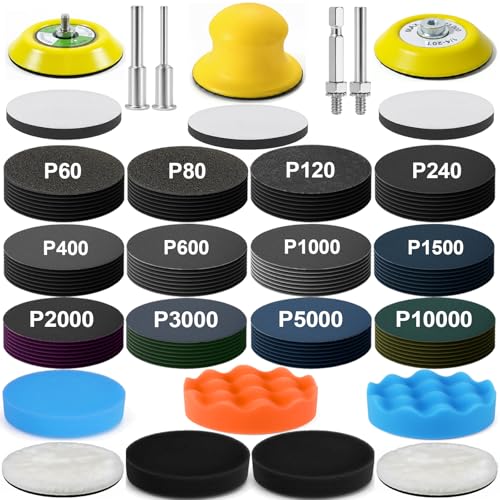
Complete 137PCS Sanding Kit: This all-in-one sanding and polishing kit includes 120pcs 3-inch sandpapers (60–10000 grit), 1 handheld sanding pad, 3 buffer pads, 2 wool pads, 5 sponge pads, 2 backing plates (inner & outer thread), and multiple adapter rods (6.35mm, 5.8mm, 3mm). Ideal for both professionals and DIY users who need precision from coarse sanding to fine polishing.
Polishing and Clear Coat Protection
After achieving uniform cloudiness across the headlight surface, your next step involves compound polishing to restore optical clarity. Use a foam pad with cutting compound, working in overlapping passes until the lens is crystal clear. Follow with a finer polish to eliminate micro-marring.
Before applying protection, thoroughly clean the surface with isopropyl alcohol to remove residues. Understanding clear coat types is essential: acrylic urethane offers good UV resistance for DIY work, while polyurethane provides superior durability. OEM-style multi-coat systems deliver maximum longevity but require more expertise. A UV-resistant clear coat will protect your headlights from future oxidation and yellowing. For optimal results, consider how beam pattern accuracy is affected by the clarity of your polished lens, as any remaining cloudiness can compromise light distribution on the road.
Master proper application techniques by applying multiple thin coats rather than one heavy layer. Spray methods demand consistent distance and cross-hatch patterns. Wipe-on sealants need light surface tooth for adhesion. Always respect cure schedules to prevent premature failure. Working in a well-ventilated area is essential when applying sealants to avoid inhaling harmful fumes during the curing process.

CLEAR LIGHTS: Meguiar's Clear Headlight Coating is the ultimate solution to maintain exceptional optical clarity on both new and restored headlights, ensuring optimal visibility and safety during nighttime driving

UV Headlight Coating Kit: The Sylvania UV Block Clear Coat Kit is a premium headlight clear coat designed to protect and restore dull or cloudy lenses to like-new condition

Wipe-on fluid is excellent for lightly yellowed or recently restored lenses
Addressing Moisture Issues and Ongoing Care
While external lens restoration addresses surface degradation, moisture infiltration within the headlight assembly presents distinct challenges that compromise both optical performance and electrical components. Moisture detection begins with identifying condensation patterns—clouded lenses indicate humid air contacting cool interior surfaces. Remove the assembly, disconnect electrical connections, and employ controlled heat application using a hairdryer through the bulb socket, avoiding plastic melting. Natural air drying face-down overnight provides safer moisture elimination.
Sealing repairs require thorough inspection for cracks, deteriorated gaskets, or compromised bulb sockets. Apply clear urethane sealant along crack lengths, both internally and externally. Coat bulb sockets with silicon spray or Teflon tape to restore seal integrity. Install reusable silica gel absorbers—two per housing—to maintain dry conditions. Physical cracks or chips compromise headlight functionality and require prompt attention to prevent further moisture penetration. LED bulbs produce less heat than halogen alternatives, which can sometimes result in more visible condensation that takes longer to dissipate. For vehicles with advanced lighting systems, verify that in-car lighting controls are properly configured to ensure optimal headlight operation during maintenance. Regular seal inspections and absorbent device recharging prevent recurrence, ensuring sustained visibility and component protection.