Your headlights staying on when the switch is off typically indicates a stuck headlight relay with welded contacts, a failed headlight switch with degraded internal contacts, or a malfunctioning DRL module locked in active mode. Corroded wiring creating unintended current paths, faulty ambient light sensors sending continuous low-light signals, or a defective timer relay can also cause this issue. You’ll need to perform continuity testing on the relay, measure voltage at the bulb socket, and inspect connector terminals to pinpoint the exact component failure causing continuous illumination.
Headlight Switch Malfunction and Internal Contact Failure
When you press the headlight switch to the off position but the lights remain illuminated, internal contact failure is the most common culprit. Switch longevity diminishes as contacts experience wear from repeated cycling, reducing their ability to break the circuit completely. Contact degradation occurs through oxidation, corrosion, and heat-induced damage, creating unintended continuity pathways. You’ll find that switches carrying full headlight current without relay protection suffer accelerated contact burnout, often welding together from excessive heat. Use a multimeter to test continuity across switch terminals in both positions—resistance readings in the off position indicate failed contacts. Flickering lights when adjusting the switch can signal early-stage contact deterioration before complete failure occurs. Mechanical spring fatigue compounds the problem, preventing contacts from fully separating. Heat damage produces visible burn marks and melted plastic within the switch housing, requiring complete replacement. For persistent on-state issues, testing the headlight relay can help determine if the problem originates in the switching mechanism or the relay itself.

Direct replacement - this headlight switch knob is designed to match the fit and function of the original control knob on specified vehicles
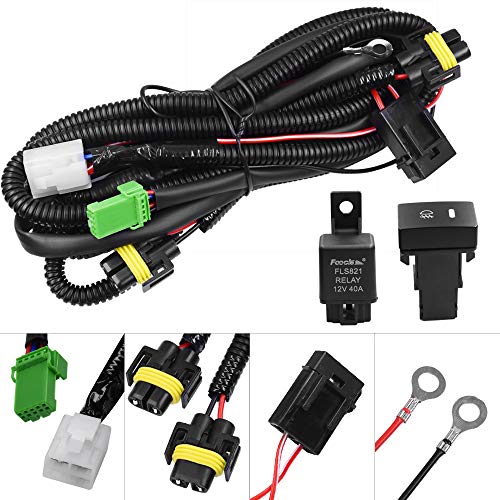
Good For Replacement fog lamps, Add-on fog lights, HID lights, LED daytime running lights, Driving lights, LED work lights, Off-road lighting kit

Heavy Duty, Two-positions, Universal Headlight Switch
Faulty Headlight Relay Stuck in Closed Position
A faulty headlight switch represents only one component in the lighting control circuit—downstream from the switch, the headlight relay serves as the electromagnetic workhorse that handles the actual high-current load to your headlights. When relay contact issues occur, specifically contacts stuck in the closed position, your headlights remain powered regardless of switch position. This failure mode results from contact welding caused by voltage spikes, moisture corrosion, or mechanical wear from switching cycles. You’ll observe continuous illumination, battery drain, and inability to control lighting. Diagnostic testing requires multimeter continuity checks across relay terminals—zero ohms where open circuit should exist confirms stuck contacts. If the problem persists after testing, you may need to replace the relay with one that matches the amperage rating of the original to avoid electrical issues. Electrical shorts to the relay coil circuit can also maintain energization. Since daytime running lights operate automatically on many modern vehicles, a stuck relay may also prevent these safety features from disabling properly. Motorized headlight systems on older vehicles commonly experience this type of relay failure with pop-up headlight assemblies. Swap the suspect relay with an identical unit to isolate the fault before replacement.

FIX DIM HEADLIGHTS & IMPROVE LIGHT OUTPUT: Upgrade your old factory headlight wiring with this H4 LED headlight relay harness kit. Fix common issues including dim headlights, flickering headlights, voltage drop, weak high beam/low beam performance and insufficient power supply. This fused relay wiring harness delivers stable battery power directly to your H6054 LED headlights, improving brightness and reliability during night driving.

Versatile Compatibility: Fits a wide range of Toyota vehicles, including for 2003-2014 4Runner, 2002-2011 Camry, 2007-2009 Prius, 2006-2012 RAV4, and more. Ideal for various automotive applications such as A/C compressors, starters, headlights, horns, fans, and other accessories.

Compatible with Volkswagen Type 1 [ Beetle / Bug ] 1967-79,
Defective Daytime Running Light (DRL) Module
Between the headlight switch and your vehicle’s lighting elements, the Daytime Running Light (DRL) module functions as an intelligent control interface that processes multiple input signals to govern automatic headlight operation. DRL module functions include interpreting ambient light sensor data, engine status, and parking brake position to determine proper lamp activation. When this module fails internally due to short circuits, moisture ingress, or component degradation, it can lock headlights in a continuous-on state regardless of switch position.
DRL module symptoms manifest as persistent illumination after engine shutdown, failure to activate DRLs during normal operation, or erratic brightness fluctuations. Diagnostic scanning tools reveal module fault codes, while physical inspection identifies corrosion or damaged circuit boards. Testing input/output signals isolates whether the module itself has failed or external wiring creates false activation commands. A malfunctioning DRL module may also prevent automatic headlight activation during daytime driving when the system should engage to enhance vehicle visibility to other road users. Additionally, a weak or dying battery can contribute to erratic electrical system behavior that compounds DRL module malfunctions. If headlight bulb replacement becomes necessary due to module failure effects, the H11 and 9005 bulbs commonly used in modern vehicles should be handled carefully to avoid contact with bare hands.

【Compatibility】 This amber DRL kit fits 2022 2023 2024 2025 2026 GMC Sierra 1500 (Refreshed), 2022 2023 2024 2025 2026 Chevy Silverado 1500 (Refreshed), 2023 2024 2025 2026 GMC Canyon, include all trim level. Notice! NOT compatible with 2500/3500 model

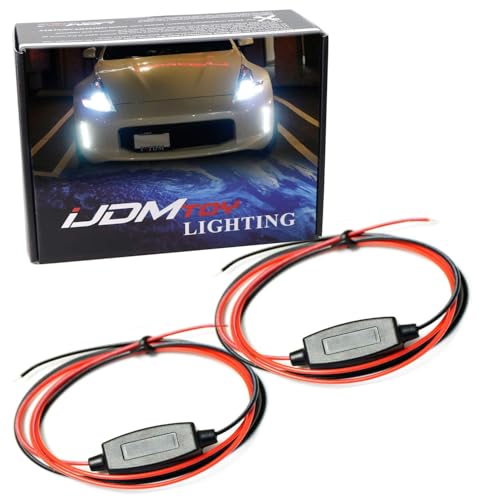
Compatible with Subaru 2013-16 Pre-LCI Subaru BRZ, 2009-21 Nissan 370Z w/ vertical DRL, 2010-15 Toyota Prius, etc
Corroded or Damaged Wiring and Connectors
Your vehicle’s electrical pathways connecting the headlight switch to the lamps themselves represent critical failure points where corrosion and physical damage frequently cause persistent illumination problems. Moisture intrusion at connector terminals creates electrochemical reactions that increase resistance and generate heat, potentially bypassing normal switching mechanisms. Damaged insulation from chafing against sharp edges exposes conductors, creating shorts that maintain continuous power flow regardless of switch position. Corroded relay terminals and fuse connections can stick in closed positions, latching headlights on permanently. Poor grounding compounds these issues through feedback currents and voltage irregularities. Corrosion effects extend to the entire circuit, requiring systematic inspection of all connection points. Proper wiring maintenance involves cleaning terminals, replacing compromised insulation with heat shrink tubing, and ensuring ground points remain paint-free and secure for reliable headlight control. Voltage fluctuations from electrical system irregularities can trigger erratic behavior in headlight circuits, causing them to remain energized even when the switch is in the off position.

KIT INCLUDES: 1 - Disc Pad Holder, 3.25 in (8,2 cm) 6 - 3M Gold Sanding Discs 500 Grit, 3 in (7,6 cm) each 4 - 3M White Finishing Discs 800 Grit, 3 in (7,6 cm) each 1 - 3M Trizact Refining Disc 3000 Grit, 3 in (7,6 cm) 2 - 3M Quick Headlight Clear Co

[High quality material] : The headlight connector is made of durable ABS material and stable transmission copper wire material, ABS shell is scratch-resistant, wear-resistant, not easy to break, durable; Copper wire has excellent electrical conductivity and stable transmission. The whole has the characteristics of high efficiency, high temperature resistance, heavy duty and lasting, and can be used for a long time

High Quality: This female adapter wiring harness sockets is made of high-quality materials, the nylon shell has good insulation, heat-resistant and flame-retardant, has good toughness, is not easy to deform or crack, the internal copper wire can stably conduct electricity, has high working efficiency, and can be used for a long time
Malfunctioning Headlight Timer or Delay Feature
When headlight timer systems malfunction, they’ll often trap your vehicle’s lighting circuit in an active state well beyond the intended delay period. A stuck relay represents the most frequent culprit—mechanical contacts fuse together from corrosion or wear, maintaining continuous current flow regardless of switch position. You can diagnose this by listening for relay clicks or performing a swap test with a known-good unit.
Body control module software glitches also disrupt the delay function, requiring diagnostic scanning tools to identify firmware corruption. Door ajar sensors and ignition status inputs feed critical signals to the timer circuit; when these fail, your module never receives the shutdown command. Additionally, moisture ingress and voltage fluctuations corrupt timer operation, creating unintended current paths that prevent normal headlight deactivation. In some cases, third-party aftermarket accessories interfere with the factory timer circuit, introducing competing signals that override the system’s ability to properly shut down the headlights.

Main Chip:NE555; Operating voltage: DC 12V; Can be controlled AC 250V/10A /DC 0~30V/max. 10A equipment. (Maximum control equipment 2000W).

🕒 Adjustable Timing: With an impressive accuracy range from 1 to 720 seconds, our time relay ensures precise control over your vehicle's electrical systems. Customize the delay-off duration according to your specific needs for optimal performance.

Independent Parameters: OP/CL/LOP parameters can be modified and saved, and they are individual
Battery Voltage Issues and Electrical System Irregularities
Battery voltage irregularities create cascading failures throughout your vehicle’s electrical architecture, directly impacting headlight control circuits that depend on stable power references. Your battery health deteriorates when voltage drops below 12.6 volts at rest or fails to reach 14 volts during engine operation. Readings under 11.6 volts indicate discharge severe enough to prevent proper switch disengagement. Corroded terminals compound these issues by restricting current flow and creating intermittent connections that trigger erratic electrical behavior. Parasitic drain exceeding 50 milliamps steadily depletes reserves, while faulty alternators delivering voltage outside 13-15 volts destabilize entire systems. A weak or failing battery strains the alternator by forcing it to compensate with increased output, accelerating wear on both charging system components. In some Ford F150 models, the perimeter lighting system may interact with battery voltage irregularities, causing unexpected headlight activation during low-power conditions. Voltage stability requires clean terminal connections, minimal parasitic draw verified through multimeter testing, and properly functioning charging components to maintain headlight control circuit integrity and prevent unintended illumination. Professional diagnosis of electrical system failures typically costs between $100 to $300 for basic connector and circuit repairs, making it worthwhile to address voltage issues before they cascade into more expensive component damage.
Faulty Ambient Light Sensors in Automatic Headlight Systems
Ambient light sensors function as photodiode-based measurement devices that continuously monitor environmental luminance levels and transmit analog or digital signals to your vehicle’s body control module for headlight circuit activation decisions. When these sensors malfunction, they send erroneous low-light data, causing your headlights to remain energized despite adequate ambient illumination. Sensor calibration drift occurs from aging photodiodes or voltage reference degradation within the sensing circuit. Installation issues include improper mounting angles that expose the sensor to direct sunlight reflections or obstructions blocking accurate light sampling. Windshield contamination, lens surface deterioration, and connector corrosion interrupt signal integrity between the sensor and ECU. Regular maintenance of sensors is essential for optimal functionality, as sensors must remain clean and unobstructed to provide accurate light readings. Diagnosing requires measuring sensor output voltage under controlled lighting conditions and verifying wiring continuity. Replace defective sensors with OEM-specified components and recalibrate through manufacturer-approved diagnostic protocols to restore proper threshold detection.
Moisture Intrusion and Weatherproofing Problems
Moisture intrusion compromises headlight functionality through multiple failure pathways that extend beyond simple condensation visibility. When water penetrates your headlight assembly through deteriorated seals or cracks, it directly contacts electrical components and control modules. This moisture ingress corrodes bulb sockets, wiring terminals, and circuit board connections within automatic headlight systems. Corroded contacts create phantom ground paths or short circuits that prevent your headlight relay from properly disengaging, causing lights to remain illuminated despite switch position. Degraded sealant integrity around lens mounts and bulb caps allows continuous moisture entry, establishing persistent electrical leakage paths. Blocked ventilation systems trap humidity against sensitive electronics, accelerating corrosion rates. The problem intensifies because headlights require breathing space due to temperature changes, causing the cooling air inside to contract and repeatedly pull in moisture-laden air from outside. While minor condensation is normal and often dissipates as the headlight heats up, persistent moisture buildup usually indicates faulty seals or clogged vents that need immediate attention. You’ll need to restore weatherproofing by replacing gaskets, applying fresh silicone sealant, and clearing ventilation channels to eliminate electrical malfunctions caused by water contamination.
Diagnostic Testing and Troubleshooting Steps
When moisture-related failures compromise your headlight assembly, systematic electrical testing becomes necessary to isolate the precise failure point causing lights to remain energized. Begin headlight diagnostics by using a digital multimeter to measure voltage at the bulb socket with the switch off—any voltage presence indicates unwanted power supply. Test relay operation by swapping with known good units or measuring contact continuity to identify stuck-closed contacts. Inspect all related fuses for damage using visual examination and electrical testing procedures. Check ground point resistance with continuity tests, as poor grounding creates erratic behavior. Use an OBD-II scanner to monitor Body Control Module outputs for stuck commands. Conduct voltage drop tests across the entire circuit to detect high-resistance points causing backfeed or improper relay function. After electrical diagnostics, consider whether oxidation or haziness in the headlight lens is contributing to inconsistent light output readings. If testing reveals a faulty headlight relay, replacement involves locating the relay in the fuse box and swapping it with a new unit. Ensure all testing equipment operates at 12.75v standard voltage to maintain diagnostic accuracy and consistency with manufacturer specifications.