No, headlight bulbs aren’t universal—you’ll find dozens of standardized sizes with different base types, filament configurations, and electrical specifications. Your vehicle requires specific bulbs like H1, H4, H7, or 9005/9006, determined by mechanical fit and beam pattern design. While some bulbs share cross-compatibility (H13 matches 9008, HB3 matches 9005), you can’t interchange single-filament H7 with dual-filament H4 bulbs. Your owner’s manual specifies the exact type needed, and installing incorrect bulbs causes beam misalignment, electrical damage, or complete incompatibility. Understanding these technical distinctions prevents costly mistakes.
Understanding Headlight Bulb Compatibility Across Different Vehicles
Headlight bulbs are not universal components, as their compatibility depends on precise mechanical and electrical specifications that vary across vehicle manufacturers, models, and production years. You’ll find that base types like H7’s single pin versus H4’s dual-filament design determine physical fit, while locking tab configurations—such as H11’s nested prongs versus H11B’s protruding tabs—prevent cross-installation. Your vehicle’s beam patterns require specific bulb shapes matched to projector or reflector housings for proper light alignment. European models typically specify H7 bulbs for low beams, whereas American vehicles favor 9006 or 9012 L-shaped bases. The brightness and color output of your headlights also depend on whether you choose halogen, HID, or LED technology, each offering different levels of illumination and lifespan. Technology choices—halogen, HID, or LED—affect bulb lifespan and thermal management within your headlight assembly. Upgrading from halogen to LED versions may require CANbus decoders in certain German vehicles to prevent electrical system errors. Proper heat dissipation technology becomes increasingly important when converting to LED bulbs, as inadequate cooling can reduce bulb lifespan and compromise performance. Always verify compatibility through your vehicle’s year, make, model, and trim specifications to confirm correct fitment and ideal performance.
The Most Common Headlight Bulb Sizes and Their Applications
Understanding compatibility requirements naturally leads to identifying which bulb specifications you’ll encounter most frequently in automotive applications. The headlight bulb types you’ll see most often include 9005/HB3 (65W high beams), 9006/HB4 (55W low beams), and H11/H8/H9 configurations prevalent in fog lights and low beams. Dual-filament options like 9007/HB5 and H13/9008 combine both beam functions at 65/55W output levels.
For bulb brightness comparison, 9005 bulbs deliver higher light output than H-series equivalents despite similar wattage ratings. American and Japanese vehicles typically utilize 9005/9006 pairings in dual-headlight configurations, while H13 dominates Ford, Jeep, and Chrysler applications. You’ll find H11 across multiple manufacturers for various functions, with interchangeable variants like H8, H9, and H16 Type A expanding compatibility options within strict geometric tolerances. Different vehicle trim levels may require different bulb sizes, so it’s important to verify the specific bulb type needed for your model’s low beams, high beams, and fog lights. The standardized bulb codes like H1, H4, and H7 indicate specific dimensions and connections necessary for correct fitting in European vehicles. When selecting replacement bulbs, comparing brightness levels and color temperature across different technologies ensures optimal performance for your specific vehicle requirements.
Key Differences Between H1, H4, H7, and 9000-Series Bulbs
Four primary bulb families dominate automotive headlight applications, each distinguished by filament architecture, base configuration, and beam delivery systems. H1’s single filament design with P14.5s base delivers concentrated beams at 55W for dedicated high beam, low beam, or fog light functions. H4’s dual-filament configuration employs a P43t three-pronged base, operating at 60/55W to handle both beam patterns simultaneously. H7 utilizes PX26d two-pronged mounting with single 55W filament, providing superior bulb brightness comparison in projector housings. The 9000-series, including 9005 and 9006, features single filaments with identical locking mechanisms but application-specific outputs of 55-65W. These filament design differences create incompatible base types, preventing direct interchange. To ensure proper installation and avoid electrical damage, it is essential to consult your vehicle’s owner’s manual or manufacturer specifications before selecting a replacement bulb. LED conversions dramatically enhance performance: H4 reaches 60W/7200LM, while H7 achieves 140W/16800LM per set. H4 bulbs were originally invented for race cars but gained widespread adoption in European automotive applications before expanding to motorcycle use globally. Headlight flickering during engine startup can indicate electrical system irregularities that may affect bulb performance and longevity.

Lights Dim Over Time, Replace In Pairs: Your lights are a pair, one is never turned on without the other. If one bulb burns out, the other isn't far behind. Replace your H7 XtraVision Halogen bulbs in pairs for optimum performance.

Lights Dim Over Time, Replace In Pairs: Be sure to replace both H7 headlights at the same time for optimum performance. If one bulb burns out, the other isn't far behind. Replacing in pairs allows for premium visibility

【Visual Enhancement】: The OKOENIEO H7 halogen bulbs are 200% brighter than other halogen bulbs, providing drivers with a wider and farther field of vision. Offering a greater visibility, they allow drivers to spot deer, wildlife, falling rocks, or obstacles ahead of time, ensuring safer nighttime driving.
Which Headlight Bulbs Can Be Swapped With Each Other
Automotive bulb cross-compatibility exists through standardized base designs and equivalent trade numbers that permit direct interchange within specific families. You’ll find H10 compatibility with 9140 and 9145 bases, though bulb wattage verification at 42W stock prevents heat generation issues. H13 equivalence matches 9008 designation perfectly for 60/55W dual filament operation without socket modifications. HB3 interchangeability with 9005 (60W) and HB3A with 9005XS provides direct high beam solutions. HB4 variations mirror 9006 at 51W, with HB4A trading as 9006XS for low beam applications. HIR trade offs include 9011 (HIR1, 60W) and 9012 (HIR2, 55W) for infrared-reflective efficiency. While 9005 fits H10 sockets after tab modification, halogen versions create excessive heat. LED alternatives eliminate thermal concerns across compatible bases. The 880 bulb family crosses to multiple designations including 881, 884, 885, 886, 889, 892, 893, 894, 896, 898, and 899, all featuring single filament construction primarily for fog light applications.

SEALIGHT Advantages: Firstly, the lens design projects the light farther away while forming a focused beam, which will not dazzle oncoming vehicles. Secondly, each bulb is equipped with 27 LED chips (most bulbs have only 6 chips) to achieve 360-degree illumination
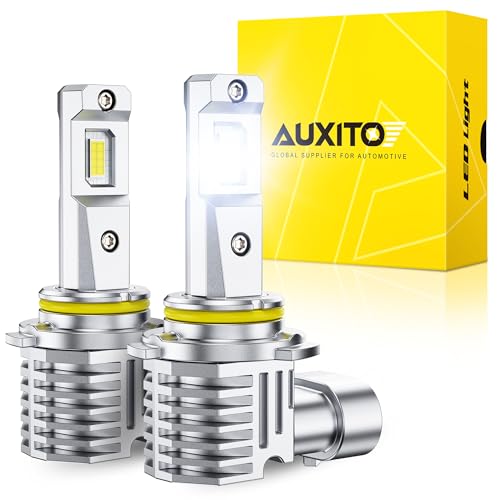
【1000% Brighter Than Standard Halogens】 AUXITO 9140 led fog light bulbs generate 1000% greater luminosity than factory halogens, dramatically improving road visibility and reducing eye strain during nighttime operation

【Plug and play: 2 Pack H11】 halogen headlight bulbs, 12V/55w, Manufactured by the Internatianal Standard, CE, DOT... Same bulbs size as original ones。 Easy to install. Street Legal.
The H8, H9, H11, and H16 Interchangeability Explained
How do manufacturers create confusion with nearly identical designations across the H8, H9, H11, and H16 bulb series? These variants share PGJ19 base types with minor pin width differences, making physical swaps possible in compatible housings. You’ll find H8 applications primarily in fog lights and DRLs at 35W/800 lumens, while H9 brightness reaches 2100 lumens at 65W for high beams. H11 lifespan extends to 270 hours at 55W for low beam installations. H16 compatibility proves most limited with its L-shaped PSX24W base and 500-lumen output. Pin spacing adjustments allow LED conversions across these types. However, wattage variations create housing compatibility concerns—installing a 65W H9 in a 35W H8 housing risks melting reflectors despite physical fitment. All three bulbs use the same connector type, ensuring compatibility across halogen, LED, and HID options. You’re technically swapping between similar platforms, not identical specifications.
How to Identify the Right Bulb Size for Your Vehicle
Three primary verification methods confirm your vehicle’s correct bulb specification before purchase. First, perform bulb markings identification by examining stampings or prints on your existing bulb’s side surface. Remove the assembly to read part numbers directly from the base. Second, vehicle manual consultation provides manufacturer-listed bulb types specific to your year and trim level. Third, utilize online automotive bulb finder tools from Sealight, Auxito, or AutoZone by entering precise vehicle details—year, make, model, and bulb position.
Physical examination verifies compatibility through base type analysis (P14.5s, BAY15d), dimensional measurements, and voltage ratings (typically 12V 55W for halogens). Cross-reference standardized alphanumeric designations like H11, 9005, or H7 against multiple sources. Confirm socket configuration matches exactly, particularly when selecting LED replacements requiring different clearance profiles than OEM halogen specifications. Consulting with a professional mechanic ensures accurate bulb type information when other identification methods prove inconclusive.

70,000LM Super Brightness: SEALIGHT H11 bulbs ensure up to 1600FT visibility through advanced CSP chip technology, delivering 70,000LM ultra-focused illumination paired with a 6500K crisp white that enhances road clarity and safety in dim nighttime driving scenarios

【10X Brighter - Newly Enhanced】The Termitor H11/H9 exterior light bulbs feature 24 high-performance chips, delivering up to 10 times the brightness of standard halogen bulbs. Upgrade your nighttime driving experience by replacing dim, yellow stock bulbs with Termitor H11/H9 fog lights, offering superior illumination and enhanced visibility with a crisp 6500K cool white light for optimal light transmission.

【Extreme Brightness】Experience 12X brightness than OEM bulbs with 96,000LM of 6500K cool white light. Perfect for night driving, fog, rain, and off-road adventures, offering wider and longer visibility
Vehicle-Specific Headlight Bulb Requirements by Make and Model
Once you’ve verified the correct bulb size through manufacturer specifications, you’ll find that requirements vary greatly across automotive brands and model years. Vehicle specific requirements demonstrate clear patterns: Honda’s 8th gen Civic uses H1 bulbs for high beams, while Toyota’s RAV4 switched from H4 dual-filament (2001-2005) to separate 9005/9006 configuration (2006-2012). American manufacturers prefer 9005/9006 combinations and H13 dual-beam systems in Ford, Jeep, and Chrysler models. Make model compatibility isn’t interchangeable—your Subaru 3rd gen Outback requires H1 bulbs, whereas Chevrolet Aveo (2009-2011) needs H4. European vehicles like Audi A6 utilize different configurations across generations: 2005-2008 models use H1, while 2009-2013 require H7 low beam and H11 fog lights. When upgrading your headlights, consider LED and HID options to improve visibility and safety performance on the road. Always cross-reference your specific year and trim level. Beyond headlights, these sizing principles apply to tail and brake lights, which also require model-specific bulb types for proper fitment.

Lights Dim Over Time, Replace In Pairs: Your lights are a pair, one is never turned on without the other. If one bulb burns out, the other isn't far behind. Replace your 9003 XtraVision Halogen bulbs in pairs for optimum performance.
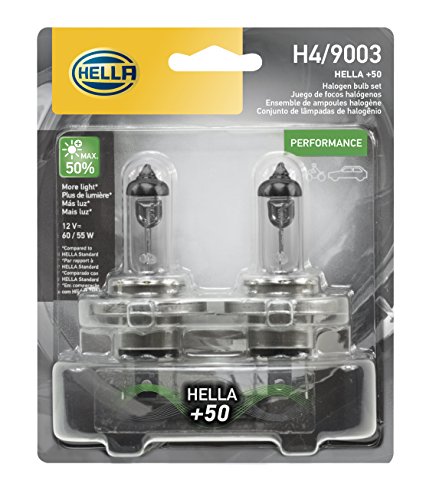
Up to 50% more light output than standard bulbs which provides you the best lighting performance, giving performance-oriented drivers additional safety time and comfort on the road.

【Huge Improvement in Visibility】-AUTOONE H11 led bulbs are equipped with high luminous efficacy CSP chips. And 1:1 halogen h11 bulbs’ beam pattern, spread out the light more to help in the side and front vision but no endangering other drivers. Safer and bright upgrade for fog lights or drl
Why H11 and H11B Are Not the Same Thing
Despite appearing nearly identical at first glance, H11 and H11B bulbs aren’t interchangeable due to fundamental differences in their base configurations. The H11 utilizes a PGJ19-2 base with enclosed vertical prongs in a rubber-plastic casing measuring 24mm wide. In contrast, H11B features a PGJY19-2 base with exposed horizontal prongs in an all-metal construction measuring just 6mm wide. These H11 bulb differences extend to physical dimensions—H11B measures 67mm MOL versus H11’s 58mm—and installation methods, with H11B requiring a twisting motion for socket insertion. H11B compatibility is restricted to specific Korean vehicles like Hyundai and Kia, while H11 works across multiple socket types (H8, H9, H16) in various sedans, SUVs, and trucks, making proper identification critical for replacement. Both bulbs operate at 55 watts and produce approximately 1350 lumens, but H11B offers significantly greater longevity with an average lifespan of 930 hours compared to H11’s 270 hours. Proper beam pattern quality is essential when selecting bulbs to ensure optimal visibility without blinding other drivers on the road. When selecting replacement bulbs, prioritizing brightness output measured in lumens ensures optimal visibility and safety performance for your vehicle’s lighting system.
CANbus Systems and LED Headlight Compatibility Challenges
When you upgrade from halogen to LED headlights, you’ll often encounter CANbus compatibility issues that stem from fundamental differences in electrical current draw. Your vehicle’s CANbus monitors headlight amperage, expecting halogen-level consumption. LEDs draw considerably less current, triggering bulb-out warnings and LED flickering as the system detects deviations from baseline parameters.
CANbus interference manifests through dashboard error codes, pulsating output that disrupts ECU communications, or bulbs remaining illuminated post-shutdown. Some vehicles exhibit reverse polarity incompatibility requiring manual correction.
Solutions include CANbus-compatible bulbs with integrated resistors (STEDI Copper Heads, Twenty20 Cree) that simulate halogen draw characteristics. External modules—load resistors, decoders, or isolators—regulate power delivery for hyper-sensitive systems. The inbuilt CANbus functions as a current regulator to ensure proper electrical flow and prevent system errors. Additionally, ensure your LED headlights meet compliance with lighting regulations to avoid legal complications during vehicle inspections.
Test compatibility by unplugging one low beam during ignition. No dashboard warning confirms CANbus compliance isn’t required for your specific vehicle configuration.
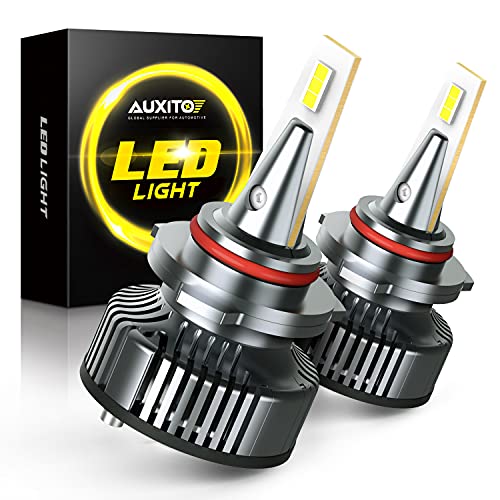
Night & Day Difference - AUXITO 9005 bulbs adopt highly bright chips, providing super bright light output. 9 times brighter than stock hb3 bulbs. 6500K white. Let you see everything in front of you clearly. Even when driving in the dark, you can go forward as if it were day.

1000% Breakthrough Brightness: The brightness of SEALIGHT H7 bulbs S3 series is 10X than traditional bulbs. We use high-power 7035 lamp beads, and the number of lamp beads in one reaches 16
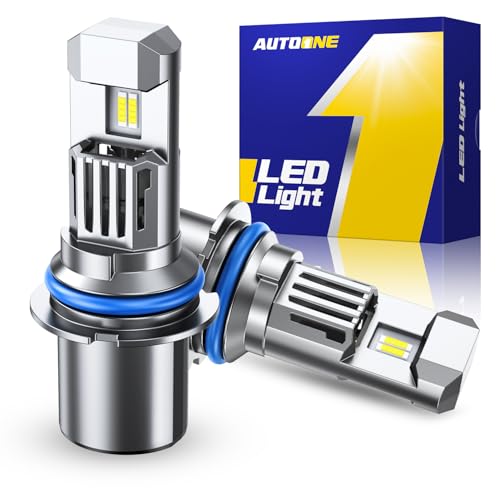
Huge Improvement in Visibility: AUTOONE 9007 led bulb are equipped with high luminous efficacy light chips. And 1:1 halogen 9007 bulbs’ beam pattern, spread out the light more to help in the side and front vision but no endangering others. Safer and bright upgrade
Halogen to HID and LED Conversion Limitations
Converting from halogen to HID or LED bulbs introduces dimensional incompatibilities that extend beyond simple socket replacement. HID complexity stems from required ballasts and wiring harnesses, with 35-55W systems needing 8-15 seconds to reach full brightness—unlike halogen’s instant-on capability. You’ll face beam pattern disruption when larger LED chips scatter light in reflector housings designed for compact halogen filaments. LED advantages include 15-25W power consumption versus halogen’s 55-65W, while delivering 3,600-4,500 lumens compared to halogen’s 900-1,000 lumens. LEDs also offer a whiter, more focused beam that enhances visibility compared to halogen’s yellowish output. However, you must address heat management through proper heatsinks. H9 and H11 interchangeability offers flexibility, but wattage differences affect upgrade performance. Conversion kits compensate for physical mismatches, though HID installations remain more complex than LED’s plug-and-play architecture. Proper LED upgrades usually require LED-specific reflectors or conversion kits to ensure the beam pattern is correct and legal. HID systems offer customizable color temperatures ranging from 3,000K golden yellow to 10,000K bluish hues for personalized aesthetics.