

To replace your 2020 Hyundai Elantra’s DRL bulbs, you’ll access the socket behind the windshield washer reservoir without removing the bumper. Disconnect the battery, then reach behind the reservoir and rotate the protective cover clockwise to release it. Twist the DRL socket counterclockwise, pull it out, and remove the old 1156/1157 bulb. Insert the new bulb without touching the glass, rotate clockwise until seated, and test functionality with the engine running. The guide below covers LED upgrade compatibility and troubleshooting procedures.
Locating the DRL Assembly on Your 2020 Hyundai Elantra
The DRL assembly on your 2020 Hyundai Elantra sits behind the front windshield washer fluid reservoir on each side of the engine bay, eliminating the need to remove the bumper or front panel for access. This positioning prioritizes driving safety while maintaining light visibility for oncoming traffic. You’ll find a small, round socket with a twist-lock mechanism positioned near—but separate from—the main headlight assembly. Look just behind the washer fluid reservoir cap to identify the bulb housing with its attached wiring plug. The passenger side offers easier access compared to the driver’s side, where space constraints may require needle-nose pliers for socket manipulation. The 2357 bulb socket features alignment pins requiring proper orientation during installation to guarantee secure contact and ideal function. For vehicles using LED upgrade options, ensure compatibility with your Elantra’s electrical system before installation. Using quality parts and performing timely repairs ensures both the longevity of your DRL system and your vehicle’s safety on the road.
Tools and Bulb Specifications You’ll Need
Now that you’ve located the DRL assembly, gather your replacement bulbs and basic tools before starting the job. Your 2020 Elantra requires 1156/1157 bulb type or 9005 LED upgrades for DRL applications. You’ll need pliers to grip and turn the socket, protective gloves to prevent skin oils from reducing bulb longevity, and a clean microfiber cloth for safe handling. A flashlight improves visibility near the washer fluid reservoir area.
For LED upgrades, verify CANBUS compatibility to prevent error codes. Lasfit T3 Series offers switchback functionality with 6000K white DRL and 3000K amber turn signals. These units feature built-in temperature control and cooling fans for enhanced bulb longevity. The 9005 LED bulbs deliver 6000LM per set at a bright white 6000K color temperature for superior visibility.
Follow safety precautions: disconnect the battery and work on cool assemblies. When replacing bulbs in pairs for consistent brightness, consider the light output measured in lumens to ensure optimal performance and visibility. Replace bulbs in pairs for consistent brightness and performance. Proper legal compliance for street use ensures your DRL upgrades meet safety regulations and maintain roadworthiness standards.

See Further and Wider - AUXITO 9005 led bulbs with 30000lm ultra-high light output are 900% brighter compared to halogen. 6500k cool white light, illuminates the roadway at nigh like daytime, making night driving more comfortable and safer.
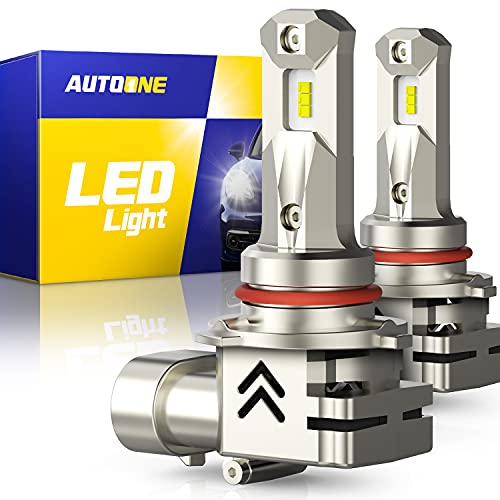
Compatible with Toyota 2003-2022 4Runner, 2004-2020 Sienna, 2007-2013 Tundra/Venza, 1992-2018 Camry/Corolla, 2008-2018 Sequoia, 1995-2012 Avalon, 1998-2005 RAV4/Celia, 1991-2017 Land Cruiser, 2003-2013 Matrix, 2010-2015 Prius; For Jeep Compass 2011-2021, Cherokee 2016-2019, Grand Cherokee 2005-2018, Commander 2006-2010; For Ram 1500/2500/3500 2011-2022; For Honda Accord 1990-2022, Pilot 2006-2022, Ridgeline 2017-2022, Civic 1988-2021, C-RV 2015-2020, Crosstour 2012-2015, CR-Z 2011-2016, HR-V 2019-2022, Odyssey 2005-2020; For GMC Yukon 2002- 2020 Sierra 2500 HD 2001-2020; For Ford F-150 2015-2022, Taurus 2008-2018,Explorer 2002-2019, Expedition 2003-2021
Accessing the DRL Socket Without Removing the Bumper
Once you’ve gathered your tools and replacement bulbs, accessing the DRL socket requires reaching behind the windshield washer fluid reservoir on the front corner of your Elantra. You’ll locate a round cover or cap protecting the bulb socket—no bumper removal necessary. Rotate this cover clockwise to release it, then pull straight out. If it’s tight, use a flat-head screwdriver for gentle leverage. Once exposed, twist the DRL socket counterclockwise to remove it from the housing. Disconnect the bulb by pushing slightly while twisting to disengage it from the socket. Avoid pulling on the wiring harness directly, as this can damage connectors. Before starting the replacement process, consider disconnecting the battery to ensure your safety while working with electrical components. When handling the new bulb, avoid touching the glass part with fingers to prevent oil contamination that can shorten bulb life. Selecting the appropriate color temperature for your replacement DRL ensures optimal visibility and maintains consistency with your vehicle’s lighting system. The entire procedure is accessible with the hood open, eliminating unnecessary disassembly that many mistakenly attempt when replacing DRLs.

Fit Hyundai Elantra 2019 2020 2021 2022,High Beam and Low Beam 9005 Lights 6000k White

This accessory is a daytime running light socket used to replace the daytime running lights of Hyundai Elantra 2019-2020

Direct Fit for 2019-2020 Hyundai Elantra SEL – Specifically compatible with 2019 and 2020 Hyundai Elantra SEL models with factory halogen headlights. According to the 2020 Elantra owner's manual, the front parking lamp/DRL uses a P21/5W (1157/7528) bulb with BAY15D base . Direct plug-and-play replacement for factory halogen bulbs.
Removing the Old Bulb From the Socket
Grasp the old DRL bulb firmly at its base—not the glass envelope—and pull it straight out from the socket with steady, even pressure. If resistance occurs, check for retaining clips that may require slight squeezing or pressing before removal. Proper bulb handling prevents glass breakage and guarantees safe extraction. Don’t twist the bulb itself during removal; the socket’s counterclockwise rotation already released the locking mechanism.
Once the bulb’s free, inspect the socket interior for corrosion, debris, or residue. Socket care is critical for ideal electrical contact and longevity of your replacement bulb. Clean any contaminants with electrical contact cleaner if necessary. Unlike reflector headlights that scatter light broadly, modern DRL systems require precise bulb positioning to maintain focused illumination for safety. Dispose of the old bulb properly, as it’s fragile and may contain materials requiring careful handling. Keep your replacement bulb ready to minimize the socket’s exposure to moisture and contaminants. Many vehicles feature an auto setting that adjusts lighting based on ambient conditions, so ensure your DRL replacement maintains compatibility with your vehicle’s automatic systems. For those with larger hands, consider using needle-nose pliers to improve grip and access in the tight workspace.

Lights Dim Over Time, Replace In Pairs: Your Lights are a pair, one is never turned on without the other. If one bulb burns out, the other isn't far behind.

Lights Dim Over Time, Replace In Pairs: Your lights are a pair, one is never turned on without the other. If one bulb burns out, the other isn't far behind

LIGHTS DIM OVER TIME, REPLACE IN PAIRS: Your lights are a pair, one is never turned on without the other. If one bulb burns out, the other isn't far behind.
Installing the New DRL Bulb Correctly
Before inserting the replacement DRL bulb, examine its base to identify the alignment features—typically an asymmetrical pin configuration or keyed notches that correspond to specific grooves in the socket. Observing these bulb alignment tips prevents common installation mistakes like forcing misaligned components. Push the bulb firmly into the socket until flush, then rotate clockwise until resistance indicates full engagement—you’ll feel or hear a definitive click. Handle only the bulb’s base, never the glass envelope; skin oils create thermal stress points that accelerate failure. Verify proper seating by checking for gaps between bulb and socket. If removal proves difficult due to tight fit constraints, avoid relying solely on electrical tape methods as alternative extraction techniques may be necessary. Before beginning the replacement process, ensure the power connector is disconnected to prevent electrical hazards during installation. For optimal performance and longevity, consider choosing aftermarket bulb brands that offer superior durability compared to standard OEM options. Finally, reinstall the housing cover, aligning tabs carefully to maintain environmental sealing. This procedure guarantees reliable electrical contact and preferable DRL performance throughout the bulb’s service life.

Resembling halogen bulb shape design and sequencing 54 4014-SMD LED chips precisely around the bulb. Delivering 360° high luminous efficiency with full 6000K white light, see more clearly and safely when reversing
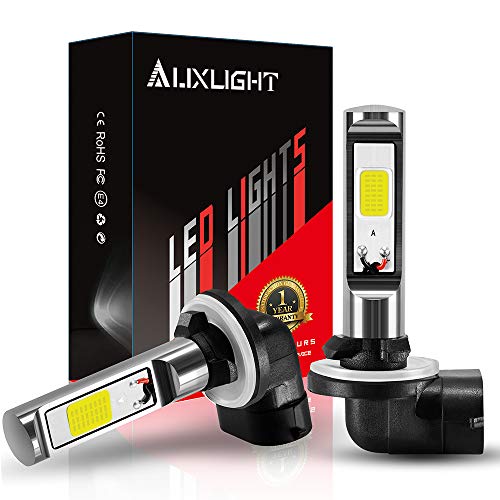
Specification: (Pack of 2) Voltage: DC 12V-24V, Lumen: 1500LM each bulb (total 3000LM), Working Power: 30W, Lifespan: 50,000+hours, Waterproof: IP68, Size: 2.49”in length and 0.47”in width, LED Bulb Type: 2pcs COB-2508 chips, Color: 6000K Xenon White.
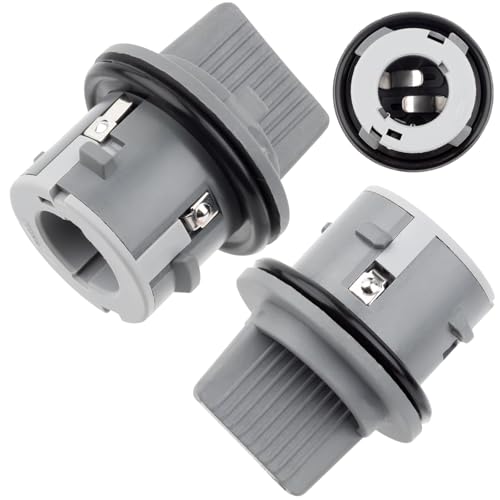
【OE Part Number】: 92166-F1000,92166-A9000,92166F1000,92166A9000; All products have passed the manual quality testing to ensure that they can work properly
Testing and Verifying Proper DRL Function
Successful bulb replacement requires systematic verification of DRL functionality to confirm compliance with vehicle safety standards and regulatory requirements. Start your engine with the headlamp stalk in OFF or AUTO position and parking brake released—DRLs should illuminate automatically. Perform a walkaround inspection confirming both lamps exhibit consistent brightness without flickering. Use a multimeter to verify proper voltage supply at the bulb socket during operation. Check for Diagnostic Trouble Codes via an OBD-II scanner to identify circuit errors. Following DRL maintenance tips, confirm the ambient light sensor remains clean and unobstructed. Apply sensor testing techniques by measuring output voltage with a scan tool. When selecting replacement bulbs, verify brightness levels and beam patterns that meet your vehicle’s specifications and safety requirements. Validate DRLs disengage when activating headlights or fog lights, validating proper system hierarchy and regulatory compliance.
Upgrading to LED DRL Bulbs for Better Performance
Upgrading your Hyundai Elantra’s daytime running lights to LED bulbs delivers noticeable performance improvements over factory halogen components. LED advantages include superior brightness output around 2000 lumens per bulb, enhanced color consistency at 6000K, and instant full-brightness activation for improved safety. Energy efficiency markedly increases as LEDs consume less power while generating more light, reducing electrical system load.
Select 1156 or 1157 base LED bulbs with CANBUS compatibility to prevent dashboard error codes and hyper-flashing issues. Verify the bulbs include built-in decoders and thermal management systems—either heat sinks or mini fans—to guarantee reliable operation. Dual-color switchback LEDs provide integrated white DRL and amber turn signal functionality. When selecting LED components, prioritize DOT compliance standards to ensure your upgrades meet legal regulations for vehicle lighting modifications.
Installation remains plug-and-play for most applications, though you’ll need to verify physical fitment within your socket housings before finalizing your upgrade selection. Always confirm your selections against OEM specifications to ensure proper compatibility with your 2020 Elantra’s factory settings.
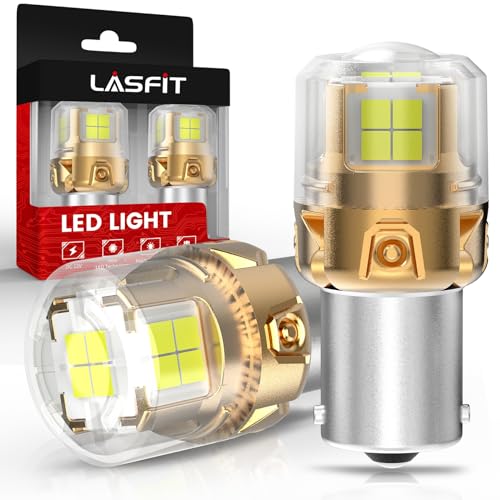
Ultra Bright & Safe: LASFIT 1156 LED bulbs equipped with 20 high-efficiency 3030 SMD chips and projector lens, delivering 360° full-beam lighting. See farther and wider when reversing, ensuring safer night driving. 6000K white color for clear visibility

(Set of 2 Bulbs) 54SMD 3014 & 3SMD 3030 high brightness chips per bulb, Working Voltage: 9v-30v (fit 12V, 24V vehicles).

(Set of 2 Bulbs) 54SMD 3014 & 3SMD 3030 high brightness chips per bulb, Working Voltage: 9v-30v (fit 12V, 24V vehicles).
Troubleshooting Common DRL Replacement Problems
Although DRL replacement appears straightforward, you’ll encounter several common obstacles that require systematic troubleshooting to resolve. Bulb alignment issues typically stem from keyed pins that must orient precisely with the socket—forcing misaligned bulbs strips connectors and damages fixtures. You’ll need to rotate the bulb gently until pins seat correctly without resistance.
Electrical contact troubleshooting becomes necessary when error codes appear post-installation. LED bulbs without built-in resistors trigger “daytime running light error” warnings intermittently during reverse or speed changes. Installing external 50-watt 6-ohm resistors eliminates these false codes. Poor electrical contact from loose bulb fitment causes premature failure—while electrical tape provides temporary securing, proper socket engagement remains essential. Understanding dashboard warning lights helps you identify when DRL issues require immediate attention versus routine maintenance. Like headlight beam alignment, proper DRL positioning requires precise aiming techniques to ensure optimal light distribution and fixture performance.
When selecting replacement DR bulbs, consider LED and halogen options as both offer different advantages in brightness and energy efficiency for your vehicle’s lighting system. Test DRL operation across all vehicle modes after installation, verifying both physical bulb illumination and dashboard error code absence.


