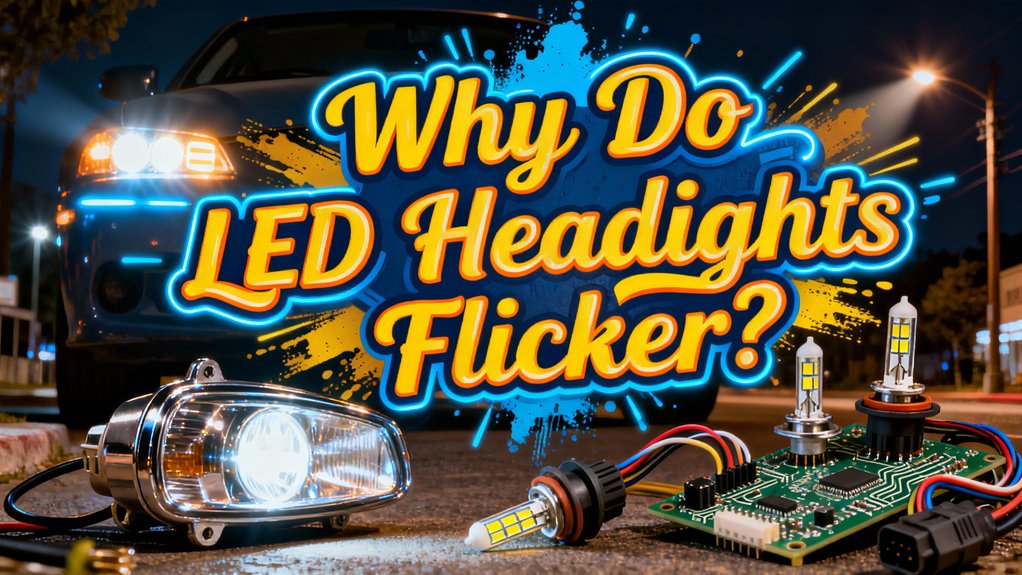
Your LED headlights flicker primarily due to voltage fluctuations within your vehicle’s electrical system that the LED driver circuits can’t adequately regulate. Corroded battery terminals, loose connections, and worn alternator components create unstable voltage delivery, while poor-quality drivers lack the robust regulation needed to convert fluctuating power into constant current. Additionally, vehicle-specific issues like CANbus incompatibility and improper grounding compound the problem. Understanding these root causes will help you pinpoint the exact source and implement the appropriate fix for your specific situation.
Voltage Fluctuations in Your Vehicle’s Electrical System
When your LED headlights flicker, the root cause typically traces back to unstable voltage delivery within your vehicle’s electrical system. LED drivers require consistent power—typically 12-14 volts—to function properly. Voltage drops occur when resistance builds up in corroded battery terminals, loose connections, or undersized wiring. Your alternator’s voltage regulator may produce erratic spikes between 14-16 volts under load, creating electrical instability that LED circuits can’t tolerate. Worn alternator components generate fluctuating output despite passing bench tests. Poor grounding restricts current return paths, while frayed wires elevate resistance and generate heat. Long wire runs to headlight assemblies amplify these Voltage drops, particularly during high-current demands from starter operation or accessory loads. This unstable voltage environment causes your LED headlights’ sensitive electronics to flicker visibly.
Incompatible Dimmer Switches and Control Systems
Unlike incandescent bulbs that draw steady resistive loads, LEDs present capacitive electrical characteristics that confuse conventional dimmer switches designed for 40-100 watt incandescent circuits. Your vehicle’s LED headlight system may employ pulse-width modulation (PWM) dimming controls that aren’t synchronized with the LED driver’s internal power supply, creating visible flicker cycles. Leading-edge dimmers designed for resistive loads can’t properly regulate low-wattage LED currents, causing the driver circuitry to oscillate between states. You’ll need to verify dimmer compatibility by checking manufacturer specifications for trailing-edge or LED-specific controllers. Mixed lighting types on shared circuits create unbalanced loads that trigger circuit overload protection or misdetection. Testing individual LED assemblies with compatible dimmers confirms whether control incompatibility causes your flicker issue. Older dimmers struggle to detect the minimum power draw of LED headlights, leading to erratic performance and visible flickering. LED technology offers longer lifespan and reduced energy consumption compared to traditional halogen alternatives, making proper controller compatibility essential for optimal performance.
![True Mods H6054 H4 LED Headlight Wiring Harness [Negative Switched Conversion] [Fused] Universal H4 Head Light Relay Harness Kit for 9003 H6024 5x7 7x6 4x6 Subaru Toyota Jeep Sealed Beam Headlamp](https://m.media-amazon.com/images/I/51+wV9S2Q4L._SL500_.jpg)
YOUR VEHICLE NEEDS THIS - Swapping out old headlights for LED conversions on negative switched vehicles like Toyota, Subaru, Mitsubishi, or Suzuki, is not a simple job. But with our plug-and-play universal dual H4 headlight relay harness kit for high/low beam it can be! The compatible sockets include: 7x6 5x7 H6024 (2D1 H6054 H5054 H6054LL 6014 6052 6053)|H6024 (2D1)|4x6 6x4 (H4651, H4652, H4656, H4666, H6545)|H5006 (2C1) sealed beam headlights and more!

Upgraded Metal Housing Strong decoding Genuine Can-Bus decoder, eliminated error code on dash for 98% of the cars.
Poor Quality Power Supply or Driver Components
The LED driver circuit serves as the critical intermediary between your vehicle’s electrical system and the headlight diodes, converting fluctuating input voltage into regulated constant current. When manufacturers compromise on driver reliability through inferior components, the circuit fails to maintain stable output despite voltage spikes reaching 15.5V or normal fluctuations between 13.9-14.2V. Low-quality drivers exhibit poor thermal management, causing component degradation under sustained load and temperature stress. These failures manifest as intermittent flickering that worsens over time. Quality assurance during manufacturing determines whether drivers can handle automotive voltage ranges and environmental conditions. Premium drivers incorporate robust voltage regulation, adequate heat dissipation, and component-grade capacitors that maintain consistent current delivery. Cheaper or older LED headlights are particularly susceptible to driver quality issues, which compromise their ability to regulate power effectively. Reputable manufacturers test their drivers across operating conditions, ensuring compatibility with OEM electrical systems and preventing power regulation failures. Like daytime visibility features, LED headlight systems require automatic safety mechanisms to function reliably in varying driving conditions. Unlike halogen and HID bulb technologies, LED headlights depend entirely on sophisticated driver electronics to function properly.

[ADAPTATION] LED Headlight assembly fit for Nissan Altima 2019-2022. **NOTE: Fit for Factory LED Models Only. Not Fit Factory Halogen Headlights Models. A good replacement for your factory-installed headlight.

[Vehicle Fitment & OE Reference]: Headlights Assembly Compatible With 2021 2022 2023 2024 Chevy Tahoe & Suburban, Compatible with Full Led Headlight Models, Reference Part Number: 85733248, 85547100, GM2502511

[ADAPTATION] Headlight fit for Mazda 6 2018 2019 2020 2021. **NOTE: Fit for Models Without Adaptive Front-lighting Systems (NO AFS) and w/LED blubs Only. A good replacement for your factory-installed light.
Loose Wiring and Connection Problems
Physical connection integrity directly determines whether your LED headlights receive consistent power, as vibration-induced movement creates intermittent contact between conductors. Bulbs loosen in sockets during normal driving, while metal contacts accumulate corrosion and dirt that interrupts electrical flow. You’ll need thorough wiring inspection to identify frayed cables hidden within looms, where age-related deterioration or collision damage causes shorts during movement. Connector corrosion around ground points weakens chassis connections, delivering inconsistent voltage that triggers flickering. Apply voltage tests and wiggle tests to locate faulty sections, then clean corroded terminals and tighten all ground bolts. Replace cracked connectors showing heat damage or discoloration. Installing a #4 ground wire from alternator to battery reduces voltage spikes. Securing bulbs properly during installation prevents shifting that compromises contact stability. Installing an anti-flicker decoder or CANbus adapter helps stabilize the power flow to your LED headlights when connection issues persist.

FIX DIM HEADLIGHTS & IMPROVE LIGHT OUTPUT: Upgrade your old factory headlight wiring with this H4 LED headlight relay harness kit. Fix common issues including dim headlights, flickering headlights, voltage drop, weak high beam/low beam performance and insufficient power supply. This fused relay wiring harness delivers stable battery power directly to your H6054 LED headlights, improving brightness and reliability during night driving.
![True Mods 2pc H4 (9003/HB2) Headlight Socket Converter Kit [for H4652, H4656, H4666, H6545] [Plug and Play] Head Light Wiring Harness Connector Plug](https://m.media-amazon.com/images/I/41dj3TnukiL._SL500_.jpg)
PLUG AND PLAY SIMPLICITY - No need to figure out how to cut into your stock wiring and solder new connections, our adapter harness is a clean and straightforward way to avoid rewiring your headlight harness.

H4 HB2 9003 Vehicle Headlight Socket: Provide great solution to replace old and broken vehicle headlights or fog lights in vehicles without standard pins for 4" × 6", 7" × 6" and 5" × 7" work; Make car headlight/fog light wire replacement easier a lot
Vehicle-Specific Electrical Mismatches
When you install LED headlights in vehicles designed for halogen bulbs, the Controller Area Network (CANbus) system creates the most common source of electrical mismatches and subsequent flickering. Your vehicle’s CANbus monitors electrical loads and expects halogen power consumption—LEDs draw considerably less current, triggering error codes. Model identification proves critical, as certain vehicles like the 2014 Jeep Compass or Ford KA exhibit hypersensitivity, rejecting even CANbus-compatible bulbs. You’ll need harness adaptation through specialized LED relay systems that bypass factory circuitry when standard resistors fail. CANbus-ready bulbs with integrated decoders resolve 95% of compatibility issues, but hypersensitive systems require OBD-II reconfiguration or model-specific adapters. Without proper load simulation matching your vehicle’s parameters, the system interprets low current draw as bulb failure, causing persistent flickering. Voltage fluctuations from your alternator during engine operation can also trigger LED flickering as the power supply varies between idle and acceleration.
Low-Quality LED Components and Manufacturing
Beyond electrical system incompatibilities, manufacturing shortcuts and substandard components create flickering problems that no amount of vehicle-specific adaptation can resolve. Low-quality LED drivers fail to regulate current properly, becoming susceptible to heat degradation that produces intermittent flickering. These defective drivers can’t stabilize power delivery when subjected to voltage fluctuations or wattage surges from high-power devices sharing your vehicle’s circuit.
Manufacturing defects in bulb assemblies—particularly in driver circuitry—lead to components failing under normal electrical loads. Poor quality control during production allows substandard parts lacking robust protection mechanisms to reach consumers. You’ll find that cheap aftermarket headlights prioritize low pricing over flicker resistance, resulting in premature wear from repeated power surges. Understanding color temperature and brightness specifications helps identify quality bulbs that maintain consistent performance. Improper headlight bulb installation without aligning tabs correctly or securing the weather cap can exacerbate flickering issues beyond manufacturing defects. While high-quality LEDs exceeding 50,000-hour lifespans cost more upfront, they eliminate frequency-related instability below 50 Hz that inferior components can’t handle. Selecting bulbs from reputable manufacturers significantly reduces the likelihood of encountering flickering issues caused by component deficiencies.

Direct Replacement- Left headlights compatible with 2018-2023 International LT625 truck (Led low beam + halogen high beam),make sure the model is right for your truck before ordering. (Driver Side)

Vehicle Compatibility - Compatible with Hyundai Elantra 2014 2015 2016

[ADAPTATION] LED Headlight assembly fit for Nissan Rogue SL/SV 2021 2022 2023. A good replacement for your factory-installed headlight.
CAN Bus System Compatibility Issues
While electrical incompatibilities and component quality create flickering problems, CAN Bus system conflicts represent the most prevalent issue in modern LED headlight installations. Your vehicle’s CAN Bus monitors current draw to detect bulb failures. LEDs consume considerably less power than halogen bulbs, triggering false “bulb out” warnings and causing intermittent flickering or hyper-flashing.
European and luxury vehicles with extensive CAN Bus installations prove most susceptible to these errors. You’ll need bulbs equipped with resistors simulating halogen load—typically labeled “error-free” or “CAN Bus-ready.” These reduce compatibility issues by 90%. Proper heat dissipation capabilities ensure that resistors maintain safe operating temperatures during extended use. LED headlights with superior heat dissipation systems can maintain their brightness and performance for 20 to 30 years under normal driving conditions.
If flickering persists, install load resistors across power and ground wires, securing them to metal surfaces for heat dissipation. Flickering LED lights can occur from insufficient resistance in the CAN Bus system, which prevents the proper electrical balance needed for stable operation. Test compatibility by unplugging one low beam and checking dashboard warnings. Some vehicle firmware allows OBD-II devices to disable headlight monitoring entirely.
Grounding and Circuit Overload Concerns
Although CAN Bus incompatibilities trigger many LED headlight failures, inadequate grounding creates equally persistent flicker problems that diagnostic scans won’t detect. Ground corrosion at chassis connection points introduces resistance issues that cause intermittent voltage drops under load or vibration. Oxidation or paint prevents metal-to-metal contact—cleaning to bare metal typically restores stability. Even fractional-ohm increases in ground resistance alter return paths, triggering LED driver protection modes and pulsed output. Shared ground paths with high-current components introduce voltage fluctuations when those systems change load. Voltage drop across shared ground straps shifts reference potential, upsetting driver regulation. You’ll need to separate headlight grounds to dedicated chassis points or run heavy-gauge dedicated ground straps. Measure voltage differences between ground points while exercising high-current loads to identify problematic shared-ground interactions. Low-quality LED drivers can also struggle with voltage regulation issues, amplifying the effects of minor grounding inconsistencies that halogen systems would tolerate without visible symptoms.